Iran has opened a multi-day public funeral and mourning period for Supreme Leader Ayatollah Ali Khamenei, turning the event into one of the most politically charged state ceremonies in recent memory.
This ritual, which began in a religious tone, has now turned into a national spectacle of mourning, strength, and defiance, with big crowds, government-arranged marches, and international delegations gathering around an event that Iranian leaders seem intent on making more than just a burial ritual. The size of this funeral has significance because it shows not only the religious stature of Khamenei but the message that Iran wants to send. It has been reported by various media sources that millions of people will gather at this event, and Iranian officials have presented this period of mourning as a time when Iranians come together in a time of conflict in the region.
A week of mourning across major cities
Public mourning ceremonies commenced in Tehran with the body of Khamenei laid out in the Grand Mosalla Prayer Complex for public viewing and prayers. The process of mourning will continue with an orderly series of activities in the major centers of religion and politics such as Tehran, Qom, Mashhad, Najaf, and Karbala. This orderly process transforms the funeral ceremony into a national pilgrimage that combines rituals of the state and Shi’a religious symbols.
Reports say the mourning period could last around a week, though some coverage describes it as a multi-day ceremony depending on the phase of the rites. That timeline is important because it shows the state’s intention to keep public attention fixed on the event while extending its symbolic power beyond a single day. By moving the ceremonies through several cities, Iranian authorities are also linking Khamenei’s legacy to the country’s religious geography and the broader Shi’a sacred landscape.
Crowd size and public response
Another of the most recurring pieces of information regarding early reports is that of the expected crowds. According to state media reports, the funeral procession can involve millions of participants, comparable to the 1989 funeral of Ayatollah Khomeini, which is said to have had around 10 million people in attendance. While exact numbers will always be hard to verify, one thing is sure—the reports emphasize the mass character of the event in its historical dimensions. And optics of a huge crowd are crucial for the Iranian leadership at the time of the funeral.
The large attendance looks like a sign of public approval and solidarity at a moment when the leadership has to prove its own stability. In other words, for the advocates of the regime, it will be evidence of continuity; and for opponents of the system, it will be a display of power.
Foreign delegations and diplomatic signaling
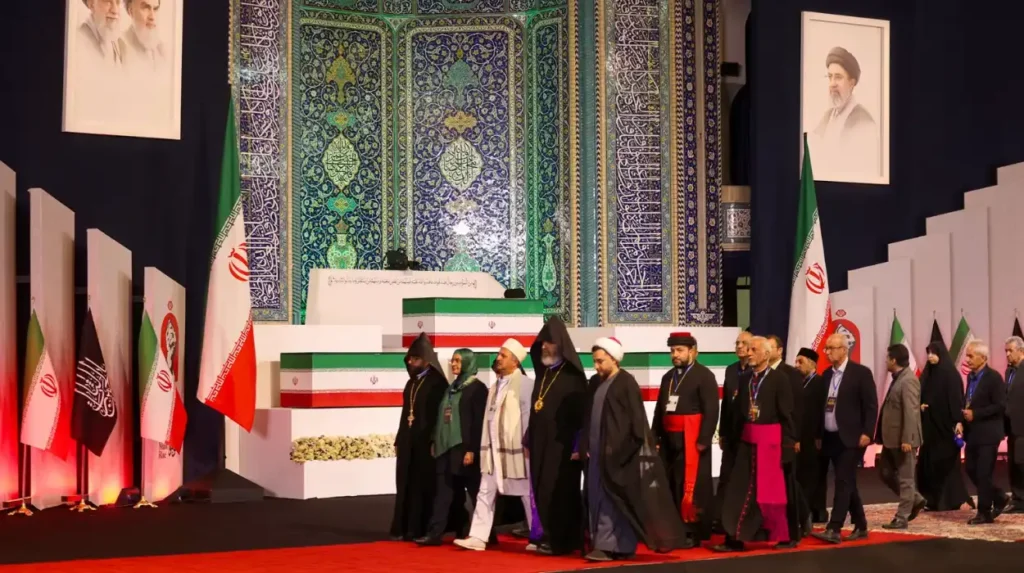
The Islamic Republic of Iran has stated that there will be more than one hundred representatives from various nations in attendance or sending their delegates for the burial ceremonies. Other sources have pointed out that there would be presence of various heads of states and other high-profile officials in the important ceremonies taking place in Tehran. It is crucial due to the fact that it helps the Iranian government to turn the ceremony into an internationally recognized event and not just a local affair. It is also important due to the fact that the presence of various international delegations plays a significant role in terms of strategic considerations.
Iran will get an opportunity to make this ceremony a proof of its continued significance in the eyes of the international community, thus using it against its opponents, especially the United States and Israel.
War context and the political message
The funeral takes place under the looming specter of war, which influences almost every aspect of its coverage. According to media reports, the former Supreme Leader was assassinated in the US-Israeli attack during the conflict that started this year, and the death of Khamenei has been contextualized within this larger framework by the Iranian media. Hence, the funeral is not only a tribute but also an act of resistance to the enemy. That is the reason why the term “political spectacle” is often used to characterize the funeral.
The country seems to be planning to turn mourning into a message, as well as to convert grief into a form of mobilization. The use of public presence, religious symbols, and foreign delegates in the funeral ceremony are the ways to prove the resilience of Iran in front of its enemies.
What Iranian officials are signaling
Iranian officials and state media have described the ceremonies in solemn and highly symbolic terms, presenting them as both religious duty and national duty. The language surrounding the funeral emphasizes unity, devotion, and resistance, with the state encouraging a public atmosphere of reverence rather than debate. That framing is consistent with how the Islamic Republic often uses major commemorations to reinforce political legitimacy.
The quotes reported in coverage are less important as isolated lines than as part of a broader narrative strategy. Iranian officials are effectively saying that the country remains united under pressure and that the late leader’s legacy will continue to guide the state. In practice, the funeral becomes a platform for reaffirming the values of the system: loyalty, sacrifice, and opposition to foreign interference.
Security, control, and state choreography
This event of such grandiose nature needs to be properly organized and secured, which seems to be the case in the current situation since all crowds, marches, religious figures, and government officials are well coordinated to keep the procession orderly and ritualistic. This organization is not at all unexpected due to the scale and sensitive nature of the event. Furthermore, it is important to note that this procession has its value beyond just organizing everything.
State funerals of such large scale are not random events, but rather have certain rituals in order to create particular images, from black mourning clothes and prayer scenes to wreaths and TV tributes. For the case of Iran, such images are meant to depict an orderly and disciplined society united around a common cause.
Symbolism of the locations
The choice of cities for the ceremonies is not accidental. Tehran serves as the political heart of the republic, while Qom and Mashhad carry deep clerical and spiritual importance within Shi’a Islam. Najaf and Karbala, meanwhile, extend the mourning narrative into Iraq’s sacred geography, giving the funeral a transnational religious dimension. Each location adds a layer of symbolism that reinforces Khamenei’s role as both a political leader and a figure embedded in the wider Shi’a world.
Final burial plans tied to the Imam Reza shrine in Mashhad are especially significant. Mashhad is one of Iran’s holiest cities, and burial there would place Khamenei in a highly revered religious setting. That choice reinforces the idea that his legacy is being absorbed into the sacred memory of the nation, not merely archived in political history.
International interpretation and regional impact
Outside Iran, the funeral is being read through a more geopolitical lens. International outlets have stressed the scale of the event, the wartime context, and the message being sent to Washington and Tel Aviv. In that reading, the ceremony is less about mourning alone and more about power projection, signaling that Iran remains capable of national mobilisation even after a major wartime loss.
There is also a regional dimension. The presence of foreign figures, allied governments, and religious networks may strengthen Iran’s narrative of resistance, while simultaneously deepening tensions with its rivals. The funeral could therefore become a reference point in the wider regional conflict, especially if Tehran uses it to reinforce hardline positions or justify continued confrontation.