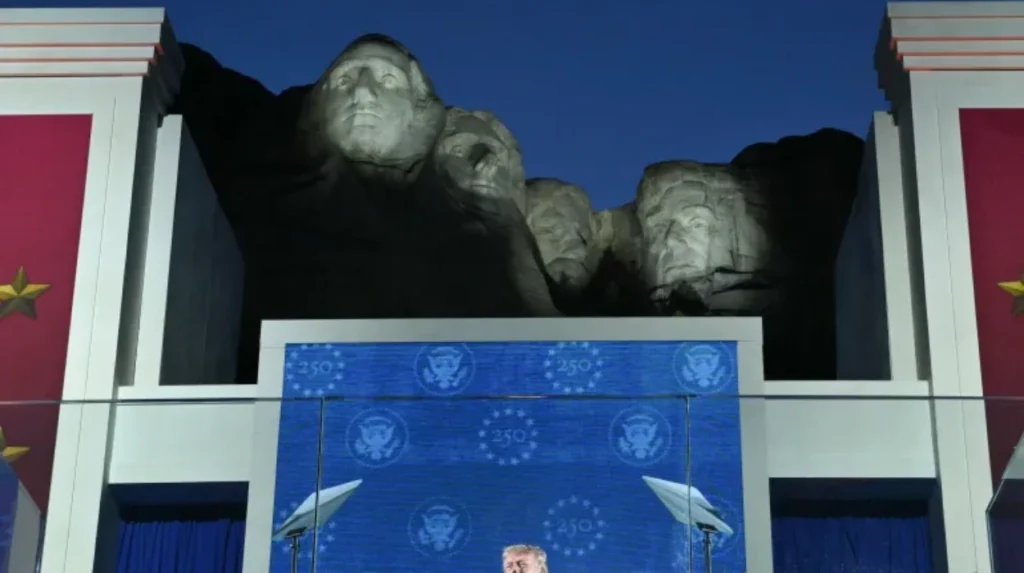
The speech that Donald Trump delivered for the 250th anniversary of the United States was much more than a formal act. The speech turned out to be a political act regarding identity, power, and ideology; the president delivered an anti-communist speech on behalf of the America 250 organization, which presented the semi-quinticentennial of the country as a challenge for the country’s power. The delivery place and time were very symbolic since this act took place when the White House was trying to present the 250th birthday of the United States as a common national achievement.
However, the rhetoric was clearly political and hostile. The language used by Trump showed his usual approach to turning patriotic occasions into political events, while the anti-communist nature of the speech gave it an ideological touch. The coverage of the event said that it was an act-resembling speech given from the National Mall, where Trump inaugurated the whole America 250 event in Washington, DC.
Patriotic Frame, Political Message
The point is not so much that Trump was praising America but the fact that he did this in connection with the message regarding the communist threat which he associated with the danger for Christianity, freedom, and the American way of life. According to media reports, Trump’s statements can be viewed against the background of anti-communism which has become evident from Trump’s previous public statements and declarations. In doing so, there were two aims. First of all, the message was intended to portray the anniversary as a moral and historic crossroad rather than a ceremony per se. Second, it provided Trump with the opportunity to present himself not as a celebrant of the republic but as its defender.
From the point of view of politics, it is a quintessential Trump strategy of turning symbolism into conflict and conflict into demonstration of power. Consequently, the speech became an occasion for the celebration of the republic and election campaign at the same time.
Anti-Communist Rhetoric
Ideologically, the heart of the story is anti-communism. This was reported in conservative media accounts of related statements by noting that he referred to communism as one of the worst ideologies in history and linked the opposition to communism with faith, freedom, and survival. The use of such language is significant in that it does not place communism as part of history but rather sees it as a current threat that requires political and cultural confrontation.dailycitizen. In this way, the comments made by Trump about communism cannot just be taken as rhetoric but serve as a world view. In other words, his world views state that the founding ideals of America have been under ideological attack and the future is threatened by the ideologies that endanger religion, property, free speech, and national pride.
His anti-communism is an ideological statement that ties in well with his identity as a politician as he has always had a tendency towards nationalism, traditionalism, and opposition to left-wing institutions.
The Crowd And Setting
The venue was almost as important as the message. According to reports, Trump launched America 250 celebrations at the National Mall, but what was significant about the way the event was designed was the manner in which the celebration took on characteristics of a big patriotic celebration and not an official celebration. This particular combination of symbols of the occasion included nationalistic icons, military theatrics, and the kind of mass appeal that is expected more out of a Trump rally and not out of the president’s ceremonial function.
In this manner, the combination of venue and the way the event was organized helped Trump merge the idea of a state occasion and a political branding event. With America 250, Trump had the national occasion, while with the rally, he had the political format. Both together combined for Trump to make a political proclamation in patriotic guise.
Economic Claims And Broader Agenda
Trump did not limit himself to ideology. Coverage of the speech indicated that he also highlighted the economy, manufacturing, and national renewal, with some reporting pointing to large investment claims and a strong-growth narrative. While exact figures vary by outlet and should be treated carefully, the broader message was consistent: America is stronger under Trump, and the anniversary is evidence of that trajectory.
That economic pitch is central to understanding the speech. It shows that anti-communism was not delivered as an isolated warning, but as part of a larger argument that the United States is either thriving under his leadership or threatened when his opponents are in charge. The speech therefore linked identity politics, economic politics, and historical memory into one message. In practical terms, that allows Trump to speak to multiple audiences at once: supporters looking for patriotic affirmation, voters concerned about prices and growth, and conservatives who want a stronger culture-war frame.
Why It Matters
Trump’s speech at the 250th anniversary of the USA was significant for what it tells us about his political approach at an important moment in American history. He did not keep ceremony separate from politics but instead combined them. Instead of delivering a neutral historic overview, he employed the occasion to further develop his nationalist world view which is opposed to leftist politics and emphasizes personal authority. This is why his speech attracted such attention, going far beyond the context of the occasion.
The speech was also significant since the occasion of America 250 is not any ordinary Trump campaign backdrop but rather a unique historic opportunity which usually brings about a national rhetoric focusing on unity, history, and democratic legacy. Trump’s focus on communism adds a new tone to the celebration which moves the national discourse from commemoration to ideology.
Reaction to the speech appears to split along predictable lines. Supportive outlets and aligned voices framed it as patriotic and optimistic, emphasizing America’s heritage, strength, and Trump’s ability to command a large national stage. Criticized by others as overly political, the address was described by some coverage as a campaign-style event dressed up as a semiquincentennial celebration.
That divide is not accidental. Trump’s speeches often operate as partisan mirrors: supporters hear reassurance and strength, while critics hear grievance and spectacle. In this case, the anti-communist language sharpened that split because communism is not just a policy topic but a symbolic one. For Trump’s base, it confirms his role as a defender of faith and freedom. For critics, it can sound like ideological inflation designed to keep his audience mobilized.