Russia’s latest strikes on Kyiv arrived at a politically charged moment, hitting Ukraine’s capital on the eve of a critical NATO summit and just before Donald Trump’s expected trip to the gathering in Turkey.
The timing of the attack lent it immediate strategic significance in that it was an event not just on the battlefield but also a message being conveyed during a crucial round of diplomacy. While one report said that at least eight people were killed by the attack in the Kyiv area, another had the death toll rise to at least 14, indicating how rapidly the body count was rising as rescue teams combed through destroyed structures. This is significant in that it demonstrates the confusion that inevitably arises after a massive overnight attack.
What the attack hit
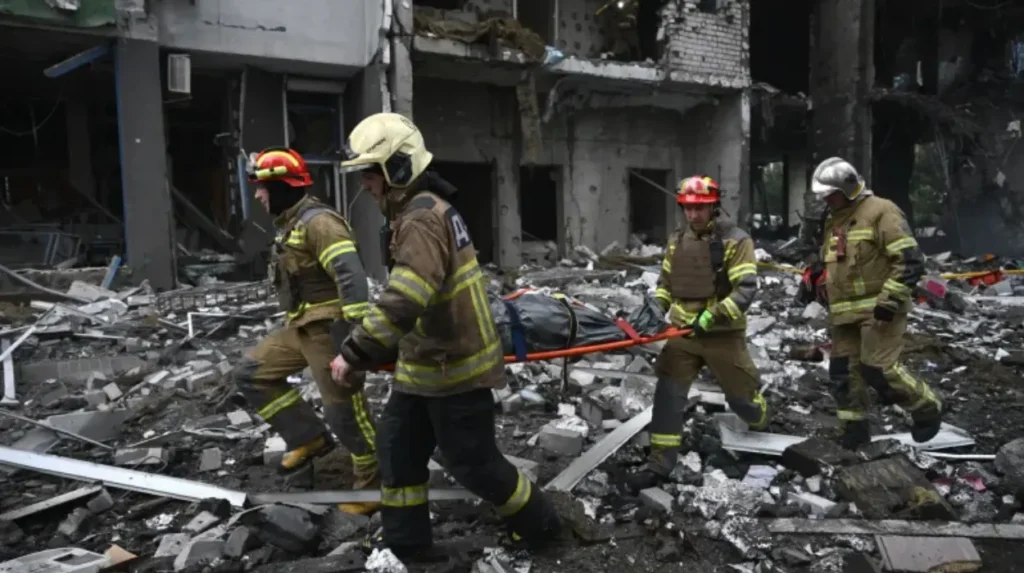
The bombardment was said to have been a coordinated strike using both missiles and drones against Kyiv and its surrounding regions, with residential buildings among those that took damage from it. Civilian casualties and fires were said to have been witnessed as a result of the strikes, making sheltering and defensive mechanisms key concerns for the people of the capital city. In another report, the attack was noted to have been the second such bombardment in Kyiv and its surrounding regions within a period of less than a week, implying that this was not just an isolated act but a concerted effort by the Russians against Ukraine. It was further reported that in the strike, there had been almost 400 missiles and drones used. From these reports, it is clear that it was a coordinated attack designed to drain the air defense system of Ukraine and instill fear. This is what makes it significant even outside of Kyiv since it was an act of war with diplomatic ramifications.
Casualties and damage
The human cost was severe. One account said at least eight people were killed, including seven in Kyiv and one in Bucha district, while at least 34 people were wounded in the capital and nearby areas. Another report placed the death toll at 14, showing that the final figures were still being updated as emergency workers cleared debris and treated the injured
That uncertainty is not unusual after an attack of this scale, especially when missiles and drones arrive in waves and damage spreads across multiple districts. In practical terms, the exact total may continue to rise as officials confirm missing persons, hospital admissions, and additional deaths from severe injuries. What is already clear is that civilians bore the impact. The references to residential damage, fires, and the wounding of dozens of people point to an attack that went beyond military infrastructure and struck the daily life of the city.
Political message
The attack also carried an unmistakable political signal. Coming on the eve of a NATO summit, it placed Ukraine’s vulnerability at the center of the transatlantic agenda and forced leaders to confront once again the scale of Russia’s air campaign.
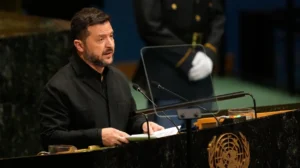
The timing for Kyiv was especially critical as the president of Ukraine, Volodymyr Zelensky, had been asking their allies to bolster Ukraine’s air defense system before the start of the meeting. The attack made the argument of Zelensky stronger as it added a new dimension of damage in the capital city to the abstract calls for assistance. Zelensky’s argument, as conveyed through the news media, was that Russia was trying to make things worse instead of showing any intention of peace. This is an important aspect as it means that Russia was not just hitting targets but was also trying to influence negotiations.
NATO and Trump context
The background of the summit is crucial because the strike was said to occur on the eve of an important NATO summit and before Trump’s visit to the country. Thus, it was not just a local tragedy but something bigger that added fuel to the discussions about the possible guarantees and military assistance that Ukraine will receive from its allies. Moreover, the news associated this tragic event with the heated discussions about air defense systems which are needed in Ukraine as never before. The scale of the attack, whether it consisted of hundreds of rockets and drones or another round of dozens of rockets and hundreds of drones, as claimed by other reports, makes the idea about the importance of air defense systems even more obvious. Besides, the tragedy added some urgency to the summit itself. The leaders came there to talk about the security policies, but the picture of burning Kyiv on the eve of the meeting made the war extremely close and immediate.
Why the figures differ
The different casualty and weapons counts across reports should not be read as contradictions so much as snapshots from different moments in a fast-moving crisis. Early reports often rely on local officials and emergency updates, while later reports may include newly confirmed deaths, revised damage estimates, or different methods of counting missiles and drones.
That is why one report can say at least eight were killed while another says at least 14. It is also why one outlet may cite 400 missiles and drones while another references a separate figure of 40 missiles and 519 drones in a related attack sequence. In war reporting, especially during active bombardment, the numbers often reflect the evolving state of information rather than a single fixed total.
What this means for Ukraine
In terms of strategy, the attack demonstrates yet again that one of the problems which Ukraine is having during the course of the war is that it is able to defend its airspace, but it is unable to secure a big city against massive attacks from the air without assistance from the outside. This leaves Kyiv open for physical attacks and political pressure whenever Russia decides to intensify the conflict. The proximity of the attack to the NATO summit makes the strike even more relevant because apparently Russia wants to test not only the defenses of Ukraine but also the determination of its allies, especially when the world’s attention is somewhere else. In this respect, the attack was not just another attempt to gain territorial advantages – it was an effort to affect the atmosphere of diplomatic negotiations regarding the conflict. For civilians of Kyiv, however, the message is much more obvious.