Five years after the Taliban seized Kabul, Afghanistan presents a deeply contradictory picture. Large-scale fighting has declined, and some Afghans have benefited from the end of the nationwide war. Yet the reduction in battlefield violence has not produced human security, economic recovery or political inclusion.
Rather than that, the nation faces growing humanitarian catastrophe, systematic discrimination against women and girls, shrinking foreign aid, climate impacts and increasing pressure from refugee repatriation. The return of the Taliban regime to power on August 15, 2021 marked the end of two decades of internationally backed republic and the longest war ever fought by the US. It also marked the beginning of a new era in Afghan history – a nation with lesser conventional warfare and greater repression, poor governance and increasingly self-reliant citizenry.
A quieter country, but not a safer life
The Taliban’s rapid offensive in 2021 swept through all 34 provincial capitals in roughly nine days. Kabul fell after President Ashraf Ghani fled the country, saying he had left “to prevent bloodshed.” Taliban co-founder Mullah Abdul Ghani Baradar then promised an inclusive government and amnesty for former officials, declaring that the movement was
“responsible for your lives and all that pertains to everyday living.
But all these promises have not resulted in an inclusive political system. Taliban have taken control of politics under their leader, Hibatullah Akhundzada, without involving political rivals, women, or representatives of civil society organizations. One aspect where security situation has improved is that large-scale conflict between Taliban, the previous regime in Afghanistan, and the international forces has come to an end. In a press release, UNAMA noted the significant decline in violence and pointed out that Taliban’s steps, including a ban on opium poppy cultivation, have created room for recovery.
However, stability is not the same as safety. Islamic State-Khorasan retains the capability of undertaking violent attacks against Taliban. Former government officials, journalists, judges, activists, and minority community members still remain at risk. Public punishments have increased as well. UN rights experts found at least 1,110 public floggings in 2025, among which 170 were inflicted upon women, and at least 12 executions in public.
“Sustainable peace and prosperity require more than just an absence of conflict,”
said Georgette Gagnon, UNAMA’s deputy special representative and officer-in-charge. She warned that restrictions on women and girls remain
“a central obstacle to broader international engagement and investment.”
Humanitarian need reaches a new high
The humanitarian crisis in Afghanistan has escalated even when attention from the international community has been drawn to other issues. An approximate 21.9 million of people, representing 45% of the population, require humanitarian assistance. This is an increase of 3.5 million people compared to 2021, as noted by the International Rescue Committee. Afghanistan is facing the sixth consecutive year of drought. There are around 4.7 million people experiencing emergency food insecurity, which is one level down from famine.
For the period between April and September 2026, an estimated 13.8 million of Afghan citizens are expected to be food insecure. According to the World Food Programme, food insecurity impacted 47% of the population in the first quarter of 2026. The reasons for this include unemployment, high prices of food, drought, insecurity caused by the conflict, decreased foreign aid and closure of the Pakistan border.
UN humanitarian officials say the crisis is visible in communities across the country. Olga Cherevko, a spokesperson for the UN Office for the Coordination of Humanitarian Affairs, described people as
“exhausted from being poor, hungry, dealing with repeated climate shocks, mounting debt and the daily struggle to provide for their families.”
That exhaustion is also a warning against interpreting the decline in fighting as a complete improvement. A family may no longer fear a battlefield nearby, but it may still be unable to afford food, reach a clinic, send a daughter to school or rebuild a home destroyed by floods.
“Security is not the same as human security,”
Cherevko said.
“Security does not put food on the table, rebuild a home washed away by floods, replace crops lost to drought, treat a malnourished child or bring a doctor closer to a remote village.”
Aid is shrinking as needs grow
One of the most problematic contradictions of Afghanistan is that although the need for humanitarian aid in Afghanistan is increasing, there is not enough funding to meet those needs. The 2026 humanitarian appeal of Afghanistan, which is worth $1.71 billion according to the International Rescue Committee, received less than one-quarter of the funding. The second independent estimate of the UN also set the requirement at $2.1 billion and reported that only 26% of the funding has been raised so far, as of August. The two numbers may be based on different appeals and different reporting dates; nevertheless, they clearly indicate the same problem: the amount of international assistance provided is much less than needed. It can be seen in the health care sector, too. According to the International Rescue Committee, the number of the supported facilities decreased from 46 in 2023 to 16 in 2026, which means that it fell almost by two-thirds. First antenatal visits were reduced by 24%.
The UN has warned that funding gaps could force health-centre closures,
“leaving thousands of mothers and newborns vulnerable to preventable complications and death,”
according to UN Humanitarian Coordinator Bruno Lemarquis.
Women-led organizations are particularly exposed. Nearly three-quarters of women-led groups surveyed in Afghanistan experienced funding cuts in 2025. More than half of 74 organizations surveyed in April 2026 said they might suspend operations or close within a year, while about two-thirds reported having six months or less of operational funding remaining.
This is not merely a financing problem. It is a direct threat to services that women can access, especially in a society where Taliban rules often restrict female patients from being treated, transported or assisted without male relatives.
Women erased from public life
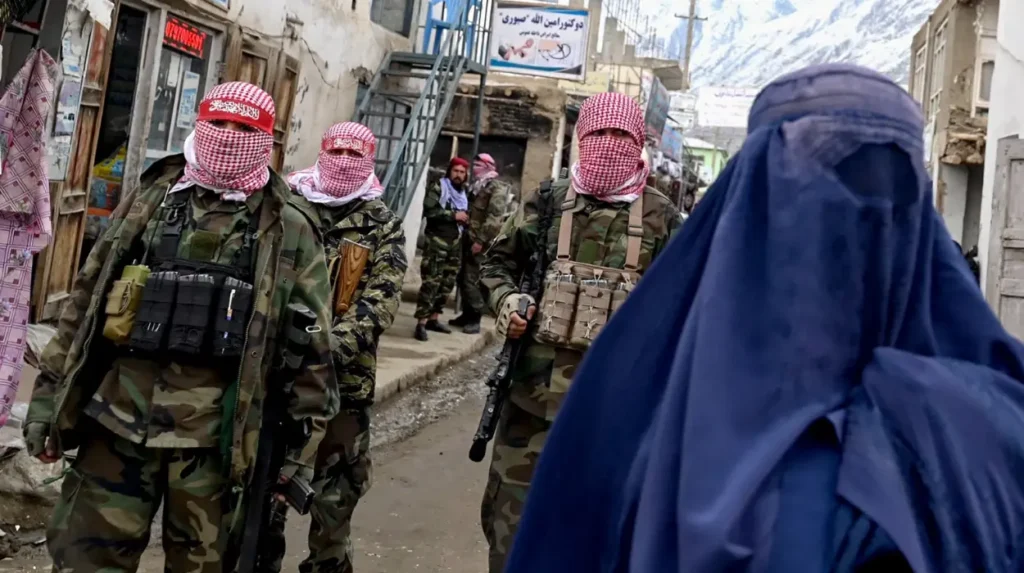
The defining feature of Taliban rule is the systematic restriction of women and girls. UN agencies say the Taliban have issued more than 100 decrees curbing their education, employment, movement and participation in public life.
Afghanistan remains the only country in the world where girls and women are formally prohibited from education beyond the primary level. Approximately 2.4 million girls are excluded from secondary education.
UNESCO described the policy as
“a grave violation of their fundamental human right to learn”
and warned that it risks
“condemning Afghanistan to decades of lost potential, deepening poverty, and irreversible harm.”
The ban is not limited to classrooms. Girls and women are barred from universities and excluded from most paid employment. They face restrictions on travel, access to public spaces, healthcare and legal protection. In many situations, women need a male guardian, or mahram, to move around or receive services.
UN Women says half of Afghan women interviewed leave their homes only once or twice a month. Many also report feeling unsafe leaving home without a male guardian. The restrictions have contributed to a mental-health crisis, while increasing the risks of child marriage, maternal death and gender-based violence.
“Women have been erased from public life,”
UNESCO said, warning that
“as a new generation of girls grows without an education, their future becomes increasingly dark.”
These repercussions can be seen in the workforce. There has been a decline in female labor-force participation, and a shortage of educated women may affect the future supply of doctors, nurses, teachers, journalists, and civil servants. The lack of women’s access to education and employment in some parts of Afghanistan is particularly problematic because many women patients cannot easily access male health professionals. Independent UN human rights experts say that the Taliban’s control mechanism represents gender persecution, which is a crime against humanity.
They also said that the term “gender apartheid” could accurately describe the system. The UN human rights experts mentioned an order in Herat, according to which women were denied entry into hospitals for improper clothing or for not having a male guardian with them. Admission rates dropped by more than one-quarter within two days. In June, at least 30 women and girls were imprisoned in the same city for violations regarding the dress code, whereas the security forces shot at the demonstrators, resulting in the death of two individuals, including a child.
Poverty is reshaping family life
Economic hardship is forcing families into decisions that deepen long-term poverty. When households cannot pay for food, rent, healthcare or transport, girls may be married off early. The practice provides short-term financial relief but often ends a child’s education and increases the risks of early pregnancy, domestic violence and dependence.
The UN’s Olga Cherevko recalled meeting families who had lost hope for their daughters’ futures.
“They told me that basically they had lost hope for their daughter’s future and of course for themselves,”
she said.
This summarizes the generational nature of the crisis. The girl who is not enrolled in high school today will have less chance of earning money in the future. She will be deprived of an economic asset for her family, and Afghanistan will lose an emerging professional. The policy thus undermines both individual freedoms and national growth. The Taliban’s morality law of 2024 has also added another layer of restrictions. According to Human Rights Watch, it extends the control over the dress, movement, speech, work and participation of women in the public sphere. It also mentions that measures against domestic violence have been made weaker, and a recent marriage law may complicate divorces for women.
Returns add pressure to fragile communities
The country is also accepting millions of people coming back from Pakistan and Iran. According to the International Rescue Committee, 3.2 million Afghanis have come back from these two countries in 2025, but according to another report from the United Nations, more than 2.5 million people have returned due to force and voluntarily. This variation can be explained in terms of the counting periods and differences in definitions, but the pressure cannot be denied. Returnees do not have any shelter, jobs, papers or access to education or healthcare facilities. Returnees come to communities that are facing drought, joblessness and starvation. Cherevko reported that nearly 44,000 people returned from Pakistan within one month, who were entering communities where there were no job opportunities and hardly any state-provided services available. The massive return movement is also linked with the problem of protection. Women, girls, journalists, ex-officials, activists, religious minorities and LGBT Afghans may be vulnerable to Taliban’s rule.
Opium ban brings mixed results
The Taliban’s ban on poppy planting has been said to have lowered opium production by around 95%. It has affected the operations of one of the biggest illegal drug economies in the world as well as a major source of income for drug smugglers and combatants. Nevertheless, it has deprived farmers and laborers of their income but without providing any substitute for this income. Rural households that depended on poppy planting suffer from joblessness and loss of income, while the drug economy adapts itself by increasing production of artificial drugs like methamphetamine.
International engagement without normalization
The international community faces a dilemma. Complete disengagement has not been able to make the Taliban see sense and restore women’s rights, while engagement might lead to humanitarian access, decrease threats of terrorism and create economic opportunities. Russia has recognized the Taliban regime officially.
Both China and the United Arab Emirates have accepted the Taliban ambassadors appointed by the Taliban regime, with China further engaging economically in sectors like oil, copper and lithium. According to human rights organizations, engagement must not turn into unconditional recognition. UN-appointed experts have advised governments not to normalize the Taliban unless and until they “make demonstrable, measurable and independently verified progress” on human rights issues. The issue is not one of diplomacy alone; it is whether international pressure can be related to tangible changes without denying humanitarian aid to millions of Afghans.
Afghanistan’s unresolved future
After five years of Taliban leadership, Afghanistan remains neither at war as was the case pre-2021 nor at peace in any real humanitarian terms. There has been a drop in violence but an increase in repression. The state remains intact but its institutional strength and fiscal capacity has weakened. The Taliban have managed to gain control but not legitimacy and a comprehensive national settlement. The greatest danger is that the international community will get accustomed to the crisis simply because it has become routine. Humanitarian organizations argue that Afghans do not wish to hear praises on their resilience endlessly but a practical means to make ends meet.
“Resilience should never become a substitute for opportunity, or an excuse for the world to expect people to endure indefinitely without the support they need,”
Cherevko said.
“The people I met are not waiting for another chance to prove how resilient they are. They are looking for the chance to live ordinary, dignified lives.”
That is the core judgment on five years of Taliban rule. Afghanistan may be less engulfed by conventional war, but it remains trapped in a broader crisis of rights, poverty, hunger and governance. Until women and girls are restored to public life, humanitarian aid is adequately funded and Afghans gain a sustainable route to recovery, the country’s apparent calm will remain a fragile and deeply unequal form of stability.