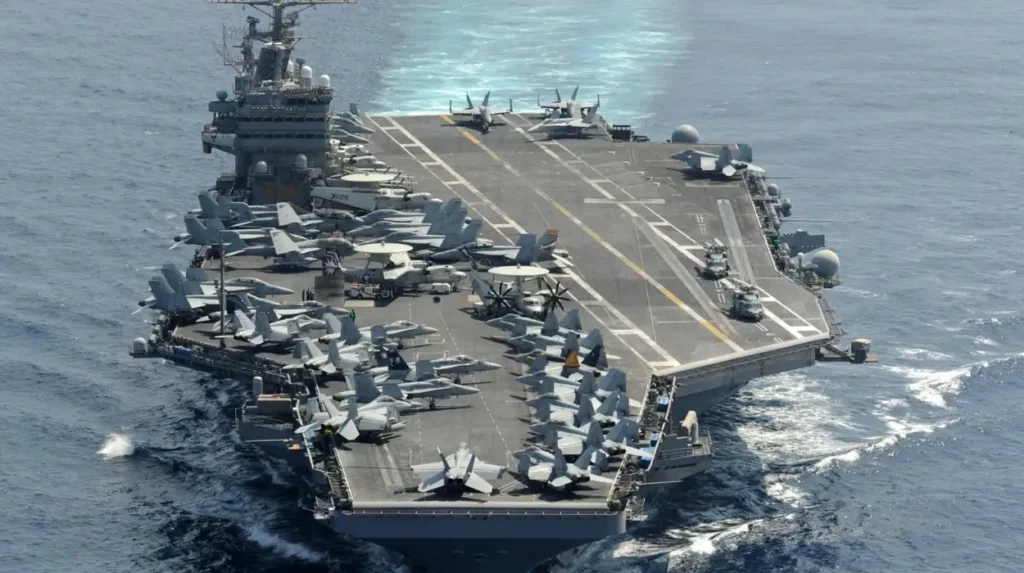
President Donald Trump’s blunt dismissal of concerns surrounding the USS Abraham Lincoln has intensified a growing dispute over the endurance, welfare and operational readiness of thousands of American sailors deployed in the Middle East.
Asked whether the carrier’s nearly nine-month deployment had gone on too long, Trump replied,
“No, no, no. Not nearly long enough.”
The president also rejected suggestions that sailors’ families were worried about their relatives, saying, “No, they’re not.”
He was making these remarks amid reports from military families, politicians and media outlets about declining morale, logistics issues and possible instances of self-harm on board. The Abraham Lincoln is over 250 days at sea, with 200 of those consecutive days having passed without making an ordinary port visit. The aircraft carrier, housing around 5,000 sailors and Marines, left San Diego on November 21, 2025, with plans to conduct a routine Pacific mission. However, it changed course for the Middle East and joined U.S. forces engaged in the war against Iran. The unusually long deployment has turned the Lincoln into an icon of the challenges the U.S. Navy faces in keeping carriers afloat in a contested environment.
From routine mission to extended war deployment
This prolonged mission was not originally intended for such a long period as almost nine months. The aircraft carrier had sailed from San Diego for its usual overseas mission, but due to some regional incidents, the plans of the Navy changed. It got to the Middle East in January, just before the onset of the Iran war on February 28, according to reports on the schedule of this deployment. After entering the Middle East region, the mission of the aircraft carrier included not only usual deterrence but also support for combat activities. The reports claim that the ship conducted about 40 days of continuous combat missions in the United States 5th Fleet area. This fact explains why there have been two deployments extended. However, it does not answer one essential question posed by families and politicians: how long could a crew of an aircraft carrier work without an estimated break?
Aircraft carriers are built to remain at sea for extended periods, but normal deployments are generally structured around rotations, replenishment visits and scheduled port calls. Those pauses offer more than recreation. They allow sailors to receive mail, obtain supplies, seek medical support, repair equipment, rest away from the ship and maintain contact with family members.
The Lincoln reportedly went more than 200 days without a normal port call. That period is far longer than the 30-to-45-day intervals often associated with carrier operations, creating an unusual strain on both crew and families.
Mental-health concerns grow
The most serious reports involve the mental health of sailors aboard the ship. Military families and some sailors have described exhaustion, hopelessness and declining morale after months of continuous operations with no clear end date.
Several reports have alleged that sailors attempted to go overboard. The Navy has not confirmed the total number of such incidents. However, U.S. officials confirmed that one sailor went overboard in early August. The sailor was reportedly wearing a life vest, was recovered quickly by an air-wing search-and-rescue helicopter and was not physically injured. The Navy treated the incident as a mental-health episode, according to CNN reporting.
Families have also described sailors expressing suicidal thoughts. At a town-hall meeting, relatives told Navy leaders that some service members had communicated feelings of despair and emotional collapse. One spouse reportedly said her husband had sent a message saying he
“hopes he doesn’t wake up tomorrow.”
Those accounts have created a gap between the lived experiences reported by families and the official statistics released by the Navy. The service says it has not observed an increase in suicidal ideation or suicide attempts aboard the carrier.
“We have not observed an increase in suicidal ideations or attempts aboard the ship,”
the Navy told CNN. It added that religious, medical and mental-health professionals were available to assess and respond to concerns.
This does not mean that individual reports should be dismissed automatically. It means that internal records of the Navy do not demonstrate an evident rise from its baseline data. However, since no figures per ship have been provided, it is hard for the public to judge the magnitude of the issue. This is one of the main reasons why the debate has grown into an issue. An incident of a sailor going overboard is a concrete fact; other claims concerning several sailors are still hard to prove.
Shortages, sanitation and daily conditions
Mental-health concerns have been accompanied by complaints about the ship’s basic living conditions. Families and sailors have reported shortages or disruptions involving food, water, hygiene products and mail.
The allegations include periods of food rationing, water-contamination concerns, broken plumbing, moldy showers and limited laundry access. Some reports said sailors struggled to obtain basic products such as soap, toothpaste and deodorant. Families also complained that care packages and mail had been delayed, lost or left in transit for months.
One congressional letter listed a series of concerns, including
“shortages of basic supplies, water contamination, plumbing issues, deteriorating mental health, deck safety concerns”
and
“disruptions in the mail system, which have caused many care packages in route to the ship to be lost in transit for months.”
These complaints have particular significance aboard an aircraft carrier. The ship functions as a self-contained city, but its ability to resupply depends on logistics vessels, port infrastructure and access to secure facilities. When combat operations disrupt supply hubs, even ordinary items can become difficult to deliver.
The Navy has said that combat operations created a
“highly contested environment where traditional supply hubs in the Middle East were disrupted by combat actions.”
Officials said the Navy prioritized deliveries, placing food first, hygiene supplies second and mail third.economictimes.
The service also says conditions have improved. It has reported continuous access to clean water, functioning air conditioning and healthy meals, including two protein options. A resupply stop in Oman reportedly provided fresh fruits and vegetables that had been unavailable for months. Mail deliveries were also said to be improving.
The competing accounts illustrate the difference between operational adequacy and acceptable quality of life. A ship may have enough food and water to continue a mission while still facing serious problems involving sanitation, rest, morale and family communication.
Navy and Pentagon reject the crisis narrative
There have been strong protests from Navy and Pentagon officials on the portrayal of a crisis situation in the Lincoln. According to the Navy, it assesses the psychological preparedness of the crew all the time and provides its sailors access to counselors, chaplains, physicians, and mental health professionals. Additionally, according to the Navy, no sailor on board of the Lincoln died throughout the current deployment. The U.S. Central Command clarified that the sailor who went overboard on August 3 was “quickly and safely recovered.” It also cited high reenlistment rates on the ship (84.4%) which is considered one of the highest in the aircraft-carrier fleet of the Navy.
This number is used by the officials to show that, contrary to some media reports, the morale of the Lincoln crew is relatively good. Nevertheless, reenlistment rates alone are not sufficient enough for making assumptions about readiness of the crew and cannot exclude acute stress situations among individual sailors. The Acting Navy Secretary Hung Cao noted that sailors were indeed stressed to the point but criticized what he thought was the excessive portrayal of the situation.
Trump’s comments fit this broader administration position. By saying the deployment was “not nearly long enough,” he framed the issue primarily through the requirements of the military mission rather than the personal cost borne by the crew.
Lawmakers demand answers
The dispute has led to calls from Democrats for an investigation into the situation and more transparency on the part of the Pentagon and the Navy. Sen. Richard Blumenthal, who is the ranking Democrat on the Senate Armed Services Committee, sought to have questions answered regarding the authorization, mission, and anticipated duration of the deployment. He also sought an explanation from the Navy on how they plan to maintain carrier deployments in the Middle East region for 12 to 24 months going forward.
More importantly, Blumenthal went past issues surrounding the USS Lincoln alone and asked whether the repeated extensions are becoming part and parcel of the U.S. Military planning strategy. The senator has set a deadline of August 27 for answering questions related to alleged lack of supplies, drinking water contamination, sanitation issues, mental and physical well-being of the crewmen.
Sen. Chris Coons described the deployment as evidence that the Navy had been “pushed to the limit.” Another lawmaker, Sen. Mary Kelly, argued that a lengthy deployment becomes especially difficult when
“the mission isn’t well defined and there is no end in sight.”
The congressional concern is therefore not limited to whether the Lincoln can technically remain operational. It focuses on whether the Navy has maintained a sustainable balance between mission demands and the welfare of its personnel.
The relief plan and unresolved questions
USS George Washington is on its way from Japan to the Middle East as part of a planned rotation strategy involving carrier fleets. The fleet will reportedly be replacing the Abraham Lincoln fleet although details concerning the process have not yet been made public. The replacement is important since it marks an admission that the present rotation cannot go on forever. The move also prompts concerns about whether the rotation of ships is happening quickly enough to avoid future problems.
The major unresolved issues include:
- The verified number of overboard or self-harm incidents.
- Whether suicidal ideation increased during the deployment.
- The complete record of food, water, hygiene and plumbing shortages.
- The time sailors will receive for recovery after returning home.
- Whether future Middle East operations will again require extended carrier deployments.
- Who authorized the repeated extensions and what contingency plans existed.
One such study carried out in 2025 on 956 sailors deployed on board aircraft carriers, destroyers, and amphibious ships showed that sleep deprivation, lack of proper medical care, inability to communicate with their families, and inability to find ways to alleviate stress were the major reasons for distress during deployment. This study does not indicate any crisis on board the USS Lincoln, but it is an important piece of information to consider.
What the dispute reveals
The dispute regarding Abraham Lincoln is, therefore, much more complicated than a single statement from the president. This incident highlights the core problem of modern maritime wars. It is expected from U.S. carrier crews to deliver constant power on a global scale; however, logistical and personnel support system may simply be not built for constant, indefinite prolongation of missions. As the President states, this operation “was not nearly long enough.” Trump as a commander-in-chief seems to care about persistence in warfare while families of sailors and senators discuss whether such kind of persistence without any predictable respite weakens the very force necessary for mission completion. From all available data, the following conclusions can be made.
The mission duration is unusual for the ship. The vessel itself stayed away from usual ports for too long time. A sailor fell overboard and was saved in time. There is distress among families and problems with conditions in which sailors live. The Navy does not confirm increase in suicide cases and claims that all necessary provisions and services are available. The final word will be given by the evidence still unpublished.
Until then, the Lincoln remains operational—but the debate over whether its sailors have been asked to endure too much is unlikely to end with the arrival of the George Washington.