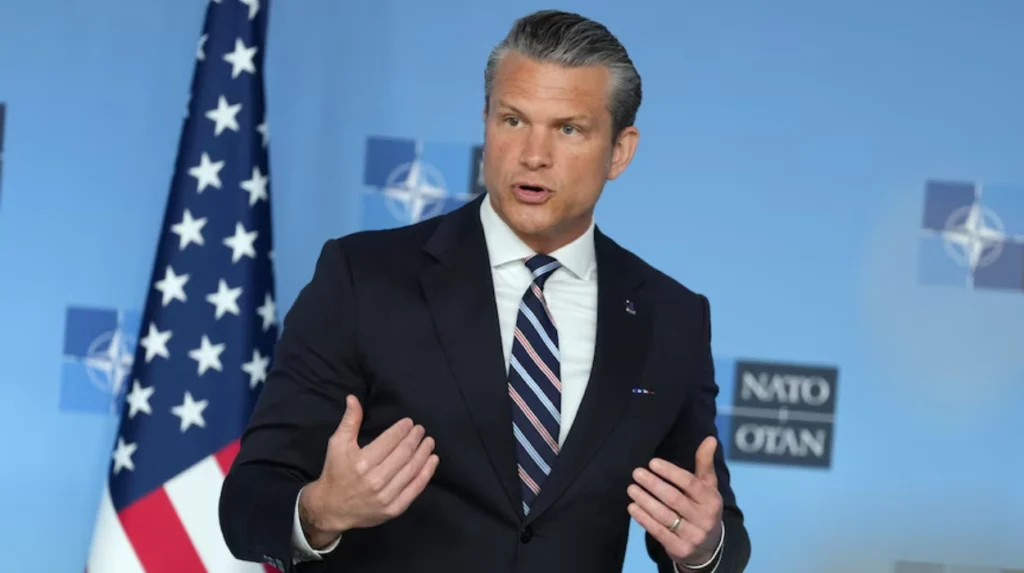
With a shocking insult that has rattled the very core of the Western alliance, the United States’ Defense Secretary, Pete Hegseth, criticized NATO’s European partners in an important roundtable discussion held in Brussels on June 18, 2026. It is in this particular round table discussion that the Defense Secretary accused the European allies of refusing to provide U.S. forces with bases on their territory for carrying out attacks on Iran. What took place in Brussels on that day was far from being a disagreement on policies, but a threat to the very security structure established after the Second World War.
Hegseth’s words carried the weight of the Trump administration’s frustration with what it perceives as European betrayal during an active military campaign. The Defense Secretary did not mince words when describing the situation, declaring that
“It was ‘shameful’ that European allies refused to give U.S. forces access to bases to strike Iran.”
This statement, delivered during NATO defense ministers’ gathering, marked one of the most public confrontations between Washington and European capitals since President Donald Trump’s second inauguration in January 2025.
Timing of the statements made by Hegseth was quite sensitive. Indeed, the US and Israel have been undertaking a military offensive against Iran, and the war has lasted already for several weeks. European allies have found themselves without any prior notice regarding the start of the war being asked for permission for overflight and basing at the very last minute, which most Europeans denied. Disagreement between America and Europe has led to diplomatic warfare.
The Core Accusation: Denied Access and Blocked Airspace
The first major allegation that Hegseth made was related to certain logistical errors that were considered unacceptable by the plans of the U.S. military. The Secretary of Defense described the case when the European countries refused to let American fighter planes use their airspace and even closed the joint bases for the operations of the U.S. troops.
Spain proved to be one of the most controversial examples cited by Hegseth in his criticism. Specifically, the Spanish government refused to allow the use of Naval Station Rota, an important naval base on the Atlantic coast, as well as Morón Air Base located close to Madrid, both of which accommodate American troops and equipment according to preexisting arrangements between the two countries. Similarly, France closed its airspace to the United States’ military planes participating in the operation against Iran. Switzerland did the same, despite not being a member of NATO.
However, the response from Switzerland was more significant than others’. Not only did Switzerland shut down its airspace to U.S. military aircrafts, but it went further to stop its export of weapons worth about US$120 million per year. Though not a heavy penalty, it showed Switzerland’s dissatisfaction with U.S. military operations.
Hegseth framed these restrictions as more than bureaucratic obstacles. He argued that
“These allies jeopardize the safety of American sons and daughters by denying them the essential access, bases, and overflight permissions that should never have been in question.”
The language he employed transformed what could have been viewed as routine diplomatic friction into a matter of troop safety and national security. By invoking the welfare of American service members, Hegseth elevated the dispute to moral grounds where compromise became difficult.
The Six-Month Pentagon Review: What It Means for European Forces
In reaction to what he called European unreliability, Hegseth declared an extensive six-month review of the United States’ military footprint in Europe. Conducted by the Pentagon, this review will analyze America’s “force posture and basing in Europe” in ways that have not been done before. In addition to being a review of logistics, the review’s mandate is to ask a basic question: How fast can NATO countries take control of their defense without American military involvement?
The conclusions that can be drawn from this review are significant. The U.S. military has deployed troops into more than ten countries in Europe, including large-scale bases in Germany, Italy, the UK, and Poland. This involves housing of tens of thousands of U.S. soldiers and storing billions of dollars worth of equipment, not to mention being the launching point for operations all throughout Europe, Africa, and the Middle East. The act of reducing or withdrawing these troops would be considered a geopolitcal earthquake.
Hegseth offered a preview of the review’s potential outcomes without committing to specific predictions. He stated that
“Some nations will not meet expectations, while others will excel”
in the coming assessment. This ambiguous phrasing suggested that the Pentagon would differentiate between allies based on their willingness to cooperate with U.S. military operations. Nations that denied base access during the Iran conflict might face particular scrutiny, while those that demonstrated continued reliability could emerge with enhanced security guarantees.
The Trump administration has framed this review as part of a broader effort to revitalize NATO into what Hegseth dubbed “NATO 3.0.” This envisioned transformation would create a “truly robust military alliance” capable of fending off any danger without relying disproportionately on American military power. The administration argues that European nations have benefited from U.S. protection for too long while failing to invest adequately in their own defense capabilities.
European Allies’ Perspective: Caught Flatfooted by Unannounced War
Although Hegseth made his remarks in Brussels, the defense ministers of Europe had a totally contrasting story to tell about the situation which had led to the diplomatic dispute. Some NATO officials have said that their countries had been “caught flatfooted” because President Trump had decided to declare an unexpected war on Iran. This war had no purpose, and neither was it planned.
European allies expressed frustration with what they perceived as Washington’s unilateral approach to what should have been a collective security decision. The lack of prior notification left NATO nations in an impossible position: either grant immediate access to military bases and airspace without understanding the campaign’s scope, duration, or endgame, or refuse and face the diplomatic consequences Hegseth has now delivered. Many European governments chose caution over complicity.
UK’s attitude was especially noteworthy considering its historical status as America’s closest European ally. It seems that Trump felt upset by Britain’s reluctance about the operation against Iran, which became yet another proof of the deterioration of traditionally strong Anglo-American relations. The reluctance of the British government was also indicative of the fact that even closest allies of the US refused to support any military actions covertly.
The NATO Secretary General Mark Rutte tried to diminish the severity of the situation during his statements after the speech by Hegseth. Rutte said that “Everything is fine” despite the fact that the USA criticized NATO and stated that the
“allies are on the right track, but need time to spend more on their defense”.
However, Rutte’s statements seemed to be inconsistent with the accusation made by Hegseth.
Hegseth’s Warning: No Excuse for Allied Failure
Hegseth’s rhetoric grew increasingly severe as he elaborated on his administration’s position. Beyond labeling the base access denial as “shameful,” he pressed further, declaring that
“There’s no excuse for that.”
This absolute statement eliminated any possibility of diplomatic nuance or justification for European actions. In Hegseth’s framing, the refusal to grant base access was not a matter of differing strategic assessments but a fundamental failure of alliance obligations.
This failure, in turn, was related to the issue of European defense spending and loyalty to NATO, and the Defense Secretary criticized the NATO countries because of insufficient military expenses and what he referred to as inadequate commitment to the war in Iran. These complaints addressed the problem that the Trump administration had long complained about – Europe’s unwillingness to pay for its own defense.
Hegseth also emphasized that the Trump administration is
“currently seeking to revitalize the 32-nation alliance in order to transform it into a ‘NATO 3.0’ that can fend off any danger.”
This vision requires European nations to take the lead on continental defense while maintaining the alliance structure that has protected them since 1949. The Iran war base access dispute has become the testing ground for whether this transformation can succeed.
The Broader Context: US-NATO Relations Under Trump
This is a case of the most recent episode in a series of escalations involving the Trump administration versus NATO Europe. Not even a month ago did the United States announce its withdrawal from furnishing specific planes and vessels to its NATO allies in case any of them were attacked. This was an indication of how willing Washington was to act unilaterally in reducing security promises in case Europeans do not live up to the administration’s expectations.
The Iran conflict itself emerged within a broader context of Middle East tensions involving the United States and Israel against Tehran. European allies have shown mixed support for these U.S.-Israel military operations, with some nations expressing concern about the campaign’s potential to destabilize the region further. This divergence in strategic outlook has complicated alliance coordination and fueled Washington’s frustration.
President Trump’s reported disappointment in the UK’s hesitation highlighted how even traditional allies faced pressure to demonstrate unwavering support. The administration appears to operate on a binary understanding of alliance loyalty: nations either fully support U.S. military operations or they fail to meet alliance obligations. This framework leaves little room for the nuanced positions that European governments often adopt in complex international conflicts.