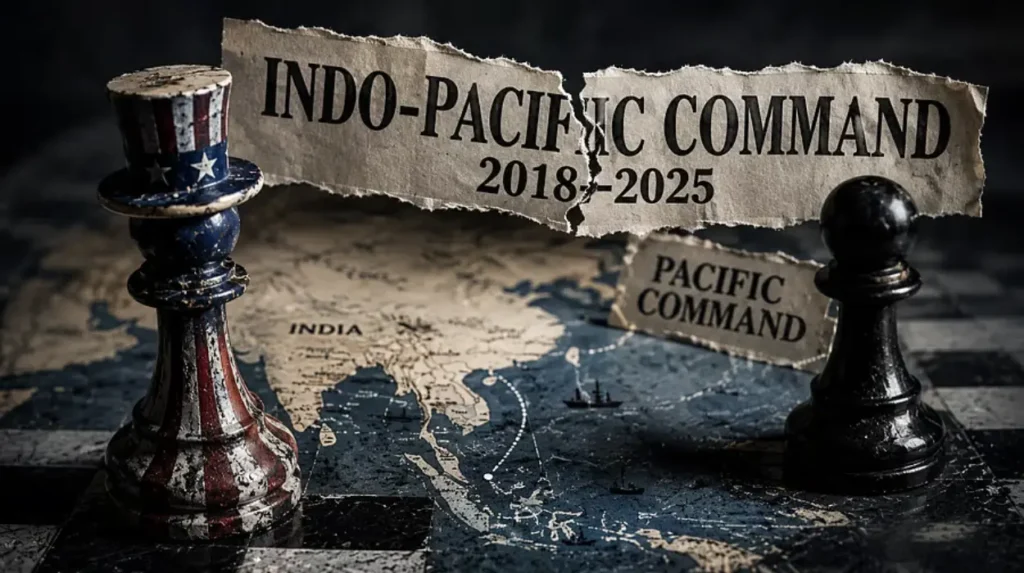
The United States Department of Defense took a bold symbolic step which has reverberated through the world’s international security circle. In what was termed as a major move on Tuesday, June 16, 2026, the Pentagon has officially stripped off the term “Indo” from the name of its military organization known as the “United States Indo-Pacific Command,” restoring its old name, “United States Pacific Command.” This comes just after eight years of usage of the term “Indo” to refer to this military group under the presidency of Donald Trump.
Although the name change seems largely symbolic, at least according to officials in the Pentagon who insist that the mission, function, and geographic responsibility of the command have not changed at all, geopolitical experts and foreign policy makers in Asia, and more specifically, in New Delhi, have already started raising questions about whether the move indicates an underlying shift in American strategy, especially concerning the United States’ ties to India.
The Timeline: From 1947 to 2026
Pacific Command of the USA was founded right after the end of Second World War in 1947, and the Command has had this designation for more than seven decades. During all these decades the command acted as a major military instrument for operation coordination in the region of the Pacific Ocean and the area of jurisdiction was defined by the waters surrounding the US’s west coast and stretching up to the west borders of India.
The turning point in the transformation of this command occurred in May 2018, in the early period of the presidency of Donald Trump. In May 2018, Secretary of Defense Jim Mattis declared that the U.S. Pacific Command was now officially referred to as the U.S. Indo-Pacific Command. The new label of “Indo” signified an official acknowledgment by the United States of the strategic linkage between the two oceans, namely the Indian Ocean and the Pacific Ocean.
Defense Secretary Jim Mattis stated at the 2018 ceremony:
“In recognition of the increasing connectivity between the Indian and Pacific oceans, today we rename the U.S. Pacific Command to the U.S. Indo-Pacific Command.”
Admiral Philip S. Davidson was installed as the command’s top commander during that historic rename ceremony, marking the beginning of the INDOPACOM era.
The 2026 Reversal: Official Announcements and Pentagon Stances
Eight years later, the Pentagon has reversed course. On June 16, 2026, the Department of Defense officially announced the restoration of the command’s original name. The abbreviation has shifted from USINDOPACOM or INDOPACOM back to USPACOM or PACOM, aligning with the command’s pre-2018 designation.
Pentagon officials emphasized repeatedly that this nomenclature change carries no operational consequences. In the official release, the Pentagon stated:
“The name change will have no impact on the command’s mission or areas of operational responsibility that were in place under INDOPACOM.”
Another Pentagon official stressed that
“the renaming does not alter the command’s operational role, strategic mission or geographic scope.”
The continuity in the geographical scope of the command is absolute. The borders have not been modified; they continue to extend from the coastal areas of western America to India’s western border, just as they did when INDOPACOM existed. There have been no troop maneuvers, no transfers of assets, and no re-deployment of military equipment.
Timing and Context: Hegseth’s Shangri-La Dialogue Speech
It is also worth noting that the decision to rename the command has been given special attention by analysts focusing on Asian security issues. The decision to rename the command occurred roughly two weeks after US Secretary of Defense Pete Hegseth made an important speech at the Shangri-La Dialogue conference held in Singapore. The speech made by Hegseth in Singapore discussed several issues concerning Asian security, but the connection between the two events was never formally established.
This particular change took place during the tenure of President Donald Trump for his second term after he was reelected in November 2024 and sworn in on January 2025. This specific piece of information has made people wonder if there is a new strategy on how the administration of Trump is handling relations with India and China, as well as the rest of the Quad nations.
Strategic Implications: What This Means for India and the Quad
This move has raised instant diplomatic and strategic worries in New Delhi. Indian officials have been publicly wondering about the commitment of America to the idea of Indo-Pacific that had acted as the bedrock of American strategy towards India since 2018. The phrase “Indo-Pacific” was not merely rhetoric but was a strategic decision on the part of America to recognize the importance of India in Asia’s security structure.
The Quad partnership between India, the US, Japan, and Australia has developed heavily based on the idea of Indo-Pacific strategy. Indian experts have started questioning whether the omission of the word “Indo” in the name of the Command reflects the growing lack of interest of the US in the Quad partnership or a strategic shift towards satisfying China’s interests in the region. The use of Indo-Pacific as a term was always considered an acknowledgement by America that India is its top strategic partner.
The symbolic weight of the name change carries disproportionate significance in diplomatic circles. While Pentagon officials insist the operational reality remains unchanged, the language of strategic policy matters profoundly in international relations. The term “Indo-Pacific” became embedded in bilateral agreements, joint military exercises, defense cooperation frameworks, and diplomatic statements between Washington and New Delhi over the past eight years.
China’s Perspective and Regional Power Dynamics
This change in name has also stirred some controversy regarding a possible realignment in the US-China relationship. There have been speculations that the exclusion of the term “Indo” in the name of the command may be an indication that Washington is reassessing its policy towards China. The decision to rename the command back in 2018 was done amid rising military and economic threats coming from China.
A reversal of policy in 2026 towards China will be a major shift from the policy of the Trump administration in the early years, as well as from the bipartisan consensus in Washington that sees China as the main strategic problem in Asia. What needs to be seen now is whether this is really a new strategic direction or just a symbolic one.
There have been no official comments from the Chinese side regarding this name change; however, in general, China has always appreciated the policies adopted by the United States that seem to undermine the containment strategy in the Indo-Pacific region. The lack of reaction from the Chinese side shows that the policy is being analyzed for its true nature.
Multifaceted Analysis: Symbolism Versus Operational Reality
The key issue about this news story is the difference between symbolism and reality. US Defense Department representatives have repeatedly insisted that this renaming is symbolic and doesn’t imply anything regarding combat actions or military missions, neither now nor in the future. In terms of geography, operational tasks, and strategic mission, this military branch hasn’t changed at all.
Language is crucially important, though, when it comes to international relations and strategy. The use of language when defining regions and strategic concepts determines the expectations that are set diplomatically, defines agreements between two parties, and creates a perception for both countries regarding their commitment to common strategic goals. The phrase “Indo-Pacific” became a key term in the cooperation strategy of the United States and India.
The removal of “Indo” from the command’s name, regardless of operational continuity, sends a symbolic message that resonates differently across diplomatic capitals. In Washington, officials may view this as fulfilling a promise to restore historical continuity. In New Delhi, the same action appears as potential diminishment of India’s strategic importance. In Beijing, the move might signal reduced U.S. commitment to India-centered containment strategies.
The Broader Context of Trump’s Second-Term Foreign Policy
This name reversal occurs within the broader context of President Donald Trump’s second-term foreign policy approach. Trump’s first term featured aggressive emphasis on the Indo-Pacific concept, with Washington explicitly positioning India as a primary strategic partner. The 2018 command rename was a concrete manifestation of this strategic priority.
The second term of President Trump, commencing from January 2025 onwards, has been marked by new strategies being used for handling international alliances and regional security arrangements. While there hasn’t been any major statement on a complete new strategy being formed, certain events, such as the change in name of PACOM, have raised speculation about a new strategy towards Asia for Washington.
The timing relative to Hegseth’s Shangri-La Dialogue speech adds another layer of complexity. If Hegseth’s Singapore remarks contained signals of strategic adjustment, the subsequent PACOM name change might represent implementation of those broader policy shifts. Conversely, if the name change remains isolated, it may reflect internal administrative preferences rather than strategic recalibration.
A Symbolic Move with Diplomatic Consequences
The U.S. Department of Defense’s decision to drop “Indo” from Indo-Pacific Command represents a significant symbolic reversal in Washington’s strategic architecture, even as Pentagon officials maintain that operational realities remain unchanged. The restoration of the historic “U.S. Pacific Command” name after eight years under INDOPACOM carries disproportionate diplomatic weight, particularly for India and the Quad alliance built upon the Indo-Pacific framework.
Although the geographical range, purpose, and duties of the command remain the same, the vocabulary of strategic policy determines expectations and relations in diplomatic circles. For those analyzing or involved in policymaking, it is unclear whether this symbolic shift represents a change in strategic thinking toward China or whether it carries greater significance, such as the reduced focus on India’s importance.
The coming months will prove critical in determining whether the PACOM name change represents genuine strategic evolution or remains what Pentagon officials claim: a purely symbolic gesture carrying no operational consequences. For now, the international security community watches closely, interpreting every Washington signal about Asia’s strategic future.