The killing of 18-year-old Henry Nowak in Southampton set off an international feud, drawing attention to policing standards in the UK. The Trump administration piled on, attacking “two-tier policing.” They tied the incident to broader concerns about ideological training and the waning of Western civilization. With Secretary Marco Rubio leading the charge, the State Department’s criticism caused waves in Westminster and among British police chiefs. They made the case that this wasn’t just about one crime—it pointed to serious issues within the system as a whole.
Henry Nowak, a university student, was tragically stabbed to death in December 2025. The murderer, Vickrum Digwa, was later convicted. However, the incident gained political overtones due to doubts surrounding the police response at the time. People claim the officers may have been hesitant or adjusted their actions due to racial concerns. This raised questions on whether the police apply different standards depending on one’s perceived identity, sparking intense debates about fairness and equality in law enforcement.
The U.S. Statement: Strong Words from Washington
The Trump administration’s intervention was swift and severe. In a post on X, the U.S. State Department declared:
“Ideological conditioning and two-tiered policing are glaring symptoms of civilisational decline. They must be rejected across the West.”
The statement continued with a conciliatory note, adding:
“The United States sends our condolences to the family of Henry Nowak and the people of the United Kingdom at this troubling time.”
This rare public rebuke during President Donald Trump’s second term—after he won re-election in November 2024 and took office in January 2025—marked a big escalation. The wording mirrored what you often hear from conservative commentators in both the US and UK, showing a growing alignment across the Atlantic on worries about identity politics and law enforcement.
Secretary of State Marco Rubio didn’t hold back. Based on reports from various outlets, the U.S. government framed the situation as a red flag for Western democracies. They centered their message around the term “two-tier policing,” which suggests certain groups get special treatment under the law. This, they argue, usually hurts public safety and justice.
UK Political Fallout: Reform UK and Conservative Backlash
The U.S. chimed in during a really tense debate. Nigel Farage, who leads Reform UK, was one of the first to call it “two-tier policing” regarding Nowak’s death. He said the incident might’ve been shaped by 2022 guidelines from the College of Policing. These guidelines note that dedication to racial equity doesn’t mean treating everyone the same or being color blind, which Farage thinks influenced the officers’ actions.
In a televised interview, Farage stated:
“The police are acting under ideological conditioning that prioritises racial equity over public safety. That’s two-tier policing in practice.”
His comments hit home with a part of the UK public that’s grown really frustrated with what they see as too lenient law enforcement, especially with knife crime. Conservative politicians chimed in, too. Some MPs called for urgently reviewing police guidance and training, saying officers shouldn’t shy away from decisive action out of fear of racism claims.
One senior Conservative MP remarked:
“No officer should hesitate to protect a life because they’re worried about being labelled racist. That’s a failure of leadership in policing.”
Labour’s Response: Review, Not Retreat
Prime Minister Keir Starmer’s Labour government faced immediate pressure to respond. While stopping short of endorsing the “two-tier” narrative, Labour acknowledged the need for clarity in police guidance. A government spokesperson said:
“We are reviewing the 2022 policing guidance to ensure it supports officers in making clear, decisive, and lawful decisions in life-or-death situations.”
Labour’s stance attempted to balance two competing priorities: maintaining commitments to anti-discrimination and equity while restoring public confidence in policing. The Prime Minister himself addressed the nation, stating:
“Henry Nowak’s death is a tragedy. We must ensure our police are equipped, trained, and supported to protect every citizen equally — without fear or favour.”
The government also emphasised that the Independent Office for Police Conduct (IOPC) was leading a thorough investigation into the actions of officers at the scene. No officers had been suspended at the time of reporting, but the IOPC confirmed that its inquiry was ongoing and independent.
Policing on Trial: The “Two-Tier” Debate Explained
“Two-tier policing” is really heating things up in British politics. It suggests that how you’re treated by police could depend on your race, ethnicity, or where you’re from. Take the Nowak case – some think officers were hesitant in their approach because they were worried about looking racist.
People who agree with this idea look at the 2022 College of Policing guidelines. These say that aiming for racial equity doesn’t mean ignoring someone’s race. But that’s led to trouble, too. Critics claim it makes cops confused and hesitant during urgent situations.
However, policing experts warn against oversimplification. Dr. Elena Harris, a criminologist at the University of Cambridge, noted:
“The idea of ‘two-tier policing’ is emotionally powerful but empirically complex. One tragic case cannot define an entire system. We need data, not just narratives.”
She added:
“Police officers face impossible choices in split-second situations. Blaming ideology without examining training, resources, and accountability is unhelpful.”
The Victim’s Voice: Henry Nowak’s Family Speaks
Amid the political storm, Henry Nowak’s family has remained focused on justice and prevention. In a heartfelt statement released through their solicitor, Henry’s parents said:
“We lost our son to a knife. We don’t want politics. We want answers, accountability, and changes that stop other families from grieving like us.”
They praised the police investigation into the murder itself but expressed concern about the handling of the scene.
“We want to know why officers didn’t act faster,”
Henry’s mother said.
“We don’t care about race. We care about our son being alive.”
The family has called for a public inquiry into the police response, separate from the IOPC investigation. They also supported stricter knife-crime laws and better youth intervention programs. “Henry was 18. He had his whole life ahead of him,” his father added.
“No child should die because the system failed him.”
Public Reaction: Protests, Division, and Demand for Clarity
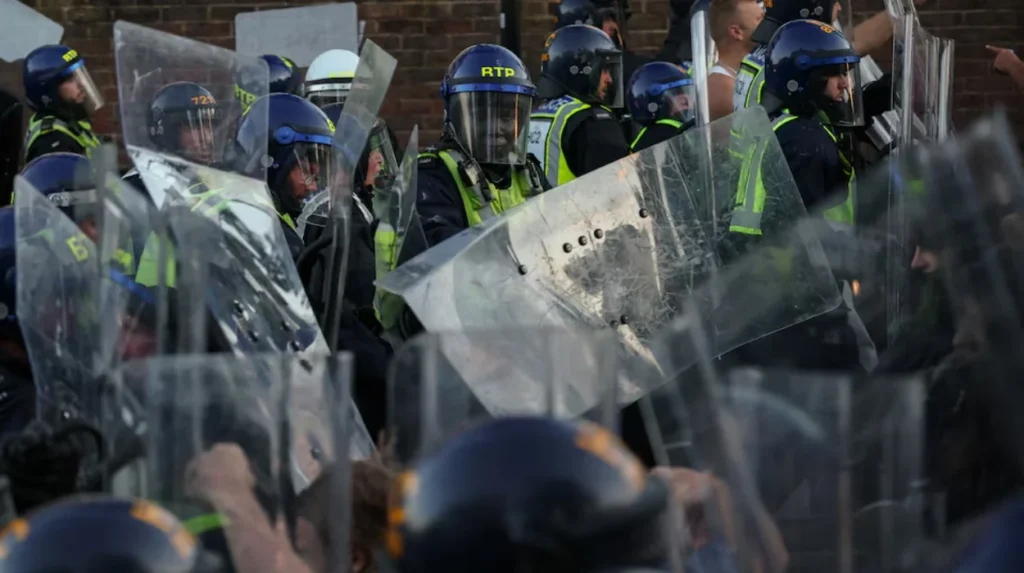
The sentencing of Vickrum Digwa sparked protests in Southampton. Clashes between demonstrators and police left eleven officers and one police dog injured. Two arrestees were taken into custody during the rioting. Chants targeting Prime Minister Keir Starmer filled the air as protesters also called for police to take a knee for Henry. Yet, this demand was divisive — seen by some as performative, and by others as crucial for showing solidarity.
Social media amplified the divide. Hashtags like #TwoTierPolicing and #JusticeForHenry trended across the UK. Supporters of the “two-tier” narrative shared clips of police training videos and guidance documents. Opponents warned against scapegoating officers and highlighted systemic issues like youth deprivation and knife availability.
International Ripples: What This Means for UK–US Relations
The Trump administration’s intervention is a rare instance of direct U.S. criticism of British domestic policy. Though the UK and US have strong diplomatic ties, public rebukes on policing are unusual. This specific critique seems to reflect a broader ideological alignment between Trump’s conservative agenda and right-leaning voices in the UK, say analysts.
Dr. James Milton, a foreign policy expert at Chatham House, observed:
“This isn’t just about policing. It’s about a transatlantic conservative movement pushing back against what it sees as progressive overreach in Western institutions.”
He added:
“The UK government must navigate this carefully. Rejecting U.S. criticism outright could strain relations. Accepting it could validate claims that UK policing is broken.”
What Comes Next: Inquiries, Reforms, and National Debate
The path ahead is unclear. The IOPC investigation is ongoing with no set end date. Labour plans to review police guidance, but the specifics aren’t clear yet. At the same time, Reform UK and the Conservatives want quick legislative changes. The family of Henry Nowak is demanding a public inquiry.
This case has revealed major rifts in British society. Issues of race, justice, safety, and identity are now at the heart of national discussions. As Nigel Farage put it:
“This isn’t just about one boy. It’s about the kind of country we’re becoming.”
And as Henry’s mother reminded the nation:
“This is about one boy. Our boy. Don’t forget him in the noise.”