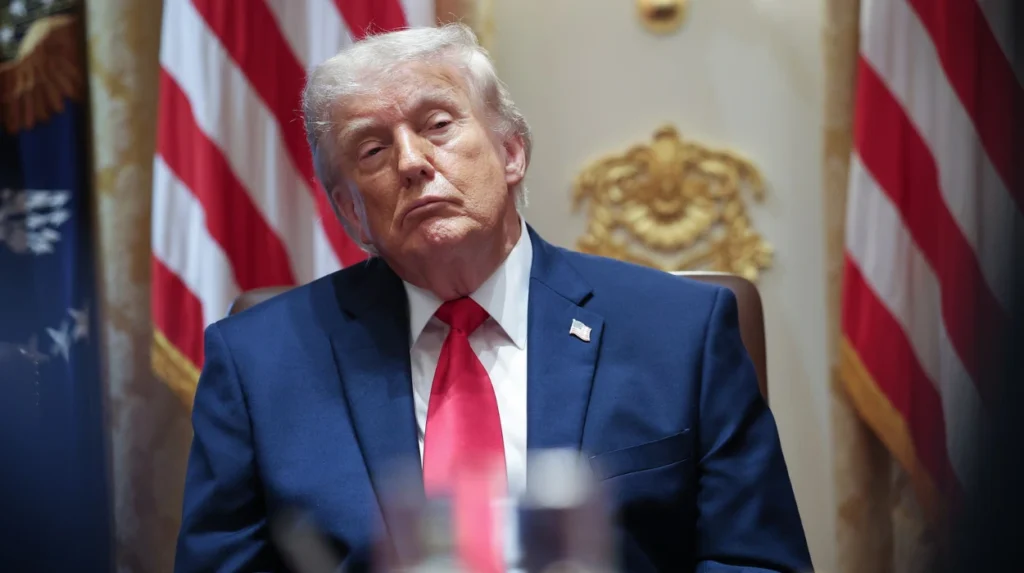
President Donald Trump has upped the ante on trade relations by threatening to put in place a 12.5% tariff against Australian products that are manufactured through slave labor. The news has been delivered amid a more comprehensive effort to clamp down on slave labor globally, and it has created quite a stir in the halls of Canberra’s trade community.
This proposal, which according to reports came from the U.S. Trade Representative, aims at the 60 economies including Australia for allegedly taking “inadequate action against forced labor.” It is quite apparent that there has been a drastic change in the relations between U.S. and Australia concerning trade.
Australia’s Trade Minister Don Farrell swiftly responded, asserting that the nation maintains
“robust, comprehensive and world-leading legislation addressing forced labour and modern slavery.”
The minister’s statement underscores Canberra’s position that the tariff threat is not only unfounded but risks damaging a vital strategic partnership.
The Core of the Allegation: Forced Labor and Trade Policy
How the U.S. Justifies the Tariff
The tariff proposal put forth by the Trump administration is largely based on Section 301 of the Trade Act of 1974, which is typically employed for investigating any instances of unfair trade. Under this act, the government of the United States may impose tariffs when it finds that actions taken by another country have negatively impacted U.S. citizens.
In this instance, the government alleges that some exported goods from Australia are potentially associated with supply chains where forced labor is used. No product or company has been publicly identified in official sources yet, but the government notes that the imposition of such tariffs will affect a wide array of manufacturing products due to their complicated global supply chain networks.
“You don’t compete with slave labor, you crush it.”
— Donald Trump, President of the United States
The above statement, which came up while making a speech on trade policies recently, sums up the position of the administration. It is a representation of an emerging ideology that advocates the use of trade policies to promote human rights regardless of political consequences.
Australia’s Counterargument: Compliance and Cooperation
Australia firmly denied those allegations by stating its tough stance towards modern slavery in terms of law enforcement. It enacted the Modern Slavery Act 2018 that compels businesses to disclose any modern slavery risk in their business operations and chains. The Australian government insists that such an act is superior to international laws regarding the elimination of forced labor.
“Australia has no tolerance for modern slavery, and we are leading global efforts to combat it through transparent, accountable, and enforceable laws.”
— Don Farrell, Australian Trade Minister
This statement was made in Canberra at a press conference, where Farrell also emphasized “the need for dialogue rather than punitive action.” He noted that Australia is a reliable partner in maintaining security and stability in the region, and any threat to introduce tariffs is contrary to decades of partnership-building work.
Historical Context: Tariffs and Trade Wars Under Trump
The “Liberation Day” Precedent
This is not the first time that Trump has applied such tariffs against Australia. In April 2025, when he delivered a speech during the “Liberation Day,” the President enacted a 10 percent tariff against all imported goods while increasing the rates to 60 countries, which included Australia. The tariffs enacted in 2025 were significant milestones in the trade relationship between the United States and Australia, reflecting a trend towards a more transactional approach towards their relationships with their allies.
At the time, Prime Minister Anthony Albanese acknowledged the deal but cautioned,
“no one has got a better deal”
but added
“that doesn’t mean it’s a good thing.”
From Steel to Slave Labor: Evolving Tariff Justifications
Initially, the justification for the imposition of duties in the early parts of Trump’s presidency was mainly related to national security, especially in relation to products like steel and aluminum. The exemption application made by Australia was rejected, with the suggestion that Australia should shift its production process to the United States if it wanted to qualify. The latest justification is about human rights violations. This change is part of a wider tactic of employing moral justification as a basis for implementing protectionism.
Economic Implications for Australia
Impact on Exports and Key Industries
Australia exported goods worth around $65 billion to the United States in 2024, which include medical appliances, machines, optical apparatuses, and food products. Imposing a tax of 12.5% will greatly diminish their competitive advantage in the U.S. market since most small and medium businesses have narrow profit margins.
Industries most at risk include:
- Medical and scientific equipment
- Precision machinery
- Automotive parts
- Processed food and beverages
Economists warn that such tariffs could lead to job losses in export-dependent sectors and force companies to relocate production or seek alternative markets.
“A tariff of this magnitude would not only hurt Australian exporters but also disrupt supply chains that U.S. businesses rely on.”
— Dr. Helen Simmons, Senior Trade Economist, Australian National University
Potential for Retaliation
While Australia has historically avoided direct retaliation against U.S. tariffs due to strategic alliance considerations, some analysts suggest Canberra may consider targeted measures. These could include:
- Reviewing U.S. investment in critical sectors
- Adjusting procurement preferences in government contracts
- Strengthening trade ties with alternative partners like India or ASEAN nations
However, any retaliation would likely be measured, given the broader security relationship under the AUKUS pact.
Diplomatic Fallout and Strategic Concerns
Strain on the U.S.-Australia Alliance
The tariff threat has reignited concerns about the fragility of the U.S.-Australia alliance. While both nations share intelligence, military cooperation, and democratic values, trade disputes have increasingly tested the partnership.
“We are allies, but allies should not be treated as adversaries in trade.”
— Julie Bishop, Former Australian Foreign Minister
Bishop’s comment reflects a growing sentiment among Australian policymakers that economic coercion undermines strategic trust. The AUKUS security pact, signed in 2021, was meant to deepen cooperation, but trade tensions risk creating friction in other areas.
Global Reaction and Precedent Setting
The world is watching with keen interest. In case of implementation of the 12.5% levy, the precedent will be established that other nations can face a similar situation if labor issues arise. It should also be noted that European Union, Canada and Japan have come under scrutiny in the past regarding their labor practices.
“Without transparent standards, tariff policies risk becoming tools of political leverage rather than genuine human rights enforcement.”
— Peter Mistress, Trade Policy Analyst, Lowy Institute
This concern is particularly relevant in the Indo-Pacific region, where Australia plays a central role in balancing China’s economic influence. A tariff war with Washington could weaken Australia’s strategic positioning.
U.S. Public Comment Period and Final Decision
The above tariff proposal is currently undergoing the public commentary period. This will be followed by a decision from the United States Trade Representative after considering the comments submitted by various industry stakeholders, non-governmental organizations, and the concerned governments. This might take several weeks to months to conclude. It is anticipated that Australia will formally protest, as they have done nothing wrong. The future decision rests upon political grounds.
Possible Scenarios
- Tariff Implemented: Full 12.5% duty on specified Australian goods.
- Partial Exemption: Certain sectors or products exempted based on compliance evidence.
- Negotiated Settlement: Bilateral agreement to strengthen labor monitoring and avoid tariffs.
- Legal Challenge: Australia disputes the measure at the WTO or through domestic U.S. courts.
A Test of Principle, Power, and Partnership
The proposed 12.5% levy on Australia will be not just an issue of international trade policy, but also a question about the ability of the United States to manage the balance between its human rights policy and its alliances. For Australia, it will not just be an attempt to protect its global reputation, but also its own national economic interests. While both countries go through this storm, their resolution will affect not only trade relations between the two countries, but also trade globally.
In the words of Trade Minister Farrell:
“We stand ready to work with our partners to ensure fair trade, but not at the cost of our sovereignty or our values.”