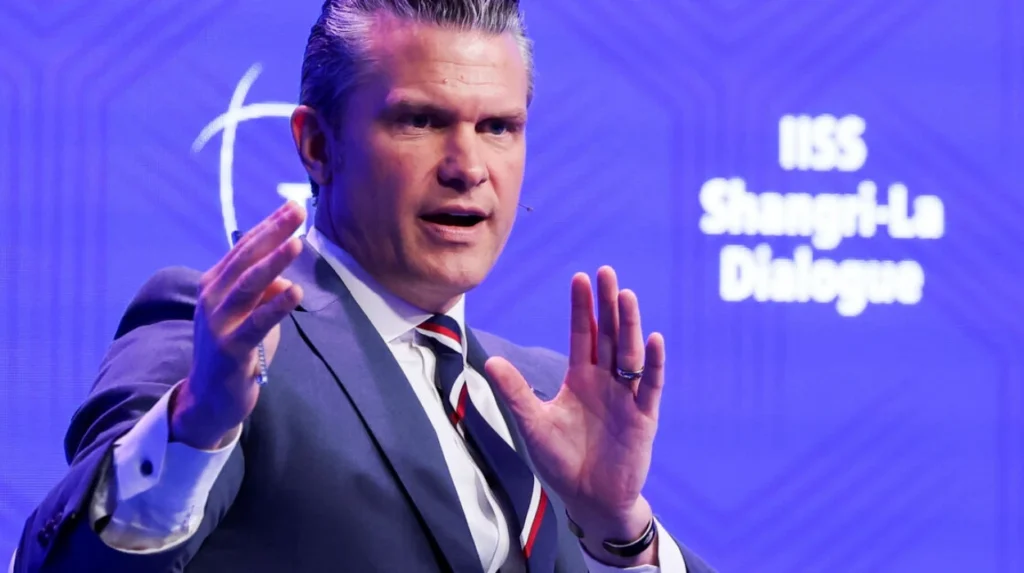
Secretary of Defense Pete Hegseth made an alarming announcement to the global community on Saturday, May 30, 2026, stating that the U.S. is ready to launch another military attack against Iran if no deal is reached through diplomatic talks. In his speech at the highly anticipated Shangri-La Dialogue defense conference in Singapore, Hegseth explained the two-pronged strategy adopted by the U.S., including diplomatic talks as well as military readiness. The move comes amid efforts by delegates from both Washington and Tehran to resolve significant differences hindering a deal to end the current military confrontation that started in March 2026.
The time factor for making such a statement by Hegseth is very relevant at this point since the international community is currently watching how the negotiation process goes after all attempts to solve the issue through military means have ended in failure. The representatives of both countries were involved in talks which took place before the talks that failed in Washington.
Military Capability and Readiness Confirmed by Pentagon Chief
Hegseth left no ambiguity regarding American military preparedness when he emphasized the nation’s readiness to escalate operations.
“Our ability to recommence if necessary…we are more than capable,”
Hegseth stated with unmistakable clarity, confirming that U.S. forces remain fully configured for immediate action. The defense secretary elaborated on the logistical foundation supporting this readiness, noting that
“Our stockpiles are more than suited for that, both there and around the globe, so we’re in a very good place.”
This assessment of military readiness extends beyond mere rhetoric, as Hegseth reinforced the Pentagon’s position by stating,
“Our capability to restart if needed…we are more than equipped.”
The remarks by the defense secretary show that American troops are still capable of embarking on combat operations literally at the drop of a hat, meaning that the military option is never out of the question.
Such capabilities are facilitated by the infrastructure of domestic and foreign-based stores which have been strategically positioned to allow for quick mobilization. The strategic positioning of such facilities globally is quite an accomplishment, especially in light of the administration’s determination to exert maximum pressure on Tehran via military and diplomatic channels.
Primary Diplomatic Effort Remains the Administration’s Focus
Even amid the thunderous cautions about military capacity, Hegseth carefully ensured that the diplomatic route was presented as the one favored by the US government. He noted that the effort to make a deal through diplomacy was considered the “primary effort,” and the US would like this diplomatic process “accomplished, if at all possible.” This means that although force is still available, the administration clearly prefers a diplomatic solution.
This approach is complicated due to the nature of the problem in which the administration tries to show its power while at the same time remaining open to any diplomatic initiatives. In the statements made by Hegseth, one can see that the military action against Iran is carried out as an attempt to compel the adversary to make a deal.
The Fallback Position: Escalation If Diplomacy Fails
As per the contingency plan outlined by Hegseth, in case diplomacy fails, “the military operation will continue with even more intensity.” There is a definite increase in the rhetoric here, as it clearly implies that the next series of military operations would be much more brutal and powerful as compared to the previous attacks.
In light of the above, there is a definite advantage in putting forth such a strong warning message, which serves as a very effective incentive for the Iranian negotiators to take up the US offers on board.
Operation Epic Fury: Context of Ongoing Military Campaign
Presently, the imminent danger of renewed strikes takes place against the background of a larger picture which involves Operation Epic Fury – an offensive initiated by the U.S. in March 2026. This particular offensive was initiated on the heels of surprise weekend strikes that resulted in hundreds of deaths and the likelihood of multinational warfare in the Middle Eastern arena. These early strikes took everyone by surprise since the rationale and objectives behind U.S. military aggression were not clear-cut until Secretary Hegseth clarified the situation.
There are four main objectives of Operation Epic Fury, which have remained relevant to American military operations since then. Firstly, the US wants to dismantle the offensive capabilities of Iranian missiles that can target American troops or their allies. Secondly, America plans to bomb Iranian sites used to manufacture such missiles so as to deny Iran any means of replacing its stockpile. Thirdly, there is an effort to neutralize Iran’s naval fleet and security infrastructure that could be used to support any aggressive operations in the region. Lastly, the operation aims at preventing Iran from getting nuclear weapons.
Trump Controls Pace While Hegseth Executes Military Strategy
The chain of command regarding the Iran conflict remains clearly defined, with President Donald Trump retaining ultimate authority over military operations. Hegseth acknowledged this reality when he stated that
“Donald Trump controls the pace of the war,”
while simultaneously noting that Israel has its own objectives that may not always align perfectly with American strategic preferences.
The allocation of responsibility is based on the true situation in Middle East geopolitics, as American allies act according to their own interests, while at the same time cooperating with America. The involvement of Israel’s objectives in relation to those of the United States creates an additional level of complication for the operations.
No Timeframe Established for Conflict Resolution
One of the most significant aspects of Hegseth’s messaging involves the absence of any predetermined endpoint for the conflict. The defense secretary explicitly stated that there is “no established timeframe” for ending operations against Iran, indicating that the United States remains prepared for a potentially prolonged military engagement.
This open-ended commitment serves as a reminder to Iranian leaders and others watching from around the world that the U.S. is firmly committed regardless of how long the talks take or how protracted the military operations are. The lack of a sunset provision for the operations means that the U.S. will not run out of patience during the process.
Contradictory Assessments Reveal Internal Policy Tensions
Although there appears to be a single voice coming from the government, certain contradictions have been brought to light with regard to the efficacy of the military attack. On one hand, Donald Trump had declared in the past that a previous attack on Iran had “obliterated” their ability to produce any nuclear weapons. However, Hegseth went on to concede that there was a very real chance that Iran could end up with a nuclear weapon in the future.
This conflict between these statements could be a result of the conflicting perceptions within the intelligence organization or simply a changing scenario based on the acquisition of new data. Whatever the reason for this disparity, it certainly underscores the difficulty of sustaining an identical line of communication in military and intelligence operations.
Strategic Communications Designed to Maximize Pressure
The strategic approach to communication used by Hegseth is an example of advanced knowledge on how to generate as much pressure as possible through appropriate messaging. Through highlighting both diplomacy and military strength, the defense secretary is able to generate maximum confusion in Iran’s political leadership regarding American intentions.
The defense secretary’s March 2026 statement suggesting that Thursday would be
“the largest strike package yet… death and destruction from above”
exemplifies the intimidating rhetoric employed throughout the campaign. This language, while controversial, serves specific strategic purposes in signaling resolve and demonstrating American willingness to use overwhelming force.
Regional and Global Implications of Potential Escalation
The possibility of further strikes and their intensification brings several consequences that go beyond the immediate conflict between the US and Iran. The countries in the region such as Israel, Saudi Arabia, and others in the Gulf States may face insecurity in their surroundings as the conflict persists without any resolution. With each step taken by the countries in the conflict, the possibility of entering a multi-country war becomes greater.
The world markets will still be affected in case of the interruption of supply of oil from the region due to military conflicts. The effects of the conflict on the world economy can be enormous.
Orwellian Labeling and the Evolution of Pentagon Terminology
Notably, Hegseth now holds the title of “Secretary of War” rather than “Secretary of Defense,” reflecting the Trump administration’s deliberate shift in terminology that emphasizes the reality of ongoing combat operations. This linguistic change, appearing in official Pentagon transcripts and communications, signals a fundamental reorientation of the department’s mission and priorities under current leadership.
The rebranding represents more than semantic adjustment, indicating a philosophical shift toward more aggressive military posture and recognition that the United States is engaged in active warfare rather than defensive operations. This terminology change aligns with the administration’s broader approach to foreign policy and military engagement.