Brazilian crude is increasingly emerging as one of the surprising winners of the ongoing Iran war, where the unrest is leading to disruptions in the global supply of oil, driving prices higher, and forcing consumers to source their oil from other places beyond the Middle East region. While the benefits for Brazil are genuine and uneven, there is a significant chance that the Brazilian exporters and producers will profit, whereas consumers within Brazil will have to bear the brunt of high fuel costs once again.
It is quite apparent why Brazil is gaining traction because, first of all, Brazil is situated out of the zone of active conflict and hence offers crude oil supplies without as much geopolitical risks as one sees from the Persian Gulf area. In the current situation, where shipping and logistics are taking into consideration the risks involved with Iranian oil supplies, there has been increased interest in purchasing barrels from Brazil among buyers in Asia, including China.
Why the market is turning to Brazil
Indeed, not only prices but also the consumer behavior has changed due to the war. Whenever it seems that there are some problems related to the stability of the Middle East oil supply, importers will try to find alternative sources to guarantee the continuity of their refineries operations and safety of their transportation lanes. And Brazil has been enjoying this trend for its oil export operations, especially to China.
This is important as it has made Brazil a relevant factor in the international seaborne crude oil trade. Every time that there is an extra risk premium for Brent and other global benchmark oil prices, it is going to be a positive development for Brazilian producers as it means more revenue from oil sales and higher cash flow levels.
There is also a strategic element. Large consumers want dependable suppliers during periods of crisis, and Brazil’s distance from the conflict zone works in its favor. It is not only selling oil; it is selling security of supply. That can be especially valuable when the market is trying to reduce dependence on any route that could be affected by war-related escalation.
Petrobras and producers stand to gain
Petrobras, the state-owned oil giant and the leading producer in Brazil, has emerged as the greatest beneficiary. An increase in the price of crude typically boosts the performance of Petrobras’s upstream business segment, improves free cash flow, and facilitates increased dividends and other forms of payout to shareholders. According to industry experts, each $10 rise in Brent may result in an additional free cash flow of about $4-$5 billion to Petrobras. This is no small amount considering the size of Petrobras, which explains investor interest in the situation.
Market commentary on the matter has been even more optimistic in some instances. According to one forecast, if prices stay around $100 per barrel for Brent crude in 2026, then Petrobras may be able to produce roughly $28.5 billion worth of free cash flows while offering shareholders around 25% returns. While these forecasts certainly cannot be taken as certainties, they illustrate the extent to which Petrobras’ financial prospects may brighten under higher international prices.
Other firms based in Brazil can also capitalize on the war. PRIO is an example of an independent company whose stock should appreciate due to the ongoing events. It should be mentioned that for companies like PRIO, the war is not only a macro factor affecting their earnings but an actual earnings driver. With increased realized prices, it will be possible to increase margins, improve balance sheets, and boost sentiment among investors.
Export data shows the shift
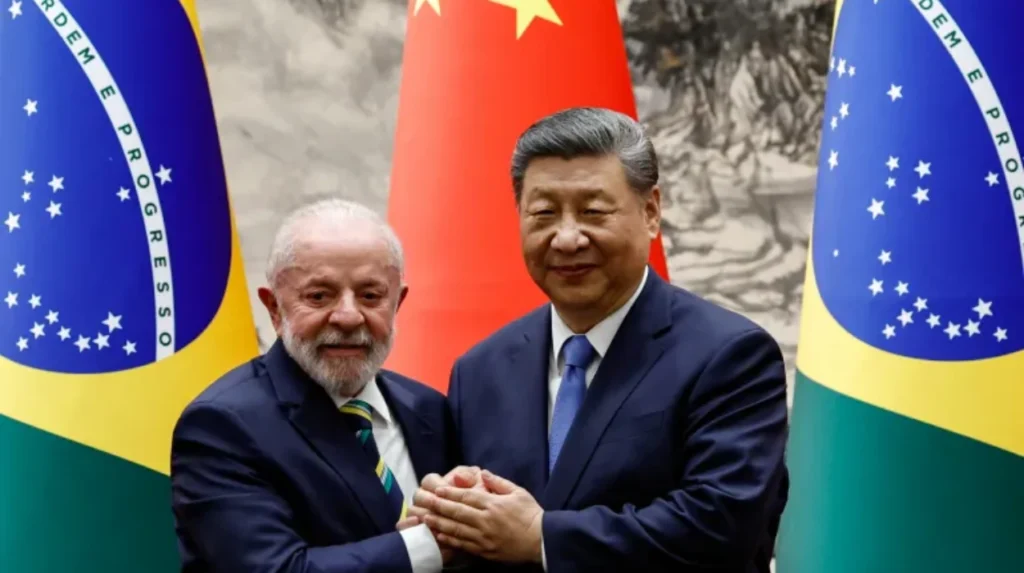
The best proof of how Brazil is currently benefiting from this is reflected in the country’s trade statistics. It has been reported recently that crude exports to China by Brazil have seen an immense surge in terms of volume as well as the total value. According to reports, in the first quarter of 2026, Brazilian crude exports to China were worth $7.2 billion, which is a massive 94.6% increase compared to last year.
The significance of this lies in the fact that the impact of the link between the war between Brazil and Iran and trade can now be observed through the market itself. China being the largest consumer of oil needs to secure its oil imports from safe sources and is seeing Brazil as one of its beneficiaries in this process.
There is also a broader significance here. Higher exports to China reinforce Brazil’s role as a strategic supplier to Asia, not just a price taker in global markets. That can shape future investment decisions, shipping patterns, and upstream expansion plans. If the trend persists, the war may accelerate Brazil’s transformation into an even more important energy exporter.
Brazil’s domestic fuel picture is mixed
Brazil has more complex issues at home compared to the exports growth. Although higher prices have been beneficial to Brazilian oil companies, consumers experience quite the opposite in terms of the impact on them. Global increases in crude oil prices could lead to increased fuel prices, transportation prices, and even inflation. It is here that the notion of being a winner comes into question.
According to AP reporting, Brazil appears quite prepared for the rising oil prices due to its ethanol blend system and biofuels industry altogether. AP reports that Brazil experienced an increase of merely 5% in gasoline prices in March, as compared to the US’s 30% increase. Moreover, according to AP, gas produced by Petrobras was roughly 46% cheaper than foreign products.
Still, insulation is not immunity. Diesel prices and other fuel costs can rise, and those increases ripple through freight, food distribution, and broader consumer prices. That can make life harder for households even in a country that exports oil. Brazil’s policy framework softens the blow, but it does not remove it.
Statement from the industry
The oil industry itself has framed the conflict as a powerful opportunity. In one widely circulated statement, Shell’s chief executive said the U.S.-Israeli conflict with Iran presents Brazil with an “enormous opportunity” to attract investment into oil assets, according to recent reporting. That kind of language reflects how seriously the industry views the shift in global energy flows.
The point is not simply that oil prices are higher. It is that capital is now likely to follow the new geography of risk. Investors tend to favor jurisdictions where production can continue even as other regions face disruption. Brazil’s offshore sector, large reserves, and export capability make it an obvious candidate for that capital.
At the same time, industry optimism should be read with caution. A war-driven price rally can reverse quickly if diplomacy reduces tensions or if global demand weakens. Producers know that a windfall today may not last forever. That is why many firms are likely to use the current moment to strengthen balance sheets and lock in gains rather than assume that the boom will continue indefinitely.
A two-sided economic impact
The key to understanding Brazil’s position is recognizing that the country is both a commodity exporter and a fuel-consuming economy. That dual identity creates a two-sided impact. On one side are oil companies, export earnings, and government revenue. On the other side are inflation, transport costs, and consumers whose budgets are squeezed by more expensive energy.
This is why analysts describe the situation as a partial win, not a clean one. Brazil can benefit from the price shock while still facing macroeconomic pressure. If oil stays elevated for long enough, the government may collect more revenue from the energy sector, but the central bank may also have to remain cautious about inflation. In that sense, the war can improve one part of the national ledger while worsening another.
This also explains why Brazil’s policy mix matters so much. The country’s biofuels infrastructure, domestic refining system, and relatively diversified energy base help it manage the shock better than many others. But those advantages do not eliminate the trade-off. Higher crude prices still feed into the economy, even if they do so more slowly than in countries with weaker buffers.
What this means for investors
For investors, Brazilian oil looks attractive in a period of elevated geopolitical risk. Petrobras and other producers gain leverage from every increase in Brent, and export demand from China adds another layer of support. If the conflict continues to disrupt Middle East flows, Brazil’s energy sector could keep outperforming broader markets.
But there are clear risks. A sharp diplomatic breakthrough could reduce the war premium quickly. A global slowdown could weaken oil demand. Domestic policy decisions could also affect the pace at which companies convert higher prices into shareholder value. So while the immediate direction favors Brazilian oil, the path ahead is not linear.
Investors should also distinguish between the sector and the country. Oil stocks can rise even if the broader economy feels strain. That distinction is essential. Brazil’s oil industry may be the winner, but the economy as a whole is experiencing a more complicated mix of upside and downside.
The bigger geopolitical picture
The war’s effect on Brazil also reflects a broader shift in the global energy order. As conflict in the Middle East reshapes trade flows, countries outside the region gain new relevance. Brazil, long viewed as a major agricultural power and emerging industrial economy, is now reinforcing its position as a major energy exporter as well.
That matters because supply diversification is becoming a strategic priority for many major buyers. China’s increased purchases from Brazil show how rapidly that logic can reshape trade. If the pattern continues, Brazil could emerge from the conflict not just with higher export revenues, but with deeper and more durable commercial ties in Asia.
In that sense, the war may produce a structural effect rather than a temporary one. Short-term price spikes are important, but the bigger prize for Brazil is long-term market share. If buyers start treating Brazilian crude as a core diversification source, the country’s oil sector could retain benefits even after the conflict eases.
Brazilian oil, then, is not simply riding a temporary wave. It is being pulled into a new strategic role by a war that has made supply security more valuable. The country’s producers and exporters are in a stronger position than they were before the crisis, but the domestic economy remains exposed to inflation and fuel-price pressure. That makes Brazil one of the war’s clearest beneficiaries — and also a reminder that commodity booms rarely come without costs.