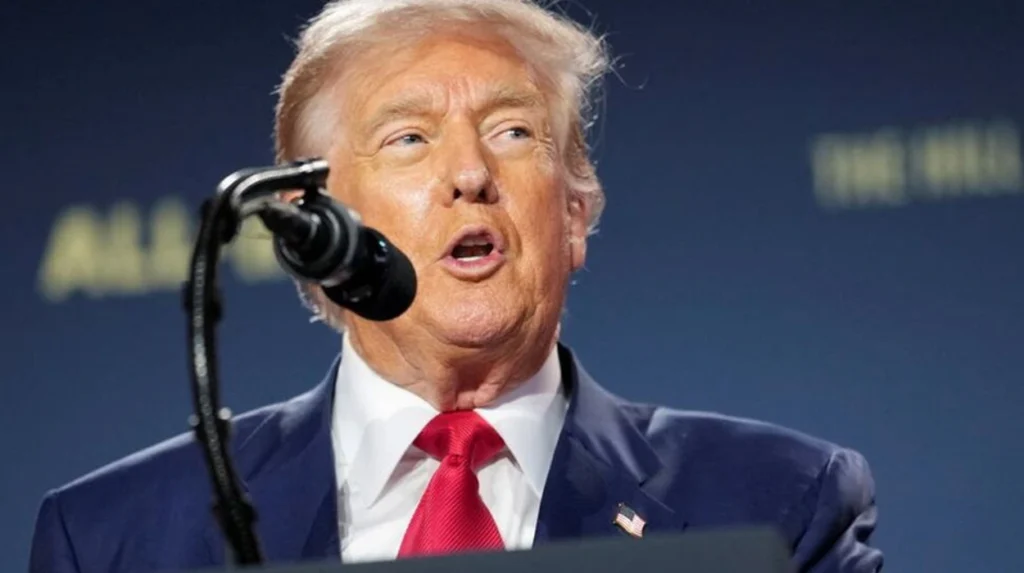
US President Donald Trump has resurrected one of the most politically sensitive foreign policy concepts in the Middle East by proposing an extension of the Abraham Accords that could eventually culminate in a deal with Iran. Speaking on Monday, Trump said that nations such as Qatar, Pakistan, Egypt, Jordan and Turkey need to join the Abraham Accords “en masse.” What is particularly interesting about the statement is both the list of countries mentioned and the approach used – normalizing relations with Israel as a bargaining chip in discussions with Iran.
Trump’s narrative implies something more than a straightforward two-party agreement. Rather, it seems that he is attempting to construct a plan in which Arab and Muslim countries will normalize their relations with Israel simultaneously with an effort by Washington to break new diplomatic ground with Tehran. He wants the Abraham Accords to be used not only as a means of putting pressure but also as a system of incentives.
What Trump is signaling
These remarks highlight one of the recurring traits of Trump’s approach to foreign policy: grand diplomacy based on transactional agreements instead of gradual developments. Based on the news reports, he suggested that it would be required for some other countries to be involved in the treaties if there was any chance of a deal being reached with Iran. The importance of such wording lies in the transformation of a voluntary process into a political prerequisite.
One of the clearest messages from the above quotes is Trump’s conviction that
“the Middle East could be reorganized by way of high-level deal-making.”
This president is not trying to introduce the Abraham Accords as an independent peace process. Instead, he is embedding them within the framework of Iran’s diplomacy, and thus, this issue becomes much larger because it involves not only Israeli-Arab relations but also regional security and American influence on the balance of power in the Gulf.
As one report summarized his view, Trump said the effort could become “the most important Deal” in the region’s history, a phrase that captures both his rhetorical style and the scale of the project he is describing. That line shows he is not talking about a limited diplomatic adjustment. He is claiming to envision a new regional order.
Why these countries matter
The inclusion of these nations in the above list is no accident since each country holds a unique place within the regional politics and maintains its own relationships with the other three: Israel, the US, and Iran. The inclusion of all of these nations under one Abraham Accords would not be merely the expansion of an existing treaty; it would completely change its meaning.
Qatar, in particular, poses a delicate situation since it has simultaneously occupied a number of different places at once – being connected with various entities in the region, serving as a mediator in many cases, and holding great importance for American foreign relations. Then there is Pakistan, which has a different character altogether due to its size and sensitivity to the Palestinian cause. Even though Egypt and Jordan have normalized relations with Israel, their public stance is still influenced by the Palestinian issue and regional Arab sentiments. On the other hand, Turkey has had a long history of conflictual yet strategic ties with Israel.
This makes the use of the phrase “en masse” by Trump politically significant. This implies a political shift as opposed to selective normalization. From a policy perspective, this means that it requires a greater diplomatic effort than what was required for the Abraham Accords, which involved just a few countries. As it was, the initial agreements were controversial. Getting others with greater constraints to sign up will prove significantly difficult.
The Abraham Accords in context
The Abraham Accords were initially hailed as a groundbreaking moment in Middle Eastern politics, whereby Israel established diplomatic relations with the United Arab Emirates and Bahrain, followed by others including Morocco and Sudan. Proponents saw it as an indication that Arab-Israeli rapprochement was possible without a final Israeli-Palestinian agreement. Others viewed the deals as avoiding the Palestinian question and rewarding rapprochement without addressing the basic problem.
The emphasis on the Abraham Accords indicates Trump’s perception of them as part of his diplomatic successes during his time in office. This is relevant from a political perspective in that it makes sense why he would link the Abraham Accords to his present negotiations on Iran. He does not want to negotiate a new deal; rather, he wants to build upon the success of a previous one.
The new element is the linkage to Iran. In Trump’s telling, the accords are not merely about peace between Israel and Arab states. They are about creating a regional bloc that can help isolate Iran diplomatically and strategically. That makes the initiative as much about containment as reconciliation.
Iran angle deepens the stakes
What makes Trump’s statement important is his framing of the role that Iran should have in the process of normalization. He is not talking about a separate process of normalization in regards to Iran, but rather about how the agreement that can be achieved with Tehran might serve as an impetus for Arab-Israeli normalization. This approach is strategic since it poses the question regarding whether normalization serves as a means or an end.
According to reports, Trump was confident about the process of negotiations with Iran going well, while at the same time pressuring the country to expand the Abraham Accords across other Arab countries in the region. The two approaches may prove to be beneficial to achieve a certain political context, where Iran faces not only pressure from the United States but also unity within the region.
Another logic behind Trump’s policy toward Iran could have remained hidden. By connecting Iran to the Abraham Accords, Trump might aim to get “two birds with one stone.” It may become easier for Trump to justify any agreement with Iran if this agreement will be linked to some tangible normalization in the region. On the other hand, Arab countries may become more willing to participate if they see that there is something happening between Washington and Tehran.
Reactions and political limits
Now, however, the emphasis seems to be on the initiative more than on any diplomatic success story. There does not appear to be any evidence at this point that all of these countries are going to join in. That is quite important because the gap between rhetoric and a genuine change in foreign policy cannot be understated.
On one hand, for those who are named here, the question is not necessarily that of whether they could back the idea of normalization in theory, but rather of whether they could afford it considering domestic politics, regional competition, and their current foreign policy. For some other states, the question is even harder because of their lack of official relations with Israel.
The reporting also suggests that Trump has been discussing the idea with regional leaders, including Saudi Arabia, the UAE, Qatar, Pakistan, Turkey, Egypt, Jordan and Bahrain. That detail is important because it implies the idea is being floated in a wider diplomatic setting, not merely as a campaign-style statement. Still, nothing in the available reporting shows that these governments have accepted the premise. For now, the proposal remains an American initiative rather than a multilateral consensus.
What the proposal would change
Had Trump been able to get some part of his agenda implemented, there would be serious implications for the region as well. The idea of the Abraham Accords would become much bigger than just a few individual deals and turn into a much more complex diplomatic scheme that would involve major Muslim or Arab states. In that way, the strategic equation in the region might change to the advantage of Israel.
On the other hand, the implementation of the idea could also lead to even greater problems with countries that consider normalizing relations with Israel too politically sensitive without any further steps related to Palestinian statehood or something like that. This could result in a negative response among those countries whose leaders would be forced into the deal.
Trump’s approach is also revealing because it keeps the spotlight on deal-making rather than process management. He is not emphasizing incremental steps, technical talks or confidence-building measures. He is emphasizing outcomes, leverage and size. That style can create momentum, but it can also create resistance when regional realities do not match the scale of the proposal.
Wider significance
The broader significance of Trump’s remarks is that they reveal how central the Middle East remains to his foreign-policy worldview. Even when discussing Iran, he returns to the Abraham Accords as a strategic centerpiece. That suggests he sees normalization not as a side issue, but as the diplomatic framework through which the region can be reordered.
The reports also show how Israel’s regional integration remains tied to larger questions of security, deterrence and U.S. influence. Trump’s message is effectively that peace, pressure and alliance-building should happen together. Whether that is realistic is another matter. But as a political and diplomatic signal, it is unmistakable.
For now, the key takeaway is that Trump is not merely reviving the Abraham Accords in name. He is attempting to reposition them as a central instrument in a possible Iran deal, while pressing several major regional players into the same diplomatic architecture. That is a bold move, and it will be judged by whether any government is willing to turn rhetoric into signature.