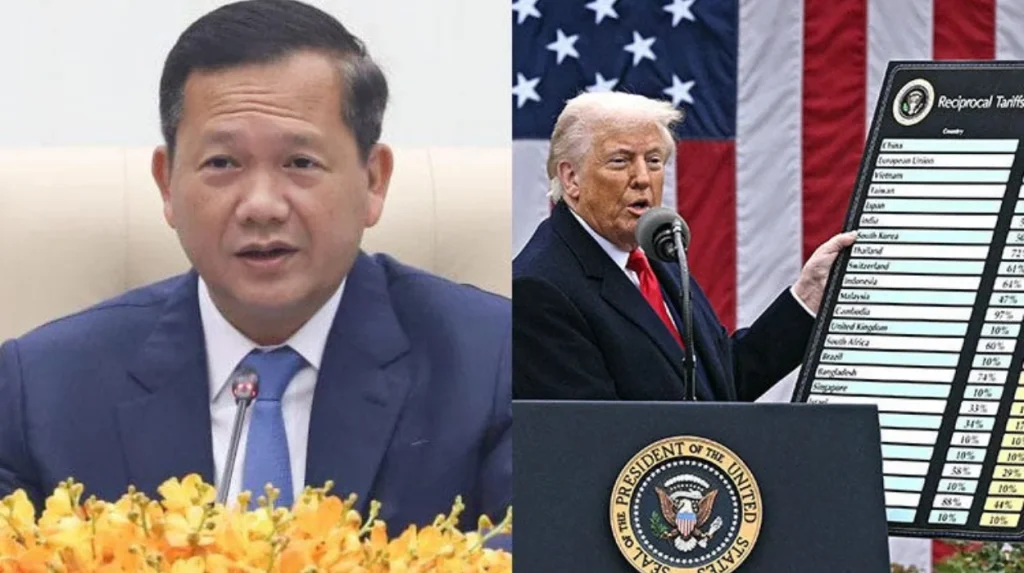
The United States and Cambodia trade relationship was put under great pressure in 2025 when Washington announced retaliatory tariffs on Cambodian exports, in a bid to correct the ongoing trade imbalances. In April, 2025 US imposed reciprocal tariffs of up to 49 per cent on Cambodian products, the main Cambodian export products being garments and footwear. The relocation was one of the components of a bigger American project of implementing fair trade and lowering the level of reliance on overseas production which jeopardized the economic stability and employment in Cambodia.
In the case of Cambodia, the tariffs were an existential threat. The economy of the country is based on the exporting sector, which is dependent on the availability of the US market, which receives close to one-third of its garments. The abrupt increase in the tariff stood a risk of losing jobs in the industrial areas especially to the women employees who supply the manufacturing industry with its workforce. Under these strains, Phnom Penh rapidly resorted to diplomacy, whereby it wanted a way of negotiating to achieve a more sustainable trade agreement that may enable it to maintain the competitiveness of its export.
Negotiating A Strategic Tariff Resolution
Months of negotiations and technical consultations gave way to a breakthrough agreement by the Cambodian and the United States on August 1, 2025. The agreement created a single mutual tariff rate of 19 percent on a broad spectrum of Cambodian exportation in the US market, far less than the original tariff rate of 49 percent suggested by Washington. The compromise was considered a win-win strategy as Cambodia would manage to circumvent a completely blown trade crisis and at the same time it would reiterate its principles of transparent trade practices.
The leadership of Cambodia made the agreement both an economic and diplomatic success. The government emphasized that the new rate kept the major industries viable in exports and minimized the uncertainty of the investors and manufacturers. Simultaneously, Cambodia accepted the tariff-free treatment of 100 US imports and this enhanced commercial relations between the two. This compromise was an indication that Phnom Penh was willing to keep in line with global standards in trade and would also keep enjoying Western markets in the long term.
Addressing Non-Tariff Barriers And Broader Trade Issues
The August 2025 agreement did not just cover tariff adjustments, but it also put into place a pledge to eliminate non-tariff barriers that had limited the US exports in the past. The two approaches involved a mutual agreement of streamlining import licensing, increasing customs transparency, and accepting sanitary and phytosanitary standards of agricultural products. The incorporation of intellectual protection and measures of digital trade was a proactive aspect to the deal.
Cambodia was also seeking technical support to achieve greater standards of export, especially in terms of labor regulations, environmental regulations, and digital provenance. Such a partnership strategy highlighted a shared understanding that sustainable trade would not necessarily require relief of tariffs but regulatory modernization that is of benefit to both economies.
Economic Implications For Cambodia
Cambodia reduced the tariff to 19 percent and this prevented the country from experiencing an economic shock that would have paralyzed the manufacturing base. According to analysts in the Asian Development Outlook 2025 report, Cambodia was estimated to maintain about 85 percent of the export market share to the United States with the new tariff regime that was still limiting its competitiveness with Vietnam and Bangladesh. The concession meant that mass layoffs were avoided as well as investor confidence, given the world trade uncertainty.
Also, the tariffs imposed on US imports will be removed and this will advantage the domestic industries which will be depending on imported machinery, textiles and agricultural inputs. This is a change in favor of the larger goal of Cambodia to diversify its industrial sector and modernize its production capacity into higher value products. It is also an indication of the strategy of Phnom Penh to develop mutual trade relations that may develop long-term growth.
Navigating Geopolitical Trade Dynamics
The Cambodia-US tariff resolution is also another example of the larger geopolitical environment that defines the trade situation in Southeast Asia. As Washington and Beijing remained at the war of wit, the Cambodian adherence to the principle of negotiation, instead of face-to-face confrontation, was an indicator of diplomatic smartness. The agreement has placed Cambodia as the eager stakeholder in the rules-based trade whilst preserving its economic ties with China as a part of the Regional Comprehensive Economic Partnership (RCEP).
This balancing game revealed the ability of Cambodia to maneuver the tricky geopolitical forces. To Washington, the compromise was a chance of gaining economic grip in mainland Southeast Asia without causing any trade confrontation. In the case of Phnom Penh, it had space to stabilize its economy, and maintain sovereignty in decision-making.
Ongoing Challenges And Future Prospects
The breakthrough notwithstanding, the future of Cambodia is still conditioned by the structural reforms. The 2025 agreement has monitoring requirements that are associated with the implementation of labor rights, export information, and adherence to environmental requirements. The US trade officials noted that any future change to the tariffs would be based on how the Cambodians perform on these fronts.
The Ministry of Commerce in Cambodia is already starting consultations with trade organizations to enhance the system of labor inspection and the use of customs digital tracking. There are however challenges within the need to enforce it in the informal sectors and subcontracting chains. Enhancing the institutional capacity is also essential in order to avoid losing trade privileges in case of non-compliance.
Ensuring Long-Term Economic Resilience
The new tariff regime provides a short-term respite but has acute questions on the economic sustainability of Cambodia. Dependence on garment export subjects the country to externalities due to the world demand volatility and change in trade policies. Analysts support the diversification in electronics assembling, in agribusiness and renewable energy production as the ways to maintain the growth in the changing trade conditions.
Moreover, production and logistics digital transformation is necessary with the help of the development partners and personal investment in order to leave Cambodia competitive. The Industrial Development Plan 2025-2030 of the government focuses on updating skills, infrastructure and adoption of technology in the entire export sector so that it remains relevant to the global supply chains.
Broader Diplomatic And Regional Significance
The Cambodia-US tariff resolution is one of the examples of effective diplomacy that prevailed over the economic confrontation. Cambodia avoided a possible trade crisis and turned it into a recalibration opportunity instead by seeking a compromise instead of retaliation. Cooperation of investment, energy transition, and digital trade in both countries are currently shifting the focus in favor of transactional tariffs to strategic engagement.
The accord coincides with the overall foreign policy strategy of Cambodia based on economic diplomacy, according to which it is more appropriate to attend to a variety of partners without relying on a specific power. Maintaining its connection with Washington and Beijing, Phnom Penh remains in its place as a regional buffer as the rivalry between great powers becomes increasingly intense.
Lessons For Developing Economies
To other emerging economies, the case of Cambodia may provide a clue of how to negotiate asymmetric trade relations with leading powers. The case of the 2025 tariff dispute has shown that smaller economies can end up getting good terms with consistency, negotiation, and adherence to international standards of trade. It also points out the increasing need to combine domestic reform agendas and external economic diplomacy.
As Southeast Asia continues to adjust to shifting global supply chains, Cambodia’s case underscores the importance of balancing national interests with adaptive diplomacy. Its success in transforming a near-crisis into a framework for sustainable cooperation reflects how strategic flexibility remains a defining asset for developing economies under external pressure.
The 2025 Cambodia-US tariff settlement represents more than a trade compromise, it encapsulates a broader story of economic survival and diplomatic adaptation. Facing near crippling tariffs, Cambodia’s strategic engagement preserved both market access and policy autonomy, reaffirming that measured diplomacy can protect smaller economies from the volatility of global trade politics. As the region braces for further shifts in tariff regimes and industrial realignments, Cambodia’s careful balancing between reform, resilience, and realism may well define its place in the next chapter of Southeast Asian economic integration.