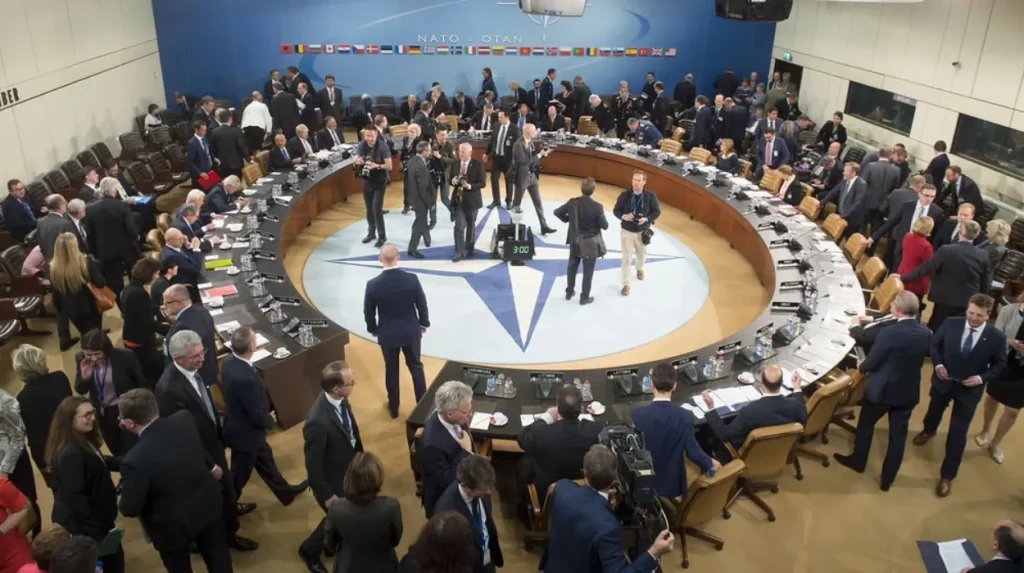
The main security architecture of Europe and North America has long been operated by NATO that was instituted to guarantee a collective defense among western allies in 1949. Its principle underpinning: Article 5, the obligation to collective defense is still preserved. However, the integrity of the alliance is again tested in 2025 with internal wrifts, geopolitical conflicts and shifting strategic priorities.
The subsequent post-Cold War expansions and interventions have transformed the initial NATO defensive scope of operation to a wider security agenda. Nonetheless, as the recent developments especially increased the tension with Russia, this instability in the Middle East and different priorities of the nations show the increasing asymmetry among the member states. The tension between the need to preserve transatlantic unity and respond to emerging threats is growing thinner, casting doubt on the sustainability and unity of NATO.
The Central Role Of The United States In NATO’s Cohesion
The US continues to be the foundation of the NATO military and financial might. It supplies the most number of capabilities of NATO such as nuclear deterrence, logistics, and command infrastructure. Nonetheless, the Washington leadership has changed greatly with some important implication on the stability of the alliances.
Transatlantic Strains Under President Trump’s Second Term
The fact that Donald Trump is coming back to presidency in 2025 has rekindled fears of the US devotion to NATO among European allies. Continuing the theme of the critique of the membership of NATO he gave during his first term in office, Trump has reiterated the burden-sharing point, and hinted at reconsidering the position of the US troops in Europe. His administration halved the amount paid by the US to the joint budget of NATO in 2017, to 16 percent by mid-2025 a sign of a more transactional attitude to the demands of alliances.
The public utterances by influential US officials have fuelled controversy. Secretary of State Marco Rubio has suggested that NATO should raise its minimum defense spending target to 5 percent of GDP in 10 years, which is way above the present 2 percent mark. This suggestion has generated tension especially amongst the smaller economies that cannot even achieve the current target.
Strategic Ambiguity And Article 5
NATO members question the political inconsistency of Article 5 despite its affirmations several times by the Pentagon leadership. Some European capitals have doubted the US to take action militarily in the event of attack on smaller allies especially in Eastern Europe. This doubt undermines deterrence and contributes to the debate on other security structures.
Defense Spending And Internal Alliance Divisions
Differences in the investment by the members of NATO in defense have long been a problem. By 2025, 23 out of the 32 NATO members are at or over the 2 per cent GDP defense spending target. But the attempts to raise this base even higher have aggravated the discord in the alliance.
Economic Constraints And Political Resistance
The post-pandemic recovery pressures and the inflationary pressures are the reasons provided by Southern European nations like Italy, Spain, and Portugal in opposition to increased military budgets. Meanwhile, Eastern European nations, such as Poland, Estonia, and Latvia, claim that the lack of sufficient investment compromises the collective deterrence, particularly in the light of ongoing aggression by Russia towards Ukraine and Moldova.
The debate on defense expenditure is an indication of deeper divisions on the strategy orientation of NATO. Whereas frontline states focus on territorial defense and deterrence, there are those that promote cyber capabilities, counterterrorism and climate related security initiatives. These conflicting priorities make the process of consensus-building and planning difficult.
Geopolitical And Strategic Challenges
The three external threats that are interrelated to developing powers define the strategic environment of NATO; namely, Russian aggression, regional instability, and systemic rivalries. Both demand specific policy action, but how to harmonize them internally is hard to find.
Russia’s Multi-Domain Threat And NATO’s Response
Russia is still posing the greatest threat directly to the eastern face of NATO. In 2025, it continues its military activities in eastern Ukraine as well as hybrid campaigns of cyberattacks, blackmailing of energy and influence operations during the cohesion of NATO. NATO has responded to this by increasing its forward presence in the Baltics and Poland, through multinational battalions and a greater air policing presence.
However, additional membership of NATO to other nations such as Ukraine and Georgia is still divisive among the members. Others are afraid that this would lead to wider conflict with Moscow. Some see it as a tactical requirement to overcome Russian revisionism. Lack of a single position makes it difficult to plan in the long-term.
Turkey And Alliance Complications
The foreign policy course of Turkey is another complex issue. The strategic interests of Ankara in Syria, Libya, and the South Caucasus usually have a tendency of going against the larger NATO interests. The fact that it has remained operational with Russian-made S-400 defense systems and recent military deals with central Asian nations have cast doubt on the issue of interoperability and trust between the alliance.
Although Turkey is an essential part of the alliance because of its geographical location, its policy independence is a burden to discipline in the alliance. Controversies concerning Eastern Mediterranean energy exploration and human rights also make the bilateral relations with other members of NATO more complicated.
Key Stakeholder Perspectives
The external audience, especially the opponents of this process, propagate the idea of the weakening of NATO. In early 2025, Russian Foreign Minister Sergey Lavrov termed NATO a community of divergent interests united by historical inertia that reminded him of the 1990s collapse of the Warsaw pact.
The leadership at NATO disproves such claims. Secretary-General Jens Stoltenberg and his likely successor, Mark Rutte have repeated the collective defense posture of NATO and have focused on strategic adjustment with the 2025 Strategic Concept. They emphasize the continuation of military training, collaborative innovation programs, and cyber collaboration itself as the signs of vitality as opposed to downward trends.
Security analysts opine that NATO is not losing its structural integrity even though its political cohesion is being challenged. The effectiveness of the alliance is becoming reliant on its capacity to align decision making amidst divergent national agendas with the credible deterrence.
Europe’s Defense Autonomy And Future Prospects
The issue of future US dependability has given a new push to the discussion on European strategic independence. Efforts within the loci of the European Union – specifically the European Defence Fund and the Permanent Structured Cooperation (PESCO)- are aimed at broadening domestic strength, interoperability, and industrial collaboration.
Complementary Or Competing Visions
The proponents of European defense autonomy believe that the autonomy will be complementary to NATO in that Europe will be able to act unilaterally in the case of lack of transatlantic consensus. But skeptics warn that overlapping of mandates may weaken the efficiency of NATO and make it redundant. The problem is that it is difficult to balance European ambition and transatlantic interdependence.
Interestingly, Germany and France have been procuring defense equipment together and have organized speedy response forces through the EU. However, the development is rather unbalanced, and smaller states are worried about being outrun or outperformed by more powerful nations.
The 2025 NATO Agenda
In its official agendas, NATO will focus on cyber expansion, use of artificial intelligence in war-planning, and enhancement of critical infrastructure security by 2025. They also focus on energy resilience particularly after gas pipelines and undersea cables associated with the Russian actors have been sabotaged.
Such efforts should help modernize the alliance and bring back internal coherence. The success, however, is determined by the ability to maintain the political will and fair burden-sharing. Fragmentation is likely to increase where the members feel that they are unequally committed or that they do not share similar priorities.
Navigating Uncertainty In NATO’s Future
The debate over whether NATO is on the brink of collapse in 2025 reflects deepening uncertainties within global security. While the alliance retains its institutional framework, its cohesion faces tests from within and without. National interests, economic pressures, and political divergences shape the alliance’s operational unity.
Yet NATO’s adaptability over decades from the Cold War to counterterrorism underscores its resilience. The current period may represent another transformative moment, requiring redefinition rather than dissolution. Whether NATO can harness internal differences as strategic diversity rather than sources of fracture will determine its role in shaping the security architecture of the 21st century. The answer to NATO’s longevity may lie less in treaties and budgets than in the trust and resolve its members continue or fail to share.