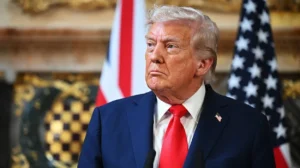
U.S. President Donald Trump forcefully gave a public statement in September 2025 saying that he would not accept any annexation of the occupied West Bank by Israel. Addressing the Oval Office, Trump said,
“I will not allow Israel to annex the West Bank. Nope, I will not allow it. It’s not going to happen.”
This is a blunt and unambiguous way of speaking, a step that is rather unusual between Trump and the Israeli government in light of Trump, who has historically been a strong supporter of Prime Minister Benjamin Netanyahu.
The announcement by Trump followed a series of back-door talks that had been conducted in the course of the United Nations general assembly in New York. The Saudi, United Arab Emirates, Egyptian, Jordanian and Qatari leaders were reported to urge the U.S. president to intervene. Such nations emphasized that annexation would be a source of tension in the region, undermine recent normalization progress, and jeopardize already fragile ceasefires in different areas of conflict in the Middle East.
Trump indicated a shift in the narrative of his Israel policy by crusading against annexation. This stance is in contrast with previous actions taken by his administration including acknowledging Jerusalem as the capital of Israel as well as the Golan Heights as Israeli land all were viewed as big supporting gestures to Israeli sovereignty positions. The West Bank is however another and more explosive matter that has profound repercussions in regard to regional politics.
Netanyahu’s Position And Israeli Political Dynamics
Prime Minister Netanyahu is still in the middle of strong domestic strife. Components of his far-right coalition seek official annexation of substantial West Bank lands, especially those where there are large populations of Israeli settlers. According to these groups, annexation is a sound strategic move to unify the Israeli grip and to avert the increasing global understanding of the Palestinian statehood.
This political situation has been aggravated by the recent acknowledgments of a Palestinian state by some democracies in the West, such as Canada, France, and the United Kingdom. According to the right-wing Israeli legislators, the annexation would reverse these trends and legitimize the long-term security interests of Israel.
Settlement Realities And Legal Contentions
The population of Israeli settlers in the West Bank nowadays is close to 700,000. These communities would be formally annexed thus becoming a part of Israeli civil law something which Palestinians and most of the international community consider to be illegal as per the international law. Opponents claim that such a move would amount to killing off any chance of a two state solution.
Netanyahu has not publicly disqualified annexation although Trump opposed it. Analysts note that one of the reasons why Netanyahu survived in his political career is because he is able to hold his coalition together, whose pro-annexation sentiments have continued to be a political rallying cry.
Regional And International Reactions
In response to the words of Trump, several Arab and Muslim-majority states released their statements in support of the U.S. stand. In response, Saudi Arabia Foreign Minister, Prince Faisal bin Farhan, added that Trump was aware of the escalation dangers and knew that annexation would call to naught decades of diplomatic gains.
The concerted diplomatic pressure by the states of the Arab world to the UNGA also seems to have impacted on Trump in his posture. A number of governments underlined that peace agreements with Israel such as the Abraham Accords were based on the condition that Israel would not make unilateral actions concerning conflict regions.
Global Diplomatic Pushback
In Europe, resistance to annexation is the same. The foreign policy offices of the European Union and Germany, France and Spain once again showed their opposition to any annexation and that this would be in breach of international law and that it would cause instability in the region. In New York, the UN Secretary-General Antonio Guterres said that annexation is intolerable in both moral and legal and political terms.
Even so, there are not enough nations to agree with what is the best action in the event Israel does. There are those who want sanctions, and there are those who advocate a new peace process. Enforcement is not a unified mechanism which makes it difficult to oppose globally.
Skepticism Over Enforcement And Outcome Uncertainty
Though what Trump said was absolute, there are some doubts over the reliability of implementation. His administration has not yet explained the consequences of economic, diplomatic or military ramifications of any Israeli violation of his warning. There is no policy roadmap or redline thresholds that can be used to rule out ambiguity in the future.
According to the political observers, it might be a two-fold purpose of the statement made by Trump to appease the allies of the Arabs and still keep the control over Netanyahu. This transactional character of the Trump foreign policy gives an additional element of uncertainty on whether he would act on what he said as a preventive measure.
Volatility In Israeli Domestic Politics
The government of Netanyahu is still unstable. In case of his coalition breaking up or in case early elections are requested, annexation plans can be postponed or redefined. Nevertheless, in recent years, the ideological alignment of the Knesset has moved to the right, thus the concept of the expansion of the territory is popular among the main political blocks.
The current stance of Trump can be used to decelerate or even stop the action of Israel, but it cannot be used to end the long-term movement toward annexation unless the political structure of Israel itself is altered.
Balancing Geopolitics, Law, And Public Sentiment
The annexation issue is also contributing to a greater geopolitical rivalry. The attempts of the Biden administration to favor the two-state solution are now re-examined by the Trump prism. The opposition of Trump to annexation could be more of a feeling of not reversing than the need to preserve the image of the American dominance in the peace process.
In Israel, there is a growing polarization in popular culture. Some citizens are in support of annexation as an issue of national identity and security, but on the other hand, there are those that consider the move a move that will enhance isolation and international criticism. Palestinians, in their turn, to a large extent view annexation as a legalization of occupation that has been depriving them of land, rights, and sovereignty already.
The action taken by Trump has added a new twist to the regional formula one that may reevaluate the diplomatic balances or cause the discussions on the feasibility of the peace process to resume. Through the response of political actors throughout the spectrum to it over the next few weeks, this is whether it will result in lasting restraint or merely temporary delay.
The Trumpian surprise opposition and the ambitions of Netanyahu, which keep colliding, have put a very critical point on the Middle Eastern geopolitics. The future of the West Bank that has been always considered through the prism of the conflict and compromise is once again in motion. With the regional players in a rebalancing act, the global community is on the lookout, not only to see how much annexation is being done but also to see how much the international obligations on peace, sovereignty, law and order are being respected. It still is yet to be determined whether the red line by Trump would represent a mere rhetorical barrier or the beginning of a real barrier that would influence Israeli-Palestinian relations in the years to come.