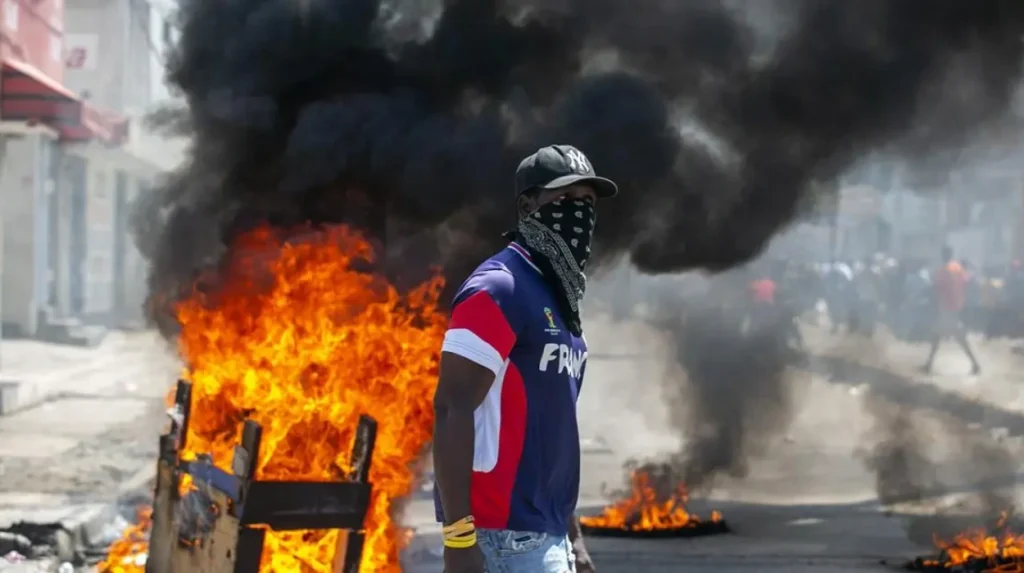
The fate of Haiti, which is worsening day-to-day in security and political situations, has caught the world anew in 2025. As more than 90 percent of Port-au-Prince has been said to be controlled by gangs, with a displaced human population of one million people and with an economy that is either collapsing or standing on its knees, regional security and humanitarian protection has never been at a higher level. Global players, especially, the United States are questioned in regard to an answer that comes off as both tactically incohesive and ethically paradoxical.
As the U.S. is publicly helping Haiti by providing a transitional government with military assistance, it is at the same time imposing tight immigration policies, such as deportation of Haitian migrants and cancellation of Temporary Constitutional Protection (TPS). These deportations continue despite conditions resembling a war zone on the ground. In addition to that, the disclosure of the fact that U.S.-based private military contractors (PMCs) focusing on the legacy network of Erik Prince are operating in Haiti are driving apprehensions connected to the lack of control on foreign security support and possible abuse of human rights.
This two-prong policy; militarized contact on the one hand and enhanced migration policing on the other side causes a gap between humanitarian duty and security-based policy.
Military Support and Questions of Legality
Role of U.S. Private Military Contractors
Reports confirm the deployment of PMCs working under Haitian government contracts to target gang networks in the capital. These operations are said to involve weaponized drones together with tactical ground interventions. Those founders of foreign military services are sternly licensed to export according to U.S. law with a condition on human rights stipulated in National Security Presidential Memorandum-10 (NSPM-10). The lack of open documentations/disclosures of such authorizations casts a shade of legality on such engagements.
Heightened militarization of the internal conflict in Haiti by foreign parties makes it more difficult to exercise control and responsibility. As PMCs are not part of the conventional military structure, there is no fine line between being a helper or an aggressor, and there is a risk of use of unnecessary force, that of the collateral damage, and of the reduction of public trust in the transitional government.
Lack of Oversight and Ethical Concerns
Such trends have set alarm bells within the U.S congress. Some of the senators have asked the question of whether the Biden administration is offering enough security assistance mechanism oversight. The idea of the unintentional U.S. participation in illegal military action that can happen in case of the non-strict adherence of the PMCs to the rule validates the interests and postulates of law transgression on the part of the United States undermining its credibility and possibly the legal norms both of the United States and on the part of other states.
Senator Edward Markey, a consistent voice on the issue, has warned that
“you can’t deport people into a war zone,”
while also calling for transparency around the State Department’s role in facilitating PMC activities and the coherence of U.S. strategy in Haiti. His mid-August 2025 request to hold hearings and inter-agency briefings highlights the increasingly political need to fix the fractured approach in the United States.
This individual has addressed the issue: Senator Edward Markey has been outspoken when it comes to seeking full disclosure and accountability in terms of U.S. policy in Haiti, where there are moral issues regarding the issue of sending migrants to lethal environments.
Deportations and Humanitarian Fallout
Return Policies Amid Crisis
In spite of Haiti immersing into sheer violence, the U.S. never stopped deporting Haitian nationals, claiming that their TPS status has expired and they should now adhere to new immigration policies. The juxtaposition of this decision with increasing death rates and internally displaced people makes this decision even more controversial. Neither the U.S. asylum policy nor international refugee law can be contrary to the principle of non-refoulement, which addresses the inadmissibility of sending persons back to locations where they will be in serious danger. The risks of the deportations may turn out to be dangerous to the United States legally in case the people are victimized on coming back.
Also, the restoration of travel bans has an outrageously unequal impact on Haitians who want to arrive in their family or due to medevac on humanitarian considerations. The opponents of immigration refer to these actions as punitive especially where there are viable alternatives of providing humanitarian parole or long-term TPS.
The Impact on Civilian Life
In Haiti, the cumulative impact of foreign military intervention as well as failure of migration safeguards has shattered the morale of civilian populations. A good number of the displaced are in temporary camps which are and can be easily attacked by armed groups and exposed to food insecurity. Loss of important amenities, such as schools, medical services, water, has incapacitated city existence. According to the local NGOs, civilian killings and sexual abuse have escalated significantly in those regions where gang and anti-gang activities take place.
External actors are looking at effective measures of tactical security, whereas, voices of the grass hold the appeal to move towards reconstruction of democratic equality and community-based reconciliation.
Global and Regional Ramifications
Diplomatic Strains and Regional Pressure
Its stand over Haiti has also affected its international and regional ties with some other players in this region. Although the United Nations and the Organization of American States agree that Kenya is in charge of the Multinational Security Support mission, Latin American and Caribbean countries raise their voices against the foreign involvement and consultations that are missing.
Meanwhile, tensions with the Dominican Republic due to border closure and anti-Haitian immigration policies cause new diplomatic challenges. Weak action in response to the waves of migration has caused suspicion and clumsy enforcement of race across the south, losing more confidence in U.S. leadership.
Migration and Border Dynamics
Haiti is not only migrating to the U.S. but also to South and Central America which poses a wider instability of the whole hemisphere. The number of interdictions that the U.S. Coast Guard performs in marine environments has intensified remarkably since the early years of 2025, yet the number of dead on the seas has increased as well. Advocacy groups note that enforcement strategies of a deterrence basis are not an effective solution to the immensity of the humanitarian crisis that is developing in Haiti.
Multilateral assistance and cross-border cooperation (including between countries) should be conducted with the principal goals of refugee protection and safe migration channels, areas that should be the current focus, in place of hasty policies that focus on enforcement.
Competing Priorities and Strategic Dissonance
Security Versus Humanitarian Imperatives
The contradiction at the heart of U.S. policy lies in its simultaneous commitment to security enforcement and humanitarian values—goals that increasingly seem at odds in Haiti. While gang violence justifies an urgent need for stabilization, current U.S. tactics emphasize force over reconciliation, and enforcement over protection.
Analysts warn that prioritizing short-term suppression through foreign contractors risks repeating historical patterns of failed interventions. Long-term peace and governance in Haiti will depend on rebuilding trust in public institutions, a process that cannot be outsourced.
Voices from Haitian Civil Society
Prominent Haitian thinkers and human rights leaders, including economist Camille Chalmers, argue that U.S. military aid has inadvertently contributed to the destabilization of Haiti by enabling actors with limited public accountability. Chalmers notes that the flow of arms into Haiti—regardless of their end use—sustains a security environment hostile to democratic rebuilding. Civil society demands a fundamental shift in approach: one that centers Haitian sovereignty, accountability, and social infrastructure over militarization.
The Need for Coherent Strategy
U.S. engagement in Haiti in 2025 illustrates the high cost of fragmented policy. It reveals a government grappling with geopolitical necessity, domestic political pressures, and the limits of intervention. As internal displacement grows and peace remains elusive, the imperative for a coherent, rights-based strategy becomes more pressing.
The situation also highlights the challenges facing modern U.S. foreign policy, where actions on the ground must align with international commitments and evolving norms around human rights and migration. With bipartisan voices in Congress demanding accountability and Haitian communities calling for dignity and autonomy, the United States faces a pivotal test of leadership.
Whether Washington can harmonize its goals—protecting its borders, supporting democratic allies, and upholding human dignity—will determine not only the future of Haiti’s fragile statehood but also the credibility of U.S. values in a world increasingly marked by crisis.