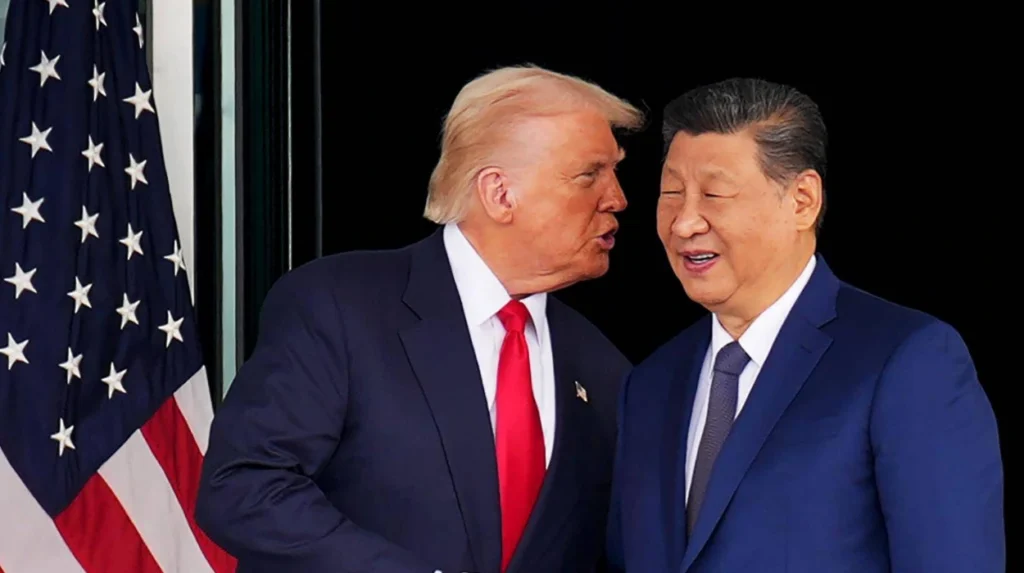
President Donald Trump and China’s President Xi Jinping are poised for a pivotal encounter in Beijing, marking a critical juncture in U.S.-China relations amid escalating global tensions. Scheduled for May 14-15, 2026, this two-day Trump-Xi Beijing Summit—with some reports extending it to May 13-15—represents the first U.S. presidential visit to China in nearly a decade, since Trump’s 2017 trip.
Postponed initially because of the escalating war in Iran, the conference comes at a time when both the world’s strongest leaders face concurrent challenges such as an unstable trade ceasefire between the US and China, the precarious state of affairs along the Taiwan Strait, regulation of artificial intelligence, reliance on rare earth minerals, nuclear proliferation threats, and the general threat of war in the Middle East. Realistic expectations prevail as experts remind us of the natural rivalry between these powers, but the situation couldn’t be more critical with midterm elections around the corner.
Summit Logistics and Historical Precedent
The Trump-Xi Beijing Summit is conducted amid logistical and diplomatic dance. Following his re-election to serve a second term starting January 2025, Trump will be meeting Xi face-to-face in Beijing, a city that provides a significant advantage to Beijing. According to reports by The New York Times, the summit starts on a Thursday, enabling more personal and side meetings with Chinese businessmen.
This is not an ordinary state visit, coming at a time when there have been several instances of dangerous encounters between Trump and Xi, most notably their 2017 meeting in Mar-a-Lago, which succeeded in easing trade tensions temporarily. The present circumstances, however, are much tenser due to the Iran war that has delayed the initial schedule.
From China’s viewpoint, this postponement has been a blessing in disguise. According to Politico, the Chinese authorities have been analyzing how America reacted to the Iran dispute and seeing their preoccupation as an opening to exert influence over Asian-Pacific matters. Trump, always ready for a business deal, comes with a team that will secure tangible benefits for him, such as talks on the sale of Boeing airplanes, the export of soybeans, and AI semiconductors. However, the summit’s low-key atmosphere emanates from the deep distrust between both nations.
Core Agenda: From Iran to Trade and Tech
The underlying issues at the Trump-Xi Beijing summit are quite many and include geopolitical, economic, and technological matters. Notably, one of the main topics for discussion between the two leaders is that of the Iran War. According to the Financial Times, President Trump will take the opportunity to confront President Xi regarding China’s involvement in maintaining the logistics of the Iranian military especially due to the blockades of the Strait of Hormuz by American-led forces.
Trade is the key economic component. The BBC notes that U.S.-China tariffs stand on shaky ground, as a fragile ceasefire prevents further escalation but does not address the underlying economic differences. American policymakers want China to purchase more goods to reduce the trade imbalance between the two nations, focusing on agricultural products such as soybeans and higher-end manufacturing, including Boeing aircraft. According to Reuters, the deal regarding rare earth minerals, which are essential for the U.S. defense industry and technological sector, still stands, although there are concerns about exports. As for technology, AI and nuclear issues have taken center stage.
Taiwan stands out in the background, a ghost present everywhere. According to CNBC, global leaders from Singapore to Brussels will be monitoring the summit for any indication of what will happen in the Taiwan Strait, where China’s incursion has escalated. As Xi tightens his grip with his third term, there is no sign of retreat in his demands for unification, whereas Trump walks the tightrope between deterrence and economic reality. In nuclear negotiations, the focus is not only on Iran but also on North Korea’s nuclear program.
Strategic Calculations: Leverage and Risks
Beijing approaches the Trump-Xi Beijing Summit with a measured dose of optimism. As disclosed by Fortune magazine, the Chinese have been “working backward from our midterm elections,” offering concessions that would strengthen Trump’s political position in the United States while ensuring that the Americans are constrained from imposing restrictions on technology sales. The war with Iran has changed the equation; according to Bloomberg, the summit has indeed been revived after its delay, taking advantage of what Beijing has learned about American military vulnerabilities.
The equation becomes trickier for Trump. Domestically, the midterm elections in November 2026 rely heavily on economic arguments; a “win” in the summit on trade may neutralize Democrat criticism of inflation due to China dependency. However, going too aggressively on Iran may backfire, turning Beijing into an enemy who would be needed in a solution to the Hormuz crisis. The videos from the NY Post on YouTube illustrate Trump’s strategy: hard language with negotiations skills. Experts predict that the outcome will be limited to a soybean sale deal or an AI discussion platform.
Global ripples extend far. European and Asian leaders, per CNBC, monitor for supply chain stability; rare earths shortages could cripple EV production, while AI pacts might set norms against weaponization. The summit tests the post-2024 world order, where Trump’s “America First” clashes with Xi’s “Community of Shared Future.”
Broader Implications for U.S.-China Rivalry
The Trump-Xi Summit in Beijing is symbolic of the renewed struggle through a new form of warfare: economic, technology, and proxy wars. The numbers behind trade show why there is a need for such a conflict: the U.S. remains a net importer with a deficit of $300 billion yearly, driving the threat of tariffs from Trump. Eighty percent of rare earth elements, necessary for U.S. F-35 fighter jets and iPhones, are Chinese-owned.
The military data regarding Taiwan is indicative of tensions: according to the U.S. Indo-Pacific Command, there have been over 2,000 flights by the PLA aircraft in the air defense identification zone in 2026. The Iranian situation is also important as China’s imports from Iran of oil amount to 1.5 million barrels a day, despite the presence of U.S. warships in the area. The negotiations will touch upon hypersonic missiles, which represent China’s advantage over the United States.
The internal policy pursued by Xi Jinping is uncompromising. The state media describes the meeting as one of equals; the idea of making any concessions is ignored. Trump, however, treats the negotiation differently:
“China needs our markets more than we need theirs,”
Trump said prior to the meeting. The meeting may result in changes to the balance of powers within the alliance: if a compromise is achieved, the Quad will relieve pressure on India; otherwise, decoupling will accelerate.
Potential Outcomes and Global Watch
Modest breakthroughs seem probable. A Reuters-sourced official affirms the rare earths pact endures, potentially expanding to lithium for batteries. Trade pacts on ag and planes offer quick wins, narrowing deficits by $50 billion, as projected. AI guardrails might emerge as a “Geneva-style” accord, curbing autonomous weapons.
Risks abound: Taiwan provocations or Iran escalations could derail. Bloomberg warns of
“summit that was delayed by Iran war”
redux if Hormuz flares. Midterms amplify pressure; Beijing’s election calculus bets on U.S. gridlock.
World leaders watch intently. Singapore’s PM eyes ASEAN stability; Brussels frets tariffs spillover. YouTube coverage amplifies buzz, with millions tuning in for Trump’s flair.
Navigating Uncertainty Ahead
The Trump-Xi Beijing Summit is no panacea but a pressure valve. Success hinges on pragmatism: Trump’s deal instincts meeting Xi’s long game. As of May 11, 2026, anticipation builds; outcomes will echo through 2027. In sum, this summit tests superpower mettle amid crises. Trade stats, Iran fog, Taiwan brink— all converge. Bold leadership could stabilize; hubris fracture. History awaits its script.