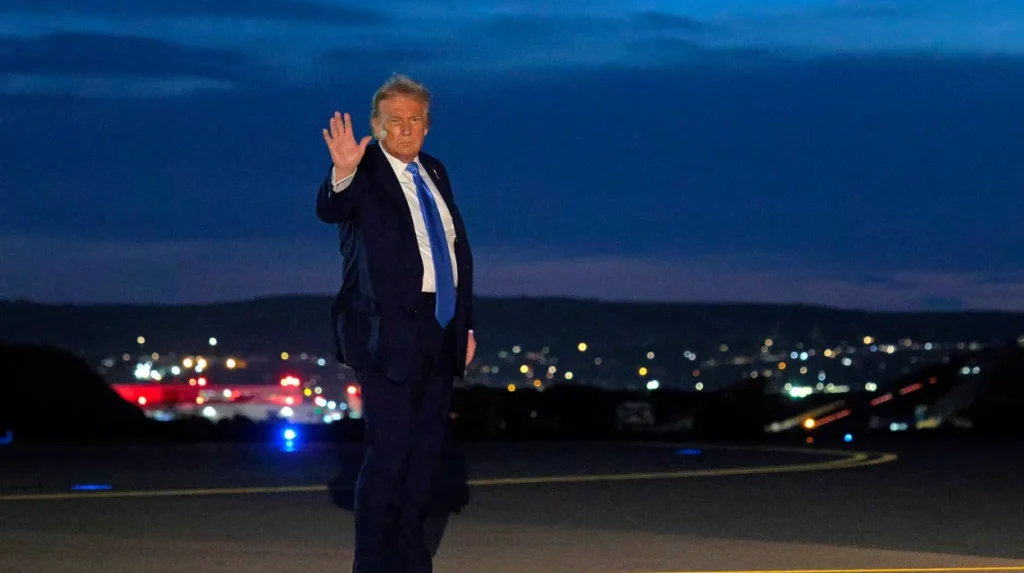
After sending a dire warning to Iranians to leave their capital city immediately, President Donald Trump indicated Monday that the ongoing conflict between Israel and Iran was rapidly escalating. He said he would return to Washington one day early from the Group of 7 summit in Canada to keep an eye on developments.
What prompted Trump’s early exit from the G7 summit?
Trump had initially intended to stay in Canada until late Tuesday, but by Monday lunchtime, he was starting to show signs that he was looking elsewhere as he considers his options for handling the rapidly worsening situation.
During Trump’s brief attendance at the meeting, some rift had already been created. Although the G7 published a statement late Monday from the leaders asking for a settlement to the situation that seemed to have Trump’s support, he first indicated that he would not sign a joint statement produced by the leaders of the G7 calling for a de-escalation between Israel and Iran.
According to an official with knowledge of the situation, the statement was released with Trump’s approval and was credited to the G7 leaders, which is usually a sign that everyone has signed on.
Is Trump serious about pursuing diplomacy with Iran?
In light of Iran’s ongoing tit-for-tat with Israel, the worrisome message seems to be intended to put further pressure on Iran to engage in negotiations. According to a US official and someone familiar with the situation, Trump has instructed his team members, including Middle East envoy Steve Witkoff, to try to meet with Iranian officials as soon as possible. This is part of his urgent efforts to ascertain whether Iran is serious about using diplomacy to end its conflict with Israel.
While privately pressing his administration to retain open channels of contact with Iran and Iranian proxies, the president has publicly maintained that Iran should come to the table to reach a deal with the US since Israel launched its first cluster of missiles last week.
Trump said he wanted US officials to meet with their Iranian counterparts this week and informed European leaders at the G7 that talks were in progress to secure a truce between Israel and Iran.
Sources claimed that although nothing was finalized, Iran and Israel were headed in the right path. Earlier Monday, Trump admitted that Iran had spoken with him through middlemen.
He was less forthcoming about his potential preparations in the event that those diplomatic attempts failed, such as whether he would use US military resources to help Israel in an endeavor to destroy Iran’s nuclear installations.
As of Monday night, the Trump administration’s Sunday statement to regional allies that it will not intervene in the Israel-Iran confrontation unless Iran targets US interests remained unchanged.
Why was Trump reluctant to sign the G7 statement?
Throughout the day, US officials gave their European colleagues and the public indication that Trump was not going to support a leader’s statement advocating for a de-escalation of the situation, but he finally seemed to do so.
According to an individual with knowledge of the situation, Trump signed off on the paper after his counterparts made changes to some of its wording, such as calling for respect for international law and a diplomatic solution to the problem.
Trump believed there was no reason to sign the statement, according to a senior White House official, considering what he has already stated in public on the Israeli-Iranian dispute. When asked if a statement would indicate that world leaders were united on the problem, the senior source said that Trump’s participation at the summit—which was requested by the other leaders—was his method of demonstrating unity.
Though they understood that Trump’s veto would dash dreams of displaying agreement on the matter, European officials had been hoping that Trump would alter his mind on the joint statement.