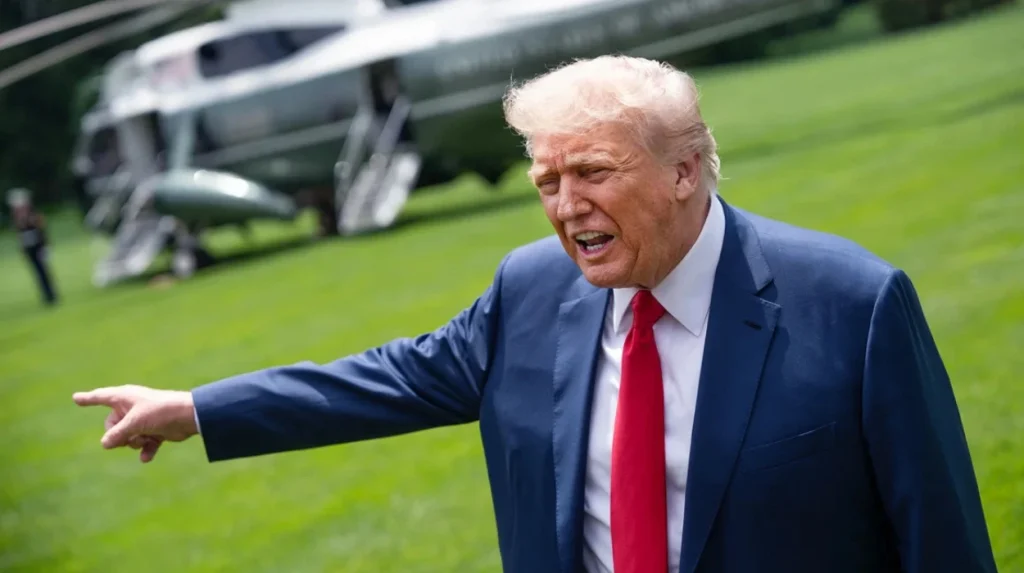
According to experts, US President Donald Trump is acting and speaking like an authoritarian leader as he escalates a constitutional conflict with California over his immigration crackdown. Much now depends on whether he is only talking tough or if his passion for strongman leadership is about to tip an already uneasy nation over the edge.
Is Trump acting like a dictator or posturing?
Trump made a shock move on Monday, authorising the detention of the Democratic governor of the nation’s most populous state. Following a weekend of turmoil that included skirmishes with police and burning automobiles in limited portions of the city, Trump later ordered the deployment of hundreds of active-duty Marines to Los Angeles and authorised the mobilisation of an additional 2,000 National Guard reservists. Immigration and Customs Enforcement sweeps for unauthorised migrants in a state and cities that are strongholds of Democratic power sparked the protests.
Trump’s decision to deploy troops despite California Governor Gavin Newsom’s opposition was the latest example of his willingness to exercise extraordinary executive power, often on questionable grounds, in contrast to his first term, when establishment officials often talked him out of his extreme impulses. Trump has threatened democracy and the rule of law on many occasions in the past, but a significant new chapter may be about to begin.
Officials in California and Los Angeles deny Trump’s assertions that they are out of control. With flash bangs, police officers repelled protesters who were hurling missiles on Monday night.
Will invoking the Insurrection Act escalate the crisis?
Officials from the Trump administration are using terms like “insurrection.” Unsurprisingly, a lot of people have interpreted this language as an indication that the White House is ready to utilize the Insurrection Act, which would enable the president to send soldiers to quell a state’s uprising. California has no such uprising.
The possibility of another cycle of tension and uncertainty was raised by the high number of protesters who assembled in Los Angeles on Monday night. Whether Trump adheres to his dictatorial rhetoric and crosses boundaries that contemporary presidents avoid, particularly with regard to the employment of soldiers in a law enforcement role, determines the course of the situation.
It could also depend on the restraint of demonstrators, who might aid Trump by engaging in more disturbances that provide frightening television images that could support his gloomy tone. It would be similar to the tactics of oppressive rulers throughout history to instigate or intensify a law-and-order crisis or public security concern, then use it as an excuse to deploy the military on domestic territory.
Is there real unrest or just political theatre?
Trump’s second term hasn’t done anything to bolster expectations of moderation. For example, the president has unlocked seldom-used executive authorities by citing extremely divisive national emergencies on trade and immigration, with little opposition from the Republican Congress. He has exercised presidential power against what he views as liberal power and influence centres, including the federal government, the media, and Ivy League colleges. Additionally, Trump threatened to misuse his position of authority once again last week when he broke off his relationship with former DOGE leader Elon Musk by removing federal funding for the SpaceX CEO’s companies.
As it sets a marker in California for other Democratic states whose leaders are reluctant to assist Trump’s deportation campaign, the administration is preparing for a battle. Evidently, it also sees a political benefit in the president portraying himself as the defender of public order, which enables Republicans to accuse Democrats of supporting laxer immigration enforcement.
What are the consequences of using the military domestically?
However, as is always the case with Trump, it is unclear if he is sincere in his threats or if he is adopting an extreme stance in order to win over his supporters or perhaps to gain some alleged advantage. All of this might indicate that the president is not yet prepared to lead the country to an unprecedented authoritarian precipice, despite the fact that his past, including that of January 6, 2021, indicates that he frequently makes the most rash decisions under pressure.
And in a state and city where resentment over Trump’s crazy four-month-old administration is brewing, he could be playing with fire. He is increasing the likelihood that flashpoints might flare and even that catastrophic events could occur by placing soldiers in such a volatile and stressful area. However, if the president is looking for a pretext to place active-duty soldiers on American city streets, perhaps that is the goal.