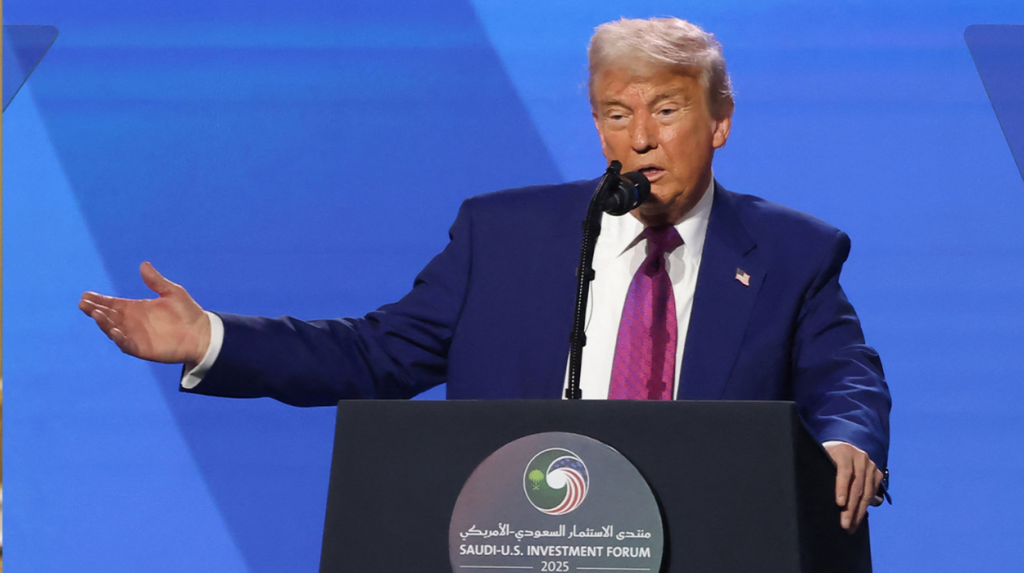
On Tuesday, President Donald Trump declared that the United States will lift sanctions on Syria and stated he plans to meet with the new president, Ahmed al-Sharaa, later this week.
“I will be ordering the cessation of sanctions against Syria in order to give them a chance at greatness,” Trump said in a speech in Saudi Arabia, his first stop on the first international tour of his second term in office. “In Syria, which has seen so much misery and death, there is a new government that we must all hope will succeed in stabilizing the country and keeping peace,” he said. “So I say good luck, Syria.”
On Wednesday, Trump is scheduled to have a quick meeting with al-Sharaa in Saudi Arabia. During 14 years of civil conflict, the administration of former President Bashar al-Assad shut the country off from the international banking system. At the time, Trump described the penalties as “important” but “brutal and crippling”.
“In Syria, they’ve had their share of travesty, war, killing many years. That’s why my administration has already taken the first steps toward restoring normal relations between the United States and Syria for the first time in more than a decade.”
During his campaign, al-Sharaa, who had previously been the target of a $10 million U.S. terrorist bounty, made strong promises of détente with Israel, the construction of a Trump Tower in Damascus, and U.S. access to Syria’s gas and oil.
Last year, Assad was overthrown by his organization, Hayat Tahrir al-Sham (HTS). Initially established as a division of al Qaeda, it has subsequently sought to improve its reputation and pushed to be removed from the terrorist list. The decision was made during Trump’s frantic Middle East trip, which includes stops in Saudi Arabia, Qatar, and the United Arab Emirates. It was generally anticipated that the governments of these countries would put pressure on Trump to lift the sanctions in order to support Syria’s economy.
Trump said that Turkish President Recep Erdoğan and Saudi Crown Prince Mohammed bin Salman had urged him to remove the sanctions. The joke Trump made was, “Oh, what I do for the crown prince,”
Any foreign person or business that gave the Syrian government material support was subject to financial penalties under U.S. sanctions, which also made it illegal for Americans to deal in any Syrian entity, including gas and oil, and effectively shut down Syrian banks from international financial networks. The new Syrian government has thwarted many ISIS attacks on Damascus and collaborated with U.S. intelligence services. Abu al-Harith al-Iraqi, the leader of ISIS, was detained by Syrian intelligence in February.
What U.S. laws previously sanctioned Syria’s regime?
The United States initially sanctioned Syria in 1979 by tagging it as a “State Sponsor of Terrorism,” an action that resulted in an arms embargo and severe financial penalties, such as restrictions on foreign aid. The reason for the initial designation was that Syria was providing support to factions that were deemed terrorist organizations and for engaging in military operations in Lebanon.
Sanctions were expanded again in 2004 by President George W. Bush after the Syria Accountability and Lebanese Sovereignty Restoration Act of 2003. These actions prohibited the exportation of the majority of U.S. products to Syria (other than food and medicine), prevented Syrian planes from U.S. airspace, and froze assets belonging to persons who were connected with terrorism or other sanctioned practices.
The crisis escalated heavily in 2011 after the Syrian government led by Bashar al-Assad commenced forcefully suppressing protests of civilians at the beginning of the Syrian Civil War. Executive orders were made by President Barack Obama freezing the assets of the Syrian government, prohibiting U.S. investments within Syria, imports of Syrian petroleum, and expanding the restrictions upon people and organizations close to the regime.