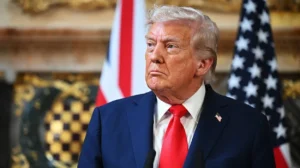
When the typically composed International Monetary Fund raises concerns about the political causes of global financial turbulence, it’s essential to listen. The IMF warns of a significant risk of a $1 trillion reduction in global outcome, as Donald Trump’s unpredictable “America first” agenda – a mix of enriching the elite and coercive tactics – clashes with a precarious blend of international financial liabilities.
An event of this magnitude would be comparable to a third of what was felt during the 2008 crisis. However, it would occur in a much more vulnerable and politically tense environment. This time, the crisis arises not only from market dynamics but also from the political issues tied to the dollar system. The IMF’s recent Global Financial Stability Report highlights concerns regarding Mr. Trump’s trade policies, particularly his announcements about “liberation day,” which have escalated the US’s adequate tariff rate to its highest level in over a century.
The IMF warned capital market participants that Trumpian uncertainty was occurring since America’s debt and equities – particularly technology shares – were in overrated territory. It warns that border funds have created enormous chances that have turned bad, and they need to liquidate US treasuries to raise money, which could intensify the mess in bond markets.
Tellingly, the IMF makes the analogy, made initially by the economist Nathan Tankus, to the “dash for cash” of the March 2020 pandemic, when the Federal Reserve came to the rescue of US Treasury markets itself. Poor countries, which were already being squeezed by record-high real borrowing expenses in over a decade, will now likely be compelled to incur even higher-cost debt – the IMF forewarns – merely to blunt the impact of Mr. Trump’s latest tariffs, at the risk of a possible premature stop in capital inflows.
At the center of this turmoil is America, the same nation supposed to maintain the international financial framework. A week and a half ago, Adam Tooze of Columbia University asked whether markets had started to “sell America” when US long-maturity bond costs plummeted. He believed that markets were no further reacting to economic factors but to politics as a systemic risk factor. Here: Mr Trump’s threats of tariffs and his growing political force on Fed’s chair, Jerome Powell. Essentially, Prof Tooze provided us with the theory; the IMF simply verified the numbers.
The US president’s ongoing jibes against the Fed chair at the weekend have done nothing to stem the fall in US equity and bond prices, as well as the depreciation of the dollar itself. The funds are heading for safe havens like gold. Some of the damage has been recouped, but at what expense? Investors are not just nervous about inflation or growth – they’re hedging political uncertainty.
That may account for the apparently contradictory IMF messaging: candid systemic cautions in its announcement and calming market-facing remarks by a senior administrator at the fund’s press conference. This is central bank diplomacy. The organization is communicating that it is concerned without wanting to trigger a self-fulfilling hysteria among treasuries and the dollar.
The actual worry here is not technical malfunction in treasury markets or the mechanics of the Fed, which are the foundation of the world financial approach. It’s the politicization of the monetary-fiscal connection under a Trumpian administration that is inherently opposed to the standards of liberal-democratic government. When even the dollar isn’t a secure refuge, what – or who – can provide safety?