Foreign policy stresses the importance of economic security to national security. It emphasizes keeping vital technologies and strategic assets out of the reach of foreign enemies to protect US interests from national security threats. Therefore, for these laws to come into play, the Committee on Foreign Investment in the United States (CFIUS) will be key. The memorandum directs CFIUS to widen the net to capture so-called “greenfield” investment and limit alternative investments made by foreign adversaries, mainly in important sectors.
America First Agenda
On February 21, 2025, President Donald Trump announced the “America First Investment Policy,” a comprehensive approach toward remaking the investment sector in foreign nations. Among its main goals would be national security by helping enhance allied nation investments while making tougher restrictions on investments from foreign adversaries, especially the People’s Republic of China (PRC).
Another distinctive feature in the exercise of leadership by President Donald Trump’s policies was his “America First” agenda, which involved numerous foreign as well as domestic policy objectives. It is an agenda that puts American interests first, with strategies designed to restore American leadership on various fronts like trade, energy, immigration, and national security. In this article, we will examine the chief dimensions of President Trump’s America First agenda and their implications and results.
Under Trump’s America First policies, the term adversaries includes friendly or allied countries as a result of their threats to America’s national security, including those that are not friends or allies. By offering a “fast-track” review procedure, the policy seeks to induce foreign direct investment from partner and allied nations. It is intended to promote investment in key areas, including high-tech while preventing these investors from cooperating with what can be called the enemies of the United States. Among the international foes specified by this policy are the PRC, Cuba, Iran, North Korea, Russia, and Venezuela. It aims to keep them off limits from important assets and sensitive US technologies in the energy, health, vital infrastructure, and agricultural sectors.
The administration’s agenda largely focuses on efforts designed to repeal the Affordable Care Act. Coverage in healthcare came under continued discussion due to the elimination of the individual mandate, although a total repeal was not accomplished.
A long-term effect of Trump’s America First program is in his court nominations. The appointment of over 200 federal judges, including three Supreme Court justices, has shifted the judiciary to a more conservative view of the Constitution.
Numerous businesses and companies support Trump. His first fund saw contributions of $1 million each from well-known tech companies such as Uber, OpenAI, Microsoft, Apple, Amazon, Google, and Meta (Facebook). In addition, automotive and aerospace companies such as Ford, Toyota, and Boeing have made tremendous contributions. Major energy corporations like Chevron, ExxonMobil, and Occidental Petroleum have demonstrated sheer policy support from the oil and gas sector. In addition, cryptocurrency companies and operators of private prisons have made distinct donations-a reflection of the many kinds of corporate support for Trump’s program.
The investment companies, which include hedge funds and private equity firms, have provided President Trump with substantial financial support. Prominent firms like Paul Singer’s Elliott Management support them. These firms often back Trump’s economic policy that has favored industries like private prisons and energy. Consistent with their increasing political clout, bitcoin businesses have likewise poured in donations for Trump’s campaign. The securities and investment industry has emerged as the top donor sector to Donald Trump’s campaign and associated super PACs, contributing an impressive $193.8 million.
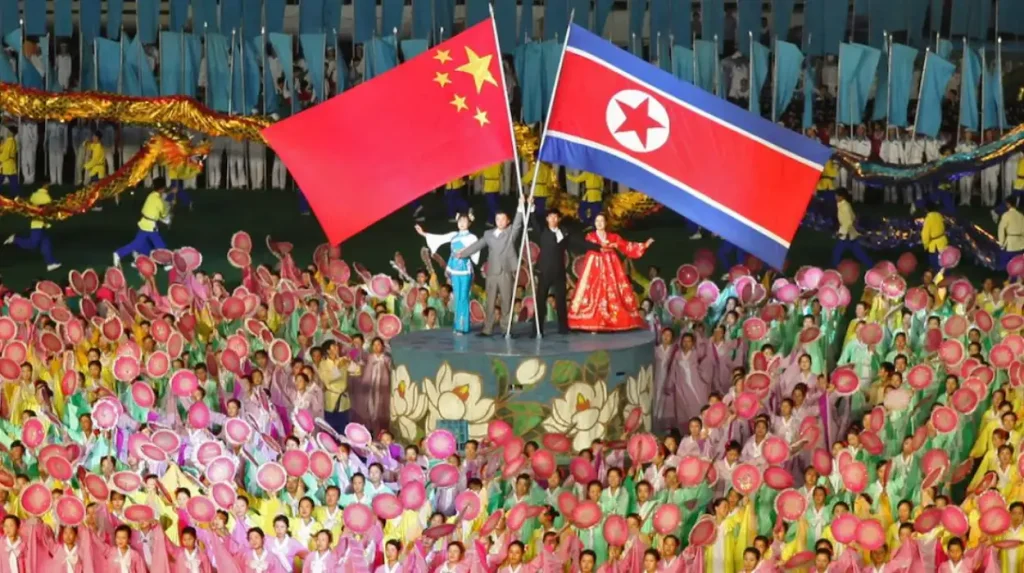
Why did China support North Korea?
North Korea holds a unique position as a buffer between the United States-supported South Korea and China. This buffer is crucial for China’s national security because it prevents American forces from reaching China’s borders. It is of great interest to China that the region be stabilized so as to preclude a conflict that could jeopardize its interests. Supporting North Korea keeps regime collapse from mushrooming into anarchy and instability.
The central aims of President Trump’s military policy were rebuilding the American military through strategic initiatives, modernization efforts, and increased defense spending. Other essential initiatives would include defeating the ISIS territorial caliphate, fortifying nuclear forces, and establishing the Space Force. In addition, Trump announced measures that included shutting down diversity offices at the Department of Defense and placing restrictions on transgender service. The emphasis in the strategy was placed on a very aggressive military posture and national defense.
Trump plans for 2025 in the light of Project 2025 to strengthen border security, implement conservative social policies, reform economic policies, and consolidate presidential power. Those are part of a broader effort to change American culture and government for conservative ends.
Transactional Diplomacy
To put it plainly, the very essence of Trump’s transactional foreign policy hinges upon the pragmatism that every decision or action has to be accompanied by something that can be measured as an outcome. This can be inferred from his statements and actions, wherein he tends to describe international arrangements and alliances as “bad deals” for the US. While his transactional approach is not at all new, what sets it apart from previous US foreign policy strategies is the application of the idea in diplomacy per se. The belief that the United States must only help or support in exchange for something in return is the underlying theme behind Trump’s diplomacy. The most visible example of this approach is his view that NATO allies must meet their defense spending commitments; otherwise, there is no justification for US involvement.
Trump is causing chaos and controversy both within and outside of his borders. Trump has often come under fire for actions and policies that substantially polarize opinion, breed uncertainty, and weaken institutions.
Exercising his executive powers, Trump has been granting commutations to high-profile individuals convicted of crimes related to the January 6, 2021, attack on the US Capitol. Critics consider these acts a serious weakening of accountability and, by extension, the possible embodiment of other extremists.
Controversial measures regarding immigration have included making two executive orders that limited refugee admissions into the United States and reducing the number of people residing there unlawfully while severely punishing would-be immigrants for these offenses. These directives have spurred a public uproar and legal challenges from many sides.
Trump’s international business partners, such as Indonesian Hary Tanoesoedibjo and United Arab Emirates President Hussain Sajwani, have been VIPs at his inauguration. They have utilized the chance to showcase their partnerships with the Trump Organization by being spotted at VIP events.
In their marketing campaigns, these partners have frequently mentioned Trump’s administration while aggressively promoting their collaborations and projects with him. Concerns over possible conflicts of interest and the use of the presidency for personal financial benefit have been raised by this.
When President Donald Trump makes the statement “diplomacy is not an option,” it means he is willing to engage foreign powers on a more transactional basis. This tends to value short-term wins over long-term commitments and trust-building that have characterized diplomatic ways until now.
Economic sanctions, tough rhetoric, and a desire for a new nuclear agreement have all been features of President Donald Trump’s approach to Iran.
In February 2025, Trump signed a National Security Presidential Memorandum (NSPM) that restored maximum pressure on Iran to check further Iran’s regional influence and blocked all routes for nuclear capability. While being confrontational, Trump stated that he would be open to negotiating and drafting a new nuclear agreement with Iran. He has claimed he is open to dialogue and wants peace but does say that Iran cannot have a nuclear weapon. US President Donald Trump has a favorable view of Russian President Vladimir Putin and often describes their relationship as friendly and cooperative.
Trump sees Putin as his friend; this has become controversial and drawn criticism, especially in light of the complex geopolitical relationship the United States and Russia have. Trump’s openly expressed admiration for Putin has included calling him “very respected” and showing appreciation for his leadership style. Such praise is rare for a president of the United States, considering that Russia would normally act against US interests.
Trump has taken heat for suggesting that the United States and Russia were morally equivalent and that each country has its problems; hence, they shouldn’t be compared in the first instance. This stance has been interpreted as a way of downplaying Russia’s invasion of other countries, known human rights abuses, and undemocratic tendencies.
What countries does Trump want to take over?
It cannot be said that Donald Trump has openly expressed a desire to conquer countries conventionally, but he has made certain eccentric suggestions along these lines: purchasing Greenland from Denmark and making jokes about uniting Canada with the United States. It is clear that these statements were inspired by a mix of economic and strategic interests, but none can be seen as part of a coherent, wider strategy of some type of territorial expansion. Trump’s aim is often to achieve security and economic advantages with great disregard for traditional norms in diplomacy.
Unpredictability and the “Madman Theory”
Unpredictability has consistently characterized the foreign policy agenda of President Donald Trump and has been taken as being calculated to keep opponents off-balance. Nixon’s Madman Theory would suggest that a leader can attain some level of diplomatic advantage by projecting an emotion of insanity or unpredictability to intimidate his opponents into the decision he desires.
Trump has put into practice foreign policies that revolve almost entirely around uncertainty, convincing him that such stylings might create higher leverage from which to negotiate and also might create instability and confusion within the ranks of opponents. To such ends, he has stated that an unpredictable state leader is the one who has the upper hand, keeping everyone from guessing at his next move. This strategy is consistent with the Madman Theory, which holds that a leader can terrify his opponents with an act of irrationality or unpredictability.
Some people made notes about Donald Trump being insane and expressed concerns over his mental health, alleging inconsistent remarks in public and behavior. Mental health practitioners, however, abide by professional rules that do not allow them to “diagnose” anyone that they have not examined in person. Thus, such evaluations are mere hypothetical suggestions and are not based on official diagnoses. The argument mirrors a broader public concern around mental health and leadership, which may have led to Trump’s failure.