In an unusual pattern, which is indicative of the immediacy and vulnerability of the existing ceasefire regime, Jared Kushner, who represents the United States in Middle Eastern affairs, went to Egypt on Sunday in order to pressure Hamas politician Khalil al-Hayya into taking some “concrete, verifiable steps” in disarmament, and then traveled to Jerusalem on Monday in order to convince Prime Minister Benjamin Netanyahu to accept a phased process, which Israel has refused to accept. The two-stage shuttle diplomacy was meant to ensure that the Palestinian party would commit itself to this process before Netanyahu would accept the timetable for implementation of the 15-point roadmap, which is central to Trump’s 20-point Gaza plan.
What makes this round different is not just the proximity of the meetings but the explicit linkage being drawn by mediators between verifiable disarmament and parallel Israeli withdrawals, a formula that has so far failed to overcome Netanyahu’s insistence that
“Israel will not retreat from any position in Gaza until Hamas has been completely disarmed.”
That stance, repeated in public over the past week, has collided with a regional consensus that now blames Israel for obstructing progress, with a joint statement from Muslim-majority foreign ministers declaring that
“Israel now bears responsibility for obstructing the efforts to bring peace in Gaza.”
The result is a diplomatic squeeze: Kushner is asking Hamas to show it can deliver on disarmament while simultaneously asking Netanyahu to accept that disarmament will be incremental, monitored, and tied to Israeli pullbacks—a political lift made harder by an election due Oct. 27, 2026 and a coalition anchored by hardliners.
The roadmap at the center of the storm
The document underpinning the negotiations is a 15-point Gaza roadmap laid out by Trump’s Board of Peace, the entity set up to implement the peace plan of the president and headed in practice by the diplomat Nickolay Mladenov, in addition to Tony Blair, the former prime minister of the United Kingdom, who is working on the initiative. According to the roadmap, Hamas would step-by-step transfer its weaponry to a new Palestinian technocratic committee entrusted with managing the administrative affairs of Gaza, and in exchange for disarmament achievements, Israeli forces would cease hostilities and start withdrawing in phases.
Mladenov has framed the roadmap as the “only way forward” to avoid a repeat of the Oct. 7, 2023 attacks, while also stressing that disarmament must be comprehensive:
“This applies to light weapons, heavy weapons, and the tunnels alike.”
That language is aimed at reassuring Israeli security hawks that nothing will be left off the table, even as the mechanics of verification and sequencing remain the most contentious details. In parallel, the Board of Peace has signaled that IDF withdrawal beyond the so‑called “Yellow Line” will occur only once Hamas is fully disarmed, a formulation that tries to bridge the gap between Netanyahu’s “disarmament first” demand and the phased approach embedded in the plan.
What Kushner pressed in Cairo—and what Hamas said back
In Egypt, Kushner’s message was blunt and specific. According to sources briefed on the talks, he relayed that
“Gaza can never again be a source of terror for Israel,”
while calling for “concrete, verifiable steps” on disarmament and an end to any future Hamas role in running the enclave.
The talks involving al-Hayya and other members of Hamas took more than two hours and were held along with other mediators, which include Egypt’s spy chief, Hassan Rashad, and Mladenov. On the other hand, Hamas reaffirmed its acceptance of the roadmap for the second phase of the ceasefire and noted, in its statement, that it had “acceptance” of the plan during the talks with “delegations from the mediators and guarantors of the ceasefire agreement in Gaza.” Hamas also asked the Board of Peace and other mediators to “compel” Israel to follow the roadmap of the first phase and stop the “violations, killings, and incursions” in the blockade area. This two-pronged approach of reaffirming acceptance while pushing for Israeli restraint is indicative of Hamas’s overall strategy of working within the confines of diplomacy while making use of reality on the ground.
Netanyahu’s red line—and the election calculus
Netanyahu’s position has been equally clear, and equally inflexible in public. He has said Israel rejected the U.S.-backed roadmap and insisted that
“Israel will not leave any position in Gaza until Hamas is fully disarmed,”
a line that has become a rallying point for his right‑wing base ahead of the October vote.
Likud Party has gone even further in the attacks, accusing the Arab nations of trying to “topple” him before the elections, turning the regional criticism into interference instead of constructive criticism. Nevertheless, some behind-the-scenes moves have become evident. A senior US official revealed in Axios that Netanyahu held talks with Kushner, where he assured the latter that even though he publicly rejected the 15-point plan, he would be ready to try it out and agreed to restrain strikes in Gaza to give disarmament a chance. According to Mladenov, in another conversation, it was made clear that the Israeli army would stay at their posts along the “Yellow Line” while slowly moving to the border starting from the point when Hamas begins disarmament. That is important because there may appear an exit strategy for Netanyahu: he would not need to concede “disarmament first” while giving the phased pullout which is linked to clear milestones.
Regional pressure mounts as the blame game sharpens
The diplomatic context of this negotiation effort has grown increasingly tense in recent days, with a bloc of foreign ministers, including those from Saudi Arabia, UAE, Jordan, Pakistan, Indonesia, and the ceasefire facilitators, putting out a joint statement that puts full responsibility on Israel. “Israel bears direct and full responsibility” for the sabotage of peace, it says, adding that the country’s rejection of the plan “directly threatens to derail extensive” efforts to calm Gaza down. This is not simply rhetoric; this message shows that the regional powers see the Board of Peace as the body that should take “immediate and concrete measures” to ensure that there is no obstruction of the process.
The crucial player of the last few Gaza agreements since 2023, Egypt, has also lambasted Israel’s rejection of the roadmap, insisting that all the provisions must be put into practice, including Israeli withdrawal and the provision of aid. The Egyptian president, Abdel Fattah el-Sissi, personally met Kushner to talk about the peace process, thus underlining his country’s dual role in hosting and guaranteeing the upcoming phase. For the Arab capitals, the stakes of the issue are not limited to Gaza’s governance; they are related to the possibility of establishing a credible security framework through a U.S. initiative.
The ground reality that keeps pulling talks back to square one
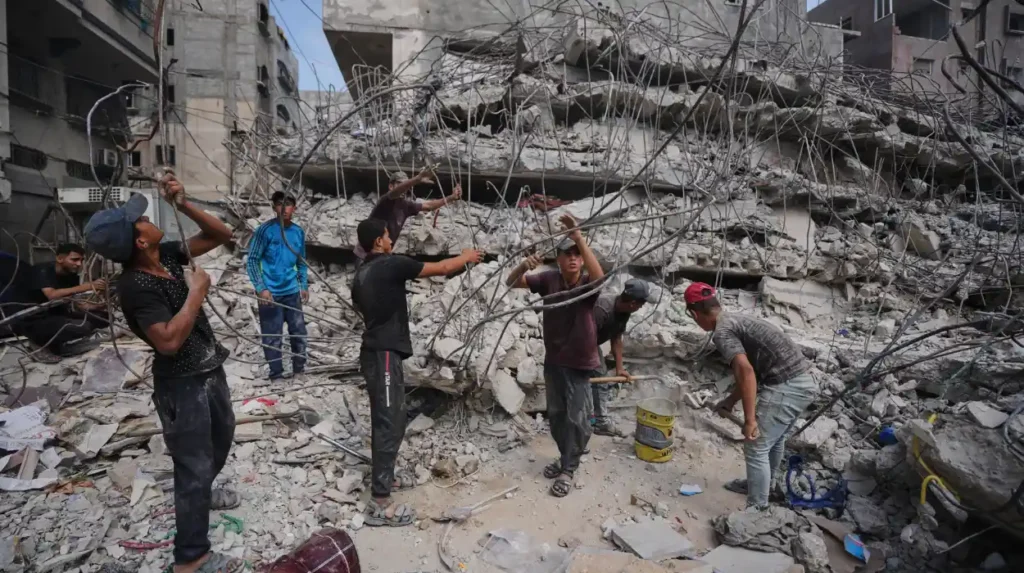
Diplomacy is taking place in an increasingly fragmented geography within Gaza. The Israeli army, for example, is said to hold around 60% of the territory, pushing past the “Yellow Line” that was to mark the border of post-ceasefire activity. Hamas, for its part, says that Israel must stop its bombardments and retreat to that line before implementing any plan, since continued attacks will make it impossible to disarm.
Even though the end of the major military activity of the ceasefire occurred more than 10 months ago, reconstruction, international force deployment, and disarmament continue to be stuck, leaving approximately 2 million Palestinians in a state of limbo that leads to further radicalization. This discord between a finalized set of agreements and the realities on the ground is why Kushner’s message in Cairo was about verification and why Kushner’s message in Jerusalem was about sequencing. There has to be a process that makes both parties feel secure in their core interests or else the roadmap itself is likely to gather dust.
What success would look like—and why it remains elusive
A workable breakthrough would likely involve three moving parts. First, a time-bound, verified disarmament schedule that covers light weapons, heavy weapons, and tunnels, with clear consequences for non‑compliance. Second, a parallel Israeli pullback tied to those milestones, beginning within the “Yellow Line” and extending to the border as verification advances.
Third, the swift deployment of the International Stabilization Force and Palestinian police system to plug the security vacuum, with reconstruction money conditional upon adherence. The barriers are just as obvious. For Netanyahu, there will be domestic demands that the disarmament is genuine before the withdrawal, and for Hamas, that the disarmament is not a capitulation without getting something in return. The regional partners hope for the success of the plan but are becoming more willing to take responsibility for its failure as indicated in their joint statement. The Americans, via the Board of Peace, have to delicately balance between maintaining the integrity of the plan and giving enough flexibility for both sides to buy into it without feeling like they’re being taken to the cleaners.