Iran has reportedly considered attacking US military targets in Europe if President Donald Trump escalates the war, marking a potentially significant expansion of Tehran’s retaliation strategy beyond the Middle East. According to two people close to the Iranian regime cited by the Financial Times, Iranian forces have assessed possible targets in southeastern Europe, including US-linked military assets in Bulgaria and Cyprus.
The report does not suggest that any sort of attack has been approved by Iran or a date has been set. Rather, the report talks about contingency planning for the case that Tehran will consider after Washington strikes back at Iranian infrastructure or launches a full-scale attack. Regardless, the implications of this assessment are very serious indeed. Until now, the military threats or retaliation carried out by Iran was limited to US installations and energy facilities in the region of the Middle East. If that threat extended to Europe, then there would be a possibility of a direct conflict between Iran and Europe.
Iran weighs expanding the battlefield
The alleged planning reflects growing concern inside Tehran that the conflict could resume despite previous efforts to establish a ceasefire and reopen negotiations. The Financial Times reported that many figures within the Iranian regime increasingly regard renewed war as a question of “when, not if.”
Both sources indicated that Iran had studied attacks on the assets of the United States in southeastern European nations like Bulgaria. The nation gained importance in the planning following its decision to allow the use of its Bezmer air base for American aircraft refueling last month. The same source also named Cyprus as a potential target should there be a revival of American offensives. The island has British bases, including the Akrotiri air base, which was attacked by a drone in March.
At the time, Western officials believed that the drone was of Iranian manufacture and had been fired by regional proxy forces. However, no one managed to confirm that it was indeed a direct assault by Iranians. The difference between an American military facility and the territory of a sovereign European nation will play a major role in any future conflict. Tehran can justify that an air base used to support American operations is a valid military target. However, the governments of Europe would regard any such attack as a major violation of their sovereignty irrespective of whether the initial target is American property or personnel.
Bulgaria and Cyprus in the spotlight
The Iranian interest in the Bezmer air base of Bulgaria can be linked to the alleged participation of this facility in aerial refuelling activities in support of US military operations. Refuelling planes are crucial for long-distance air offensives, as they help keep combat planes in the air and operating at a much greater distance from their bases.
The calculation made by Iran implies that this country might be willing to strike at facilities which are vital to US military operations instead of concentrating its response efforts on the facilities in the Gulf region or the neighboring countries. It implies a broader interpretation of the battlefield as the place where military actions take place both at the frontline and at the logistics bases. The other example of a potential target for Iran is Cyprus, which is not a member of NATO, but is home to British sovereign base areas, vital for the operations in the Middle East region.
Cypriot officials moved quickly to reject the idea that the Republic of Cyprus was itself an Iranian target. A government source told the Cyprus Mail:
“We are in contact with Iran and Cyprus is not a target.”
That statement is intended to reassure the public and protect Cyprus from being portrayed as an active participant in the conflict. It also reflects Nicosia’s effort to preserve communication channels with Tehran while avoiding any misunderstanding over the role of British facilities on the island.
The reported targeting assessment, therefore, should not be interpreted as evidence that Iran has decided to attack Cyprus as a country. Rather, the report concerns military facilities and assets that Tehran may associate with US or British operations.
Tehran’s warning to Washington
Iran’s reported planning is linked to previous threats from its military and political leadership. The Islamic Revolutionary Guard Corps and other Iranian commanders have warned that a renewed full-scale conflict would produce a response broader than earlier attacks against US military assets, energy facilities and infrastructure in the Middle East.
The Revolutionary Guard last month warned the United Kingdom over the use of British bases by American forces. Its message was direct:
“Any base that is used to launch an attack on Iranian territory will be considered a legitimate target.”
That warning provides the clearest context for the current report. Iran is attempting to establish a deterrence principle: countries that permit their facilities to support US attacks could themselves face retaliation. The policy is designed to complicate American military planning by forcing Washington to consider the vulnerability of its overseas support network.
One of the regime insiders cited by the Financial Times said Iran would not impose geographical limits on its response if the United States attacked critical Iranian infrastructure. The source stated:
“Should the US go too far, Iran will defend itself at any price, go beyond the region and hit Europe too.”
The statement is both a threat and a political signal. It tells Washington that attacks on bridges, power plants or other infrastructure could provoke a response against locations far beyond the immediate theatre of war. It also warns European governments that American military cooperation could carry risks for their own territory.
Hormuz cables add another dimension
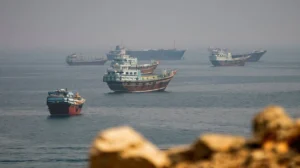
A third alternative that Iranian forces have considered is launching an attack on subsea fiber optic cables in the Strait of Hormuz. These cables form part of the communication system of the area which connects various governments and corporations. This move is not comparable to launching an attack through missiles on a military base since it will affect civilians as well as disrupting communication systems, financial transactions and military communications. This move is particularly interesting since the Strait of Hormuz is still a key element of the conflict. Talks about opening up the strait have failed, and ship movements have been very minimal. According to CNBC, a recent attack on a commercial vessel sailing through the strait has left one dead.
Iranian officials have continued warning ships attempting to pass through the waterway. According to a statement quoted by Fox News, an Iranian military spokesperson said ships would
“find several beautiful holes in their hulls.”
The language illustrates the increasingly confrontational nature of the crisis. The United States has insisted that the waterway is open and operating under its control, while Iran has challenged that claim through threats and attacks on shipping. The result is a dangerous gap between political declarations and conditions at sea.
A fragile diplomatic framework
The latest escalation follows the collapse of diplomatic efforts between Washington and Tehran. A June memorandum of understanding reportedly fell apart after Iran attacked vessels in the strait and both sides accused each other of violating the interim arrangement. The breakdown was followed by tit-for-tat strikes and a renewed US blockade on Iranian ports.
The 60-day ceasefire agreement expired on Monday, and Trump has ruled out extending it. On Tuesday, he said there were
“no talks or conversations going on, or scheduled”
with Tehran.
That statement suggests that the immediate space for diplomacy has narrowed considerably. Without a functioning ceasefire or negotiation channel, each side is increasingly relying on military pressure and public threats to influence the other’s calculations.
The United Arab Emirates added to the pressure on Wednesday by announcing that it had suspended
“all trade, commercial exchanges, and financial transactions”
with Iran until further notice. The UAE’s Defence Ministry also said it had detected two ballistic missiles launched from Iran towards its territorial waters.
The UAE’s decision could intensify Iran’s regional isolation, but it may also increase Tehran’s incentive to demonstrate that pressure against Iran will carry costs. Attacks on US-linked assets in Europe would be one possible way to impose such costs while avoiding a direct strike on a Gulf state.
Iran’s long-range capability
The central question is whether Iran can credibly threaten military targets in Europe. Sidharth Kaushal, a research fellow at the Royal United Services Institute, described the threat posed by Iranian missiles to Europe as “real, but limited.”
However, according to Kaushal, these missiles will encounter great trouble in inflicting substantial harm over long distances. The issue here is similar to that which arises in planning attacks from a distance; the longer the missile flies, the harder it will be for it to remain accurate and carry a sufficient payload. A missile may be able to reach its target, yet be incapable of damaging it because of insufficient accuracy or destructive power. According to Douglas Barrie from the International Institute for Strategic Studies, Iran’s unsuccessful attempts to attack Diego Garcia showed that Iran possesses some kind of weaponry with a range in excess of 2,000 kilometres. Nevertheless, according to him, the exact amount of these missiles is not known.
Barrie said:
“How many of these they actually hold is a different question, and whether or not they would be willing to use even a handful to make some kind of grandstanding statement is an open question.”
He also warned that missile attacks at longer ranges carry substantial risks.
“The risk is that the missiles fail or are shot down,”
Barrie said, adding that the longer the range, the harder it is to achieve accurate strikes.
Those limitations may make proxy operations, cyberattacks, sabotage or attacks on vulnerable infrastructure more attractive to Tehran. Kaushal said it could be
“more fruitful for them to work through proxies,”
including Shia militias in Iraq, Hezbollah in Lebanon and the Houthis in Yemen.
Evidence from earlier attacks
It is evident that Iran has shown its intentions of striking targets from great distances in the past. Just days after the outbreak of the war between the United States and Israel in early February, Washington claimed that Tehran had fired several missiles at Diego Garcia, which is a military base jointly operated by the United States and the UK in the Indian Ocean about 4,000 km away from the place of origin. Not a single missile hit the intended target. Turkey also claimed in March that NATO’s air defenses had shot down several ballistic missiles fired from Iran.
In addition, during that time the British air base of Akrotiri located in Cyprus suffered from drone attacks. Officials from the West believe that the drone had been sent from Iran using regional proxies. The Financial Times also reported about an Iranian attack on the US military base located in Jordan that killed three Americans. An Iranian insider said that this attack was the most precise one conducted from long distances by the Islamic Republic.
One source portrayed the Jordan attack as a warning to Europe:
“This was also a message to Europe: it can receive missiles, so it should know where it should stand in this war.”
The source added:
“A very big mistake, such as hitting our infrastructure, could make the war go beyond the region and reach Europe.”
Those remarks underline Tehran’s preference for calibrated ambiguity. Iran wants its adversaries to believe that escalation is possible, but it has not publicly accepted responsibility for every operation attributed to it. This allows the regime to increase pressure while retaining room for deniability and de-escalation.
The NATO and European risk
The assault of an Iranian military asset against a US military asset in Bulgaria will result in repercussions that go beyond a bilateral crisis between the US and Iran. Bulgaria is a NATO member state, and an attack against it can result in immediate consultation under the provisions of collective defense within the alliance. It does not mean, however, that NATO will immediately declare war against Iran.
The way in which the alliance will respond to the attack depends on the type of the attack as well as the determination of responsibility, among other factors. In any case, a military attack that causes casualties or severe damage will lead to a lot of pressure to act. There will be another complication with regards to the involvement of Cyprus in this situation. While the Republic of Cyprus is not a NATO member state, the UK, which is a member of the alliance, has sovereign base areas on the island. The attack will result in another potential confrontation between the UK and Iran despite the fact that the Republic of Cyprus might not be targeted.
Hardliners gain influence in Tehran
The reported threats coincide with a shift in Iran’s internal power structure. The Financial Times said Supreme Leader Ayatollah Mojtaba Khamenei had elevated hardliners to senior security and military positions. Mohsen Rezaei, a former Revolutionary Guard commander, was appointed the country’s top security official.
Iranian analysts interpreted the appointment as evidence that hardliners had gained influence as prospects for a lasting agreement weakened. Figures such as Mohammad Bagher Ghalibaf, described in the report as Iran’s top negotiator, appeared to have been pushed aside.
One insider described the message from Tehran in stark terms:
“Don’t be mad, because I’m madder than you are.”
The appointment of more hardline officials does not necessarily mean that Iran wants an unrestricted war. It may instead reflect a bargaining strategy aimed at convincing Washington that military pressure will not force Tehran into a weak agreement. Yet the danger is that deterrence rhetoric can become self-reinforcing, particularly when negotiations have collapsed and commanders are rewarded for defiance.
What happens next
The veracity of the threat coming from Europe would hinge on how Washington acts next. In case Trump launches an attack against the power stations, bridges, harbors or other forms of infrastructure in Iran, Tehran may have no choice but to retaliate in a manner that displays both its ability and willingness to do so. The threat from Europe poses a lot of dangers for Iran. By striking out directly from Europe, it might bring all the European governments to stand against Tehran, making more ground for military strikes and closing the door to any future diplomacy. On account of this, Iran may choose to use indirect means of attacking through proxies or targeting of communications and transportation infrastructures.