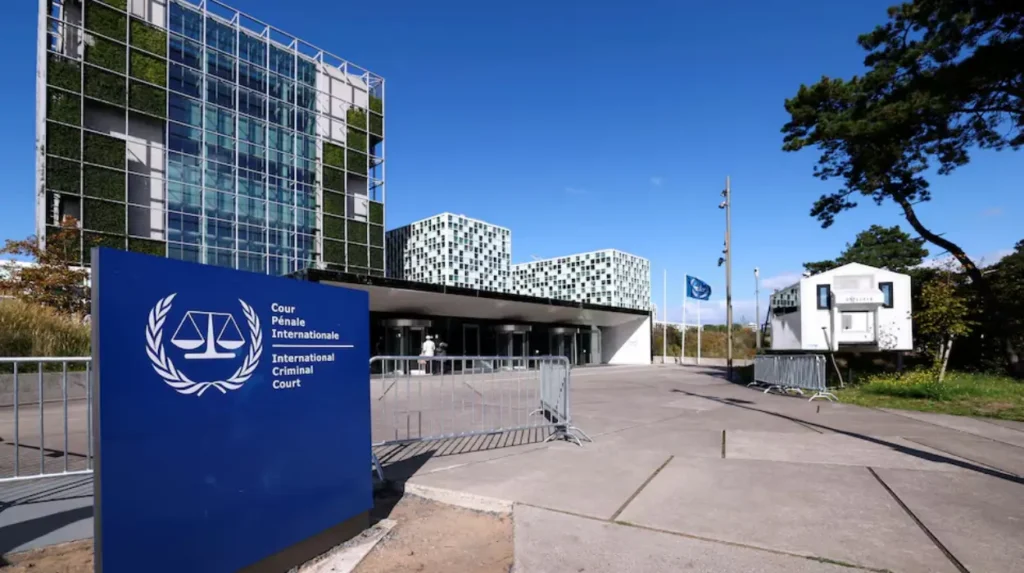
Japan has issued a rare public criticism of its closest security ally after the United States imposed sanctions on International Criminal Court President Tomoko Akane and senior trial lawyer Abdoulaye Seye. Tokyo described the measures as “very unfortunate,” signalling an unusually open disagreement with Washington over the authority of the world’s permanent court for war crimes, genocide and crimes against humanity.
This conflict puts Japan in an awkward diplomatic situation since Japan relies on the military might of the United States for its national security, but Japan is one of the biggest proponents of the ICC; Japan is a state-party to the Rome Statute and a leading financier of the Court. With Washington having imposed sanctions on Akane, who happens to be a citizen of Japan, the conflict has turned from one purely based on legal aspects into one of a political nature. The conflict reflects the larger divide between the Western governments regarding the extent of the jurisdiction of international criminal justice. The U.S., which perceives the ICC as an overly politicized and unaccountable organization that oversteps its mandate, holds a different position from Japan and the Netherlands.
Japan’s rare criticism of Washington
Japan’s Foreign Ministry issued its response on Wednesday, August 19, after the U.S. State Department announced the sanctions a day earlier. The ministry said Tokyo had consistently supported the ICC’s work to investigate and punish the most serious crimes affecting the international community.
“Japan has consistently supported the ICC, which is a permanent international criminal court, in its efforts to prosecute and punish the most serious crimes of concern to the international community and to uphold the rule of law,”
the ministry said.
From that standpoint, the ministry described the new U.S. measures as “very unfortunate.” It added that Japan would continue working to strengthen the rule of law in the international community while maintaining communication with the countries involved.
The language was measured, but politically charged. Criticism of the US by Japan is unusual in public settings as the bilateral alliance forms the cornerstone of Japanese security policy. There is much cooperation between the two in terms of deterrence, missile defense, intelligence sharing and dealing with security challenges arising from China and North Korea. There were no suggestions of counter sanctions, leaving the ICC or any impact upon security cooperation in the statement by Japan. Rather, the statement tried to separate the legal controversy from the alliance as a whole. Japan’s message was clear; the willingness to be a partner to the US in security issues does not mean supporting actions against the international court or Japanese official at that court. This careful balance is part of the larger foreign policy strategy of Japan.
Washington expands campaign against ICC
U.S. Secretary of State Marco Rubio said Washington was sanctioning Akane and Seye under Executive Order 14203, titled
“Imposing Sanctions on the International Criminal Court.”
The order provides the legal framework for financial and travel restrictions against ICC officials involved in investigations or prosecutions that Washington considers illegitimate.
The State Department accused the ICC of being
“a corrupt and fatally politicized supranational court”
that had
“maliciously abused its authority and exceeded its mandate.”
Rubio said the Court had assaulted state sovereignty and attempted to exercise jurisdiction over nationals of countries that had not ratified the Rome Statute.
In announcing the measures, Rubio said the two officials had directly engaged in efforts to investigate, arrest, detain or prosecute officials whose governments had not consented to ICC jurisdiction. The administration said its campaign would be broader than the latest designations.
“Our whole of government campaign to dismantle the threat posed by the ICC to national sovereignty will be sweeping,”
the State Department said. It added that Washington expected more countries to join its campaign by ending their funding and participation in the Court.
The administration further warned that it could take additional measures to
“systematically dismantle the ICC until it is incapable of threatening American sovereignty.”
Sanctions will block all financial assets belonging to both Akane and Seye that are located within the jurisdiction of the U.S. This will also hinder any transactions that the two are involved in, in terms of the involvement of American-based organizations, corporations, and individuals. They will also limit their ability to use the American financial system, which is critical since most of the international banks use the dollar-clearing systems located in the U.S. It was mentioned in the reports that there would be an additional time frame until September 17, 2026, during which time transactions related to Akane can go on.
Who are Tomoko Akane and Abdoulaye Seye?
Tomoko Akane is a Japanese judge, and the first Japanese citizen who became the head of the ICC. Akane was chosen to preside over the Court in March 2024 and has been a judge at the ICC since 2018. Prior to joining the ICC, she had a distinguished career in the Japanese criminal justice system and held top legal posts. It adds a certain diplomatic nuance to the sanctions against the country because Washington not only sanctions an international judicial official, but also sanctions a current Japanese citizen who leads a court sponsored by Japan.
Abdoulaye Seye is a Senegalese senior trial lawyer for the ICC. He was a member of the prosecution structure that was engaged in cases of alleged international crimes, including those related to Israel and the Gaza war. Therefore, it can be said that the United States sanctioned the leadership of the Court as well as one of its members who participates in the legal prosecution process. Thus, it seems that the choice of both Akane and Seye was made on purpose in order to deliver a certain message.
The legal dispute behind the sanctions
The United States is not a party to the Rome Statute, the treaty that established the ICC in 2002. Washington has repeatedly argued that the Court should not investigate U.S. nationals because the United States never accepted the treaty’s obligations.
The ICC and its supporters reject that interpretation as incomplete. The Court’s jurisdiction is not based solely on the nationality of an accused person. In certain cases, it can investigate alleged crimes committed on the territory of a Rome Statute member. It can also act when the United Nations Security Council refers a situation to it.
That legal principle is central to the ICC’s position on Afghanistan and Gaza. Even where an accused person is a national of a non-member state, the alleged crime may fall within the Court’s jurisdiction if it occurred in a member state’s territory or within another recognised jurisdictional framework.
Washington’s concerns have been further amplified by the fact that the ICC has investigated alleged offenses against U.S. troops in Afghanistan and issued arrest warrants against Israeli Prime Minister Benjamin Netanyahu and former Defence Minister Yoav Gallant for the crimes allegedly committed during the Gaza war. It must be understood that the issuance of the warrants does not mean conviction, as there must be a judicial process carried out in the Court and individual criminal liability established.
Nevertheless, the administration of the United States believes the warrants to be baseless and politically motivated as they are targeting high-profile officials from one of America’s close allies. In other words, the Trump administration sees the sanctions as a matter of sovereignty and not an effort to cover up for war crimes. The reasoning behind such an approach lies in the belief that no international body can establish legal authority over governments that never accepted its jurisdiction. The alternative point of view is that the aforementioned position would create blanket immunity for officials from powerful non-member states.
ICC says sanctions threaten rule of law
The ICC condemned Washington’s decision and said the sanctions endangered the international legal system. The Court argued that targeting judges, prosecutors and staff for performing their legal duties would undermine judicial independence.
“When judicial actors are threatened for applying the law, it is the international legal order itself that is placed at risk,”
the ICC said.
The Court also said that sanctions against officials carrying out its mandate were incompatible with the responsibilities assigned to the institution by its member states.
“Measures targeting judges, prosecutors and staff who work towards the fulfilment of the mandate that was conferred to the ICC by States undermine the rule of law,”
the Court said.
Despite the pressure, the ICC declared that it remained “undeterred” and stood firmly behind its personnel and victims of serious atrocities.
The statement reflects the Court’s institutional dilemma. Its authority depends on cooperation from member states, access to evidence, funding and the ability to protect its personnel. U.S. sanctions do not automatically terminate those functions, but they can make banking, travel, insurance, procurement and international cooperation more difficult.
Akane had already warned in December that American sanctions could have consequences extending beyond individual officials. She said the measures could
“rapidly undermine the court’s operations in all situations and cases and jeopardize its very existence.”
That warning is significant because the latest sanctions target the ICC’s president. If financial institutions and partner governments become increasingly cautious about dealing with Court officials, the pressure could affect ordinary administrative work as well as specific investigations.
Japan’s role in the ICC
On 1st October 2007, Japan signed the Rome Statute. Since then, it has become one of the most influential political and economic backers of the ICC. There are several factors that make Japan supportive of the ICC. First of all, Japan has always been in favour of peaceful dispute resolution, justice for gross violations and strengthening of the international community. Second, supporting the ICC is the tool that emphasizes Japan’s disapproval of aggression and war crimes in other regions of the world.
Third, the work of the Court is highly relevant to Japan’s political identity after the end of the war. The Japanese governments usually preferred international legal tools in general but had strong strategic relations with the US. Thus, the backing of the ICC is an instrument of both the foreign policy principle of Japan and of maintaining the rules-based international order. Japan became subject to extra scrutiny after the sanctions imposed by the US against Akane. Sanctioning Japan’s ICC president makes an explicit contradiction between the alliance of Tokyo and Washington.
The Japanese Foreign Ministry’s response indicates that Tokyo is not prepared to treat the sanctions as a purely American domestic measure. By defending the ICC’s mandate, Japan is protecting the legitimacy of its own financial and political support for the Court.
At the same time, Japan’s careful language suggests that it wants to prevent the dispute from becoming a broader confrontation. Tokyo is likely to continue dialogue with Washington while opposing efforts to force it to abandon the ICC.
Wider impact on America’s allies
The conflict has already pitted Washington against European allies. The Netherlands, where the ICC is located in The Hague, did not approve of sanctions. Dutch Foreign Minister Tom Berendsen called Akane to negotiate the Netherlands’ continued support for the International Criminal Court. This stance might motivate other European nations to speak up in support of officials of the ICC and ensure financial backing. In addition, this action may contribute to suspicions that Washington intends to use its national economic leverage to put pressure on the independent international institution.
This issue is especially sensitive with regard to nations that recognize the Court’s investigations into the criminal activity of Russian officials and maintain close relationships with the United States. Those governments which advocate for the ICC investigations into Russia will have trouble endorsing the actions of the United States if the investigations cover Israel or America. As a result, there will be a division within the West concerning international justice. Washington will require protection for its nationals and allies, whereas Europe and Asia will stand for equality under the law irrespective of citizenship and political connections.
A test for the U.S.-Japan alliance
These sanctions are not signs of deterioration in the alliance between the U.S. and Japan. Security collaboration is much more vital to the two countries than their disagreement on the ICC. Japan is under security threats in the region which render its alliance with the U.S. essential, while the U.S. sees Japan as one of its major allies in the Indo-Pacific region. However, this situation creates a new point of contention. The U.S. can perceive Japan’s support of Akane as a sign that Japan is safeguarding an organization whose actions are considered by the U.S. administration to be against the national sovereignty. On the other hand, Japan may see the application of the sanctions on its soil as a way through which it will lose its credibility whenever it talks about accountability in other cases.
For now, Tokyo’s formula is clear: maintain communication with Washington, avoid retaliatory action and continue supporting the ICC’s role in prosecuting the most serious crimes.