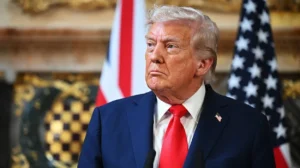
The reported decision to secretly move President Donald Trump from Air Force One to a smaller military aircraft after the NATO summit in Ankara has exposed the extraordinary lengths to which U.S. security agencies may go when presidential travel is threatened. The operation reportedly involved a catering vehicle, a decoy aircraft, concealed flight information and a deliberate effort to keep the travelling press corps—and possibly some White House officials—unaware of the president’s actual location.
According to The Washington Post, Trump left Türkiye on July 8 on a US Air Force C-32A aircraft after initially boarding the presidential plane in front of cameras. The transfer was reportedly carried out because of a threat from Iran to carry out an assassination attempt on the president’s plane or because of intelligence that Iran or any pro-Iranian groups could try to hit Trump’s aircraft. Reuters also later reported about the event, based on the report from The Washington Post, confirming that it was indeed a secret operation.
This event was not just an exchange of planes; it was a sophisticated cover-up plan which aimed at making it seem like the old plane had the president aboard when Trump was transferred secretly to Britain. The event brought up issues regarding the safety of the newer Boeing 747-8 provided by Qatar, the credibility of the intelligence regarding Iran, and the extent of secrecy around presidential movements.
A carefully staged departure
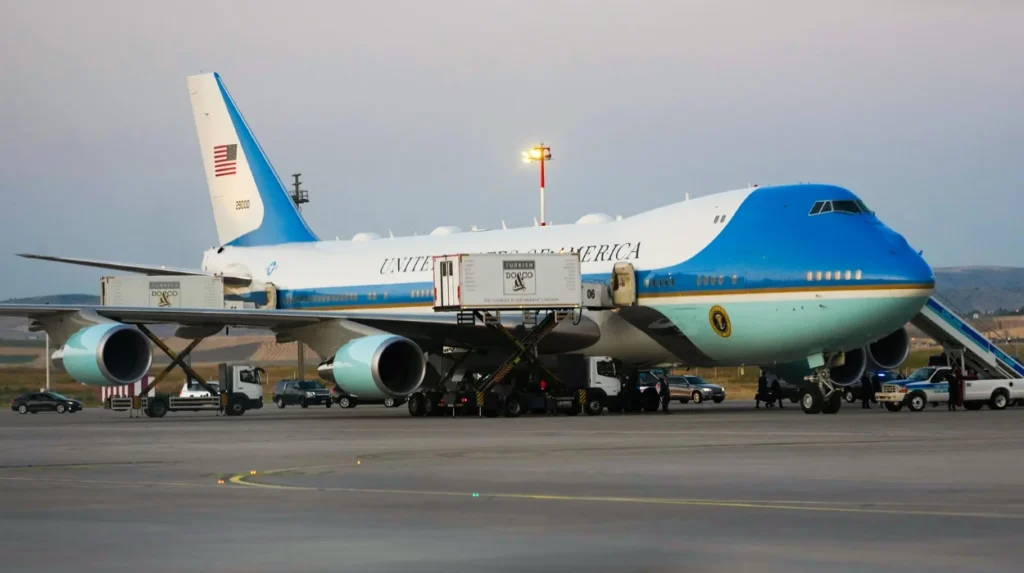
It is noteworthy that prior to his journey, Donald Trump arrived at Ankara to attend a NATO conference using the new Boeing 747-8 supplied by Qatar. However, upon his return, the new aircraft was sent to Britain before Trump boarded the old Air Force One. This move was considered interesting since it was a new, expensive $400 million aircraft and a potential future presidential aircraft. The story unfolded later. As soon as Trump boarded the old aircraft in front of all cameras, he was allegedly taken away from it inside an airport catering vehicle. It was usually used to supply planes with various provisions and parked next to the plane in such a way that it was on the same level with a plane entrance. Trump together with some of his aids was transported to the C-32A military plane using the said vehicle. According to CNN, this procedure was an “elaborate ruse” during which Trump got off the old presidential aircraft using an airport catering vehicle and got on a smaller military plane.
The older aircraft continued to operate as a decoy. It carried journalists and some White House personnel, creating the public impression that Trump remained aboard. According to reports, the travelling press pool was not informed of the transfer at the time. Some White House staff members were also allegedly unaware that the president had left the aircraft.
That concealment was central to the operation. If an adversary was monitoring presidential movements, the visible departure of Air Force One could have provided a false target while Trump travelled aboard the smaller C-32A under a military transport call sign.
The Iranian threat behind the move
U.S. officials reportedly considered the threat sufficiently serious to alter Trump’s travel arrangements. The reported danger involved Iran or Iranian-backed groups and was described by some sources as a possible assassination attempt against Trump or a missile attack against the aircraft carrying him.
The earlier reports of The New York Times had stated that the Secret Service suggested to President Trump that he travel back to the U.S. in the old Air Force One since there were concerns related to security due to the absence of the certain defensive systems in the Qatar-owned aircraft. CBS News reported that the departure of Trump from Ankara happened as a response to a credible threat coming from the Iranian proxies and involving a potential missile attack.
There was no complete agreement on the nature of the threat in the reports. While initially it was reported that it was a generic security threat rather than a specific plot, CNN had reported that no new threat was actually discovered against the president at that time, while intelligence information suggested that some members of the hard-line Iran leadership were eager to target him. In the latter reports, including the Washington Post version, the threat was described in more detail as an Iranian assassination plot.
Publicly available information does not establish exactly what intelligence was received, which agency produced it or whether U.S. officials confirmed an operational Iranian plan. There has been no public release of the underlying intelligence assessment.
The aircraft security dispute
The operation was closely connected to a dispute over the Qatar-donated Boeing 747-8. The aircraft had been offered to the United States for presidential use but reportedly lacked some of the specialised defensive systems and secure communications capabilities associated with the existing Air Force One fleet.
The older Air Force One aircraft is equipped with classified communications, electronic countermeasures, missile-warning systems and other defensive technologies. Public reports have referred to laser-based systems capable of interfering with heat-seeking missiles, although the full specifications remain secret.
The Qatari aircraft had been modified for presidential use, but former U.S. officials questioned whether all required security work could have been completed in a short period. The Guardian reported that the aircraft was valued at roughly $400 million and that Trump said it would be “maxed out” with the necessary protections.
The White House rejected any suggestion that Trump had been exposed to unacceptable danger. White House Communications Director Steven Cheung said,
“The new Air Force One is a state-of-the-art aircraft that has been fitted with high-level security protocols that ensure the safety of the President and his staff.”
The Air Force also defended the aircraft, saying it was
“safe, secure, and equipped with the most advanced technologies necessary to meet requirements of the presidential mission.”
The service added that some capabilities would be completed or enhanced as the aircraft moved through the presidential modification process.
The distinction is between being safe enough to carry the president and possessing every capability of a fully integrated U.S. presidential aircraft. An aircraft can have secure communications and basic protective systems while still lacking the layered defensive architecture, redundancy and operational integration of the long-established Air Force One fleet.
Trump’s public explanation
Before the fuller account emerged, Trump presented the use of the older aircraft as a relatively routine decision. He said the newer aircraft had been sent ahead to Britain to allow military personnel to inspect it.
Trump also spoke publicly about the danger from Iran. During the NATO summit, he said,
“I’m No. 1 on the kill list for Iran.”
He did not provide evidence or operational details supporting the claim.
He later went on record to say that Iran will suffer a retaliatory strike in case it tries to murder him. CNBC says that Trump made it known that 1,000 missiles were “locked and loaded” and would hit Iran in case it tried to murder him. This was one of the administration’s ways of dealing with the hostile attitude it held towards Iran. Nevertheless, the claims made did not prove the existence of a plan to launch an attack at all. The initial statements by the administration regarding the aircraft swap as “distracting and misleading” seem now more reasonable.
Why use a C-32A?
The C-32A is a modified Boeing 757 used to transport the vice president, cabinet officials and other senior U.S. government figures. It is smaller and less recognisable than a presidential Boeing 747 and can operate under a military transport call sign rather than the highly visible Air Force One designation.
Technically speaking, the name “Air Force One” does not apply to one particular airplane. This is the designated code name of any airplane carrying the American president. In case if Trump had been aboard the C-32A, this particular airplane should have been called Air Force One. Using another military code apparently helped hide Trump’s whereabouts. Therefore, Trump’s ride on the C-32A served as dual-purpose transportation.
On the one hand, this particular airplane provided him with a more secure mode of transport compared to the recently-modified Qatarian plane. On the other hand, it was unlikely for any hostile parties to identify his whereabouts using any public flight tracking websites. Reportedly, the C-32A was transported to Britain apart from the two Boeing 747 airplanes. The Qatarian plane arrived first, and then there came the C-32A and the old Air Force One.
The press and transparency problem
The most politically sensitive aspect of the episode may not be the catering vehicle but the exclusion of the travelling press pool. Presidential reporters are normally expected to accompany the president in order to provide an independent record of his movements and activities.
In this case, journalists reportedly remained aboard the aircraft that functioned as a decoy. They were apparently unaware that Trump had transferred to another plane. As a result, the press pool could not independently verify the president’s actual flight, arrival or location during the journey.
There is a clear security argument for limiting information in an emergency. The Secret Service is responsible for protecting the president, not for preserving the normal convenience of journalists. If public knowledge of the president’s aircraft created a credible risk of attack, concealing his route could be justified.
But the operation also raises institutional concerns. The White House reportedly allowed the public impression to continue that Trump was aboard Air Force One. That goes beyond withholding sensitive information and approaches the deliberate creation of a false travel narrative.
The distinction matters because presidential travel has constitutional, political and historical significance. Journalists rely on access arrangements to verify where the president is, who accompanied him and whether official accounts are accurate. If press pools can be unknowingly placed on a decoy aircraft, future administrations could cite security as a reason to restrict independent presidential coverage more broadly.
What is confirmed and what remains uncertain
Several sources agree that Trump came back from Türkiye using the older Air Force One plane and not the new Qatar-gifted one, and the reason for doing so has been attributed to security concerns related to Iran. Sources also agree that the Qatar-gifted plane left ahead for the United Kingdom before Trump could use it for his return to the United States. Some of the most sensationalized aspects of the report such as the catering-truck move, Trump’s move within the airport container and the fact that no journalist was aware of it came mainly from unnamed officials and people who knew of the whole operation.
According to the Washington Post, the publication has examined the video footage and other material provided by the airport, and the White House has not issued an official timeline yet. It is still unclear whether the Iranians had a concrete action plan against Trump during the NATO meeting or whether any American agency took the threat based on a general intelligence report.
A security success—and a warning
If the reported account is accurate, the operation succeeded in preserving uncertainty about Trump’s location during a period of heightened tension with Iran. A decoy presidential aircraft, a smaller military jet and a concealed transfer would make it more difficult for an adversary to track the president through visual observation or open flight data.
However, at the same time, the case illustrates the weaknesses of presidential travels. The scandal regarding the use of the donated plane proves that an expensive or state-of-the-art aircraft does not necessarily mean a fully prepared platform for national security. Special communications, electronic warfare capabilities, defense from missiles, logistics hardening, and years of testing are required for presidential planes. Additionally, the case clearly reveals that there can be a clash between security needs and democracy. The authorities might have had a justifiable reason for concealing the existence of Trump’s plane, yet the reported deception prevented reporters and citizens from independent verification of facts.