U.S. President Donald Trump has claimed that the United States Navy has achieved “100%” control of the Strait of Hormuz, escalating an already dangerous confrontation with Iran over the strategic waterway.
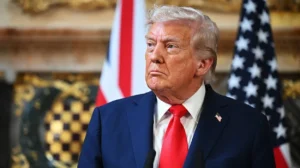
Speaking to reporters in the Oval Office on Monday, Trump said the strait was open and that American forces were the only power controlling access through it. He attributed the claim to the U.S. Navy’s mine-clearing operations and its continuing blockade of Iranian ports and coastal areas.
“It’s open now. The only one that has control of the Strait of Hormuz right now is the United States Navy,”
President Donald Trump said.
Trump described the American military position as a “steel wall” and said Iranian efforts to place mines had not undermined U.S. authority.
“They will, on occasion, drop a mine, and we find the mine,” Trump said.
These comments constitute the most definitive example of Trump’s continual claims that Washington, not Tehran, will decide if ships can transit safely through the strait. They also illustrate the crux of the conflict between the United States and Iran regarding negotiations; whether the United States guarantees freedom of navigation or seeks to control the international maritime strait through force of arms.
Military power versus legal control
However, Trump’s statement has some operational realism, although it goes well beyond the evidentiary support provided in his statement. The United States boasts the most powerful navy in the area. It has sent warships, planes and maritime monitoring devices to safeguard shipping and to carry out the blockades of Iranian ports. This makes it possible for the US to escort vessels, intercept ships, conduct inspections and deal with any threats. The US Central Command also reported that American troops are monitoring the strait so as to keep it open. However, military influence does not equate legal sovereignty. The Strait of Hormuz separates Iran from Oman. The narrowest part of the strait is about 21 nautical miles wide. The waters of the strait belong to the territorial seas of the two coastal states.
The United States neither owns the strait, nor administers it as sovereign land, nor does it have an internationally recognized right to determine which vessels can traverse it. Ships and aircraft normally have the right to navigate the strait, as per the principle of transit passage in international law. Coastal states do not have the right to arbitrarily suspend this right.
Although the United States and Iran have not both ratified the UN Convention on the Law of the Sea, maritime experts generally regard the rules governing international straits as reflecting customary international law.
The legal position also complicates Iran’s claims. Tehran cannot automatically convert the waterway into a national checkpoint, impose compulsory passage permits or close the route whenever political tensions rise. The most accurate description, therefore, is not that either side has complete control, but that the United States and Iran are contesting operational authority over a waterway that remains legally international.
Why the waterway is critical
The Strait of Hormuz links the Persian Gulf with the Gulf of Oman and the Arabian Sea. It is the principal maritime route for the energy exports of Saudi Arabia, Iraq, Kuwait, the United Arab Emirates, Qatar and Iran.
The U.S. Energy Information Administration said oil flows through the strait averaged approximately 20 million barrels per day in 2024. That represented about 20% of global petroleum-liquids consumption and more than one-quarter of global seaborne oil trade. Approximately one-fifth of the world’s liquefied natural gas also passed through the waterway.
The Asian economies which would suffer the most from a long-term disruption are China, India, Japan, and South Korea. Collectively, they constitute almost 69% of the crude oil and condensates shipments through Hormuz to the Asian countries in 2024. Qatar’s shipments of liquefied natural gas (LNG) also rely extensively on the shipping lane, so that the crisis poses danger to the supply of both oil and gas.
America is less reliant on the Strait of Hormuz compared to decades before. Persian Gulf crude oil and condensates shipped through the strait account for about 2% of total US petroleum liquids use in 2024. However, any significant disruption will still have an indirect impact on American consumers due to higher oil prices worldwide, higher insurance rates, increased transport costs, and strain on allied economies. In addition, Saudi Arabia and the United Arab Emirates have pipelines which can bypass parts of the strait, but their spare capacity is estimated to be only 2.6 million barrels per day.
Iran’s challenge to Washington
The Iranian stance is that the United States cannot singlehandedly control the water passage. The Iranians have viewed the U.S. naval presence and blockade as the major impediments to resuming normal shipping activity. The Iranian government has also contended that previous agreements allowed for the country to have a say in determining the conditions of shipping. The Iranian stance is that the United States has to pull back its navy, terminate the blockade, and recognize the role of Iran in ensuring security prior to reopening the passage.
Some of the demands reported from the Iranians include ceasing U.S. military activities, lifting sanctions, unfreezing Iranian assets, and compensating for the damages caused by the war. Iran also requires assurances of no future attacks on the country and a role in defining shipping procedures. According to reports, the Iranian Parliament Speaker, Mohammad Baqer Qalibaf, stated that the management of the strait will not revert to pre-war times. In May, Iran created the Persian Gulf Strait Authority and declared that ships required a passage permit to pass through the strait.
That demand directly conflicts with Washington’s interpretation of freedom of navigation. The United States has rejected any Iranian system under which Tehran could decide which commercial ships enter or leave the Gulf, or require vessels to pay compulsory transit charges.
The disagreement became sharper after Trump proposed a 20% charge on cargo shipped through the waterway. He said the payment would compensate the United States for providing maritime security. Iran responded that the charge was excessive but indicated that a fair fee for genuine security services might be considered.
The proposal has exposed an important political contradiction. Washington criticises Iran for attempting to impose control over an international waterway, yet Trump’s own proposal could be interpreted as an attempt to impose a U.S. security charge on international shipping.
The blockade and shipping disruption
The United States has maintained a naval blockade of Iranian ports since mid-April, with the measure later being reinstated after attacks on commercial vessels and renewed military confrontations.
In July, U.S. Central Command said the blockade applied to vessels travelling to and from Iranian ports and coastal areas. At the time, more than 20 U.S. Navy warships and hundreds of military aircraft were reported to be operating across the Middle East.
U.S. officials say American forces have helped facilitate the passage of more than 800 commercial vessels through the Strait of Hormuz since early May. They have presented the figure as evidence that the U.S. Navy is protecting international commerce rather than closing the waterway.
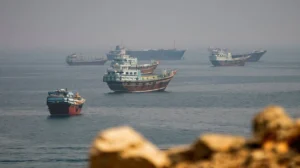
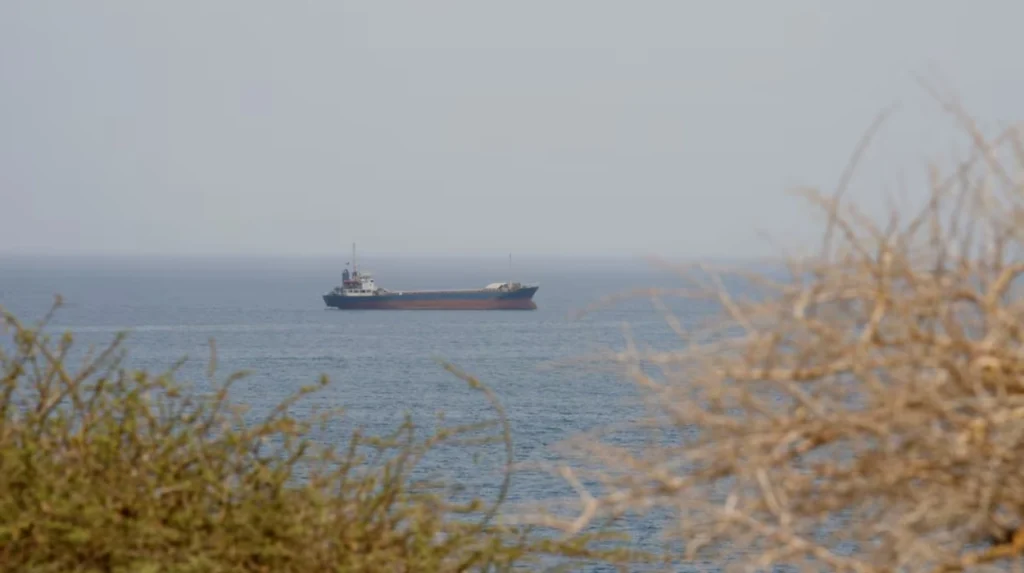
However, the reality at sea is far from usual. As follows from the media reports about the shipping crisis, daily traffic went down from around 130 to 140 movements of vessels prior to the onset of conflict to just a few on certain days. Once only two ships were reported crossing the strait on a certain day. As of August 9, according to the statement from the U.S. Central Command, 53 commercial vessels were rerouted, two of which were rendered inoperative and two boarded for inspection.
The maritime authorities warn ships about the expected increase in radio communication, surveillance from the Iranian Revolutionary Guard Corps, potential inspections and the significant presence of the U.S. Navy. These numbers refute the idea of the safe and unobstructed passage. One could be an open waterway while the vessels avoid passing there due to the dangers of being attacked, seized, detained, or insurance problems. From a maritime perspective, navigability does not consist only in the possibility for the warship to enter the waterway; it is also about the passage of neutral merchant vessels.
Diplomatic stakes and Pakistan’s role
The competing claims over Hormuz are now linked to broader attempts to negotiate an arrangement between Washington and Tehran.
Pakistan’s Defence Minister Khawaja Asif said on August 11 that the United States and Iran were close to “some sort of arrangement” or peace deal. Pakistan, Oman and Qatar have been involved in diplomatic efforts aimed at reducing tensions and restoring commercial navigation.
The two nations of Iran and Oman seem to have had discussions on a possible route for shipping and have come to some agreement concerning the coordinate points. However, there are still unresolved issues such as who will have jurisdiction over the passage of vessels, the need for ships to get permission and also how the incoming and outgoing vessels will be handled and whether there will be any charges at all.
President Trump has constantly mentioned that a deal that will lead to the opening up of the strait is imminent. On August 5, he indicated that the waterway “is sort of open right now” and that considerable strides have been made. However, Iran maintains that the United States needs to first stop what they refer to as its hostility. The diplomatic challenge is difficult due to the fact that both parties are trying to use military force to achieve political gains.
Global economic consequences
The conflict has already unsettled oil markets. Brent crude was reported near $89.67 per barrel, while U.S. benchmark crude was around $83.98 per barrel. Oil prices had risen by more than 10% over the previous week as uncertainty over the strait intensified.
A prolonged closure or partial disruption could produce a wider economic shock. Asian refineries would face difficulty replacing Gulf supplies, LNG prices could rise, and shipping companies would pay higher insurance premiums to enter the region. Oil tankers could also be forced to wait outside the Gulf or take longer routes around the Arabian Peninsula.
The crisis would not necessarily remove all energy supplies from world markets immediately, because some countries have strategic reserves and limited pipeline alternatives. However, even a partial reduction in flows could raise prices sharply because the global market has little spare capacity to replace 20 million barrels per day at short notice.
The risk is especially serious for energy-importing Asian states. China, India, Japan and South Korea would face the greatest direct exposure, while poorer developing countries could experience higher fuel, transport and food costs.
What Trump’s statement means
Trump’s declaration is best understood as a political and military message rather than a settled legal fact. It is intended to reassure shipping companies, pressure Iran in negotiations and demonstrate that the United States has seized the strategic initiative.
The US has the capability of exerting dominance over naval operations in the area through mine clearance, protecting selected vessels and making life hard for Iranian forces. However, geography continues to favor Iran in this instance. Iran sits on the northern shoreline, capable of monitoring a good deal of the channel and is able to employ mines, missiles, drones and fast attack boats to terrorize the maritime traffic. All of this indicates that the US could have the edge when it comes to military capabilities, but not uncontested control. Even though the Iranians have no legal jurisdiction in closing the strait, they have the capacity of making navigation through the waterway perilous such that commercial interests stay away from it. This is significant when it comes to any future agreements because it means that a sustainable agreement must also involve who will set the terms of navigation and how commercial shipping will be protected.