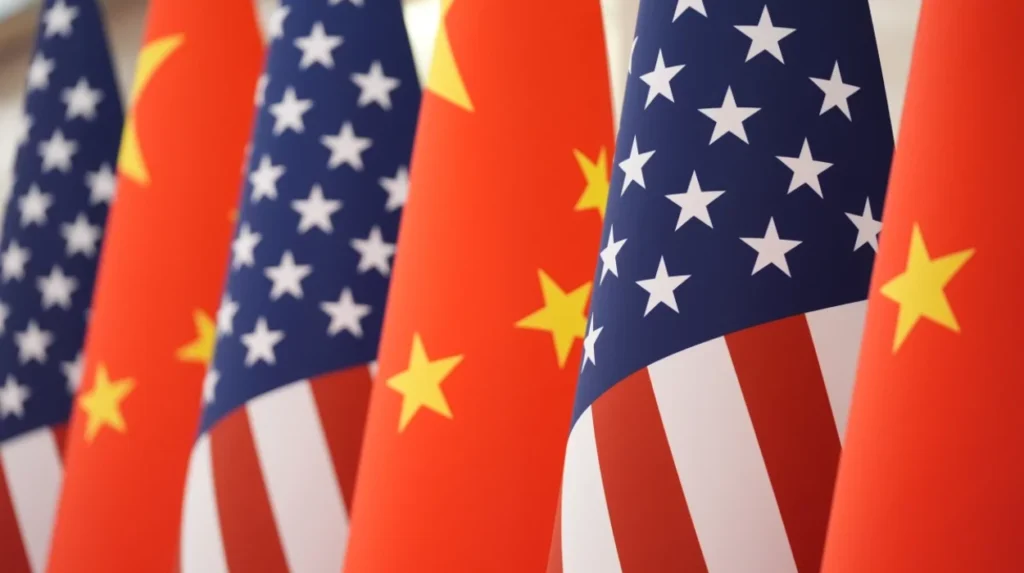
China has taken action against the increasing restrictions that America is imposing on Chinese technology firms by announcing sanctions on ten American defense contractors and rare earth mining firms, with this action being considered the latest escalation in a conflict between the two global superpowers that has spanned many decades. This move, which was done on Monday, June 22, 2026, involves putting sanctions on U.S. defense contractors and rare earth mining firms by banning their imports of crucial dual-use products from China.
Beijing’s countermeasure is all the more interesting given that only days ago, the Pentagon issued an updated version of its 1260H List, often referred to as the Chinese Military Enterprises List, adding many Chinese technology enterprises allegedly contributing to Beijing’s military modernization campaign. The new regulations debar prominent Chinese technology firms from entering into contracts for US defense projects, an act which the Chinese government has vehemently criticized as discriminatory and baseless.
The Mechanics of China’s Retaliatory Package
China’s Ministry of Commerce announced an export control system that forbids the exportation of dual-use products to the ten listed American companies. Dual-use products refer to those commodities, technologies, and material that can be used for both civilian and commercial purposes as well as military purposes. This type of product is highly desirable by military organizations involved in manufacturing military technology.
The sanctioned companies span two critical sectors: military drone manufacturers and rare earth mining operations. Among the specifically identified firms are MP Materials Corp, USA Rare Earth, Teal Drones, and Jaia Robotics, though the official Chinese announcement does not provide a complete public list of all 10 targeted companies. This selective disclosure appears designed to maximize pressure while maintaining strategic ambiguity about the full scope of Beijing’s targeting criteria.
“The export restriction aims to protect China’s national security,”
stated the Ministry of Commerce in its official announcement, framing the measures as a defensive response rather than an aggressive maneuver. The ministry emphasized that all existing export activities between Chinese suppliers and the sanctioned U.S. companies must cease immediately, with no grace period for compliance.
Washington’s Trigger: The Pentagon’s 1260H List Expansion
The expansion of the 1260H list is an embodiment of increasing bipartisan anxiety on the part of Washington lawmakers regarding the supposed connections between Chinese tech firms and the Chinese military apparatus. The 1260H list, as per Section 1260H of the National Defense Authorization Act, compels the Department of Defense to compile a list of Chinese firms believed to be helping the PLA in its modernization process.
This month, the Pentagon added many new companies from China to its list, ranging from those that manufacture technology in fields like artificial intelligence, semiconductors, aerospace, and advanced communication technologies. These companies suffer from strict limitations when it comes to working with the U.S. government and taking part in any defense-related research.
The expansion appears particularly targeted at China’s emerging technology sectors, where Beijing has invested heavily through state-backed initiatives aimed at achieving technological supremacy in critical industries. By preventing Chinese firms from participating in defense contracts, the United States seeks to limit their access to cutting-edge research, development funding, and potential military applications of their technologies.
China’s Official Position and Strategic Messaging
The actions of Chinese officials were presented in such a way that they were viewed as being forced to react defensively because of the unnecessary targeting of the legitimate Chinese businesses by America. The statement of the Ministry of Commerce was an indication of Beijing’s resolve to safeguard its firms.
“It’s a direct response to the U.S. government’s egregious act of adding to its so-called ‘Chinese military enterprise list,'”
the ministry declared, using deliberately strong language to convey Beijing’s displeasure while avoiding terminology that might provoke immediate diplomatic backlash. The use of the word “so-called” signals China’s rejection of the list’s legitimacy and its underlying assumptions about Chinese companies’ military ties.
“The U.S. is creating discriminatory lists under the guise of national security,”
the ministry further accused, suggesting that Washington’s national security rationale masks what Beijing views as economically motivated protectionism designed to stifle Chinese technological competition. This narrative aligns with China’s broader diplomatic strategy of portraying itself as a victim of American hegemony while positioning its actions as rightful resistance to unfair treatment.
“China will implement all necessary measures to protect Chinese companies,”
the announcement concluded, leaving open the possibility of additional retaliatory actions if Washington continues its current trajectory. This language serves both as a warning to the United States and as reassurance to Chinese domestic audiences that the government will not tolerate external pressure on its business community.
Strategic Implications for Rare Earth Markets
Rare earth mines have great importance in terms of being part of the sanction list of China because of the use of rare earth materials in defense technology in the current era. Scandium, yttrium, and other lanthanides are required in all types of military technology, including fighter jet engines, missiles, electric motors used in war machinery, and radar systems. China is the world leader in the production of rare earth materials; almost 60-70% of the total mining production and 90% of the refined rare earths belong to China. Thus, Beijing has great power over any country trying to build its defense technology or switch to green energy technology through rare earths.
MP Materials Corp, being the largest rare earth miner in the Western Hemisphere and the owner of the Mountain Pass mine in California, is especially exposed to the potential implications of these sanctions. It had been making efforts to develop a vertically integrated rare earth supply chain in America, where processing plants will be established to decrease dependence on the refinement capacity of China. Nevertheless, the Chinese export restrictions may hinder the ability of MP Materials to obtain the necessary equipment or intermediate products.
USA Rare Earth, another sanctioned company, is developing the Round Rock rare earth project in Texas and has similarly aimed to create domestic supply chains for critical minerals. The sanctions threaten to delay or complicate these efforts, potentially extending the timeline for establishing non-Chinese rare earth processing capacity.
Military Drone Industry Impact
The targeting of drone manufacturers like Teal Drones and Jaia Robotics reflects growing U.S.-China tensions over unmanned systems technology, which has become increasingly important in modern military operations. Both companies specialize in tactical drones used for surveillance, reconnaissance, and potentially combat applications, sectors where Chinese manufacturers have gained significant competitive advantages through cost-effective production and advanced technology integration.
The Chinese components such as batteries, motors, cameras, and navigational equipment used in drones are now essential elements of the supply chain for many American drone manufacturing firms owing to their excellent blend of performance and cost-effectiveness. The inability of these U.S. firms to acquire the required components will mean that the firms will be forced either to modify their products or look for other options that would prove more expensive or even disrupt production processes in their efforts to comply with their defense contracts. The sanctions show the acknowledgment of the importance of drones in military matters by the Chinese government and its resolve to use the power of export control to hinder America’s defense efforts in this arena.
Previous Sanctions Escalations
The most recent sanctions constitute the third major round of retaliatory actions taken by China against U.S. defense firms within a few years, continuing the trend of an increasingly aggressive tit-for-tat policy that characterized relations between Beijing and Washington ever since Trump’s first term. In December 2025, China imposed mainly symbolic sanctions on 20 U.S. defense firms and 10 of their executives, such as Boeing and Northrop Grumman, due to the U.S. decision to approve new weapons supplies to Taiwan worth over $10 billion. The sanctions were mostly limited to the restriction of Chinese contracts with the sanctioned firms and executive visa restrictions.
January 2024 saw Beijing sanction five U.S. defense companies under its Anti-Foreign Sanctions Law, a legal framework enacted specifically to counter foreign sanctions against Chinese entities. Those measures included investment restrictions and trade bans but similarly focused on companies with relatively limited exposure to Chinese markets.
The new sanctions will have a different effect in terms of implementation since they will concentrate on imposing control over the export of dual-use products. This would mean that these sanctions would immediately affect the targeted companies and could lead to an interruption of the companies’ activities within several weeks.
Broader Trade War Dynamics
This is indicative of the shift in the nature of the relationship between the United States and China from one that was concerned mostly about trade imbalances and tariffs to a technologically competitive relationship in a number of industries. Technology is now seen by both countries as necessary for security, economic strength, and global power.
Washington’s approach has emphasized “small yard, high fence” strategies that target specific technologies deemed critical to national security while maintaining broader trade relationships in non-sensitive sectors. China’s response has been more comprehensive, using its market dominance in critical materials and components as leverage to discourage U.S. restrictions and protect its technological development programs.
The economic impact is not limited to the target companies only. American defense firms are likely to incur increased cost and delay in manufacturing due to the necessity to source components from other suppliers, which could disrupt the development of their weapon systems program. The Chinese firms could have trouble finding other customers after being deprived of American military contracts.
Potential for Further Escalation
Analysts warn that this may just be the start of a possible cycle of escalation, especially considering that both countries possess huge stockpiles of tools that can be used to inflict economic damage. In the case of America, it can impose more sanctions on Chinese technology companies, more investment bans, or even impose secondary sanctions on firms still operating with the sanctioned Chinese businesses.
China retains substantial leverage through its dominance in critical materials, including not only rare earths but also other minerals essential for electronics manufacturing and green energy technologies. Beijing could expand export controls to additional sectors, impose restrictions on U.S. agricultural exports, or limit access to Chinese markets for American companies.
The diplomatic implications are equally significant, as continued escalation could undermine cooperation on shared global challenges and deepen geopolitical divisions that affect international alliances and security arrangements. Both Washington and Beijing face pressure from domestic constituencies to demonstrate strength and protect national interests, making de-escalation politically difficult even when mutual benefits from cooperation exist.
The coming weeks will be critical in determining whether this latest escalation represents a new normal in U.S.-China relations or whether both nations can find pathways to manage their competition without triggering uncontrolled economic conflict that could harm global prosperity and stability.