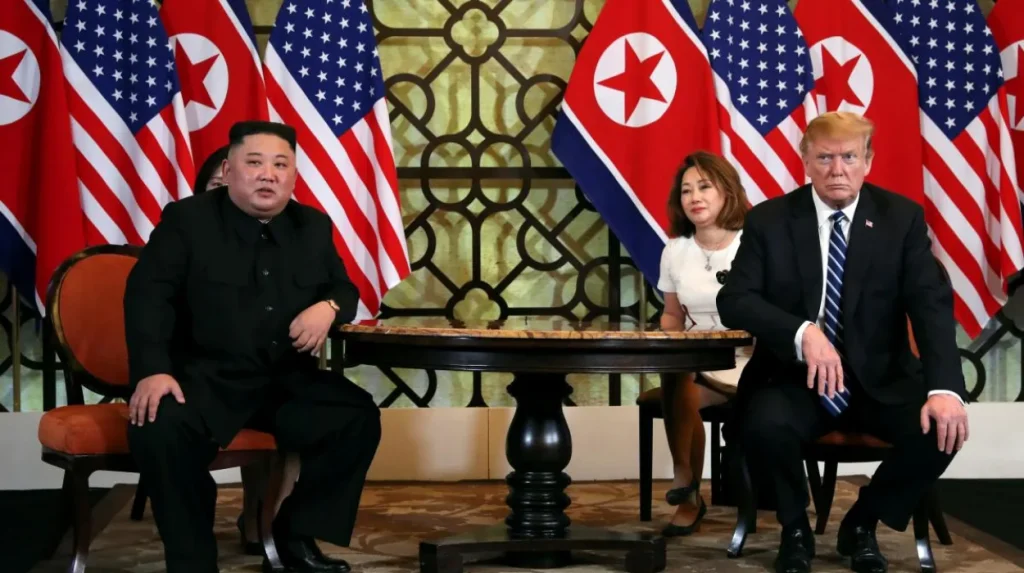
The US-North Korea Diplomatic Talks Update 2025 unfolds within a tense strategic environment defined by accelerating missile development in Pyongyang and recalibrated diplomatic priorities in Washington. Early 2025 marked renewed international attention after North Korea carried out a series of short-range ballistic missile tests, signaling its capacity to advance weapons programs despite economic constraints. These actions heightened US urgency to revisit dialogue channels while ensuring cohesion among allies concerned about regional deterrence stability.
The Biden administration continues to emphasize pressure combined with diplomacy, echoing previous bipartisan approaches but applying enhanced coordination with Seoul and Tokyo. The administration’s policy framework insists that denuclearization remains essential to any long-term settlement, even as officials acknowledge the growing complexity of achieving verifiable constraints. North Korea’s insistence on full sanctions relief before substantive commitments further complicates the landscape.
Washington describes its stance as “practical diplomacy,” reiterating willingness to hold exploratory talks without preconditions. However, Pyongyang’s intermittent engagement patterns and emphasis on sovereign defense capabilities reflect a strategic play aimed at extracting maximum political concessions while avoiding definitive commitments.
Evolving Dynamics In High-Level Engagements
Indirect communication through regional partners has intensified in 2025. South Korea’s mediation efforts, backed by its renewed security strategy, have facilitated limited information exchanges between American and North Korean negotiators. According to senior administration officials, several proposals for a phased freeze have been conveyed indirectly, focusing on limiting missile test frequency in exchange for humanitarian exemptions to existing sanctions.
North Korea’s responses have alternated between conditional openness and strong criticism of US “hostile policies.” This oscillation reflects Pyongyang’s broader communications tactic signaling readiness to talk while maintaining deterrence gestures designed to strengthen bargaining positions.
Interplay Between US Envoys And Regional Partners
US special envoys’ coordinated visits to Seoul, Tokyo, and Beijing illustrate a sustained American strategy to align regional expectations. Officials confirmed in mid-2025 that Washington had agreed with Seoul on a joint verification framework proposal. This framework aims to establish baseline inspections of Yongbyon facilities using advanced monitoring tools developed through a trilateral US-Japan-South Korea initiative.
China’s role in facilitating communication has grown quieter but remains consequential. Beijing has continued to propose variations of the “dual suspension” concept, urging the US to reduce large-scale military exercises in exchange for testing freezes. Although Washington has not agreed to such terms, the possibility of altering exercise schedules remains a subtle but significant negotiation lever.
North Korea’s Calculated Signaling
Pyongyang’s missile launches, satellite tests, and public statements underscore a deliberate approach to shaping negotiation conditions. North Korean officials assert that nuclear capabilities are “non-negotiable defensive tools” but indicate conditional interest in discussing arms control rather than denuclearization. This shift in framing, noted by analysts in 2025, aligns with broader global trends in nuclear modernization and reflects Pyongyang’s bid for recognition as a de facto nuclear state.
Challenges Hindering Negotiation Progress
One of the most difficult aspects of the US-North Korea Diplomatic Talks Update 2025 is the verification debate. American intelligence agencies and IAEA assessments point to ongoing activity at covert enrichment sites beyond Yongbyon. Without full disclosure, any freeze risks superficial compliance. The US and regional partners have floated the introduction of AI-supported monitoring tools and satellite-based automated detection systems, though North Korea has dismissed such mechanisms as infringements on sovereignty.
Domestic Pressures On Both Sides
The politics in Washington makes it difficult to have manoeuvring space by the administration. The idea of sanction relief without iron-clad safeguards has been challenged by congressional committees, and the diplomatic pace has been criticized by the lawmakers of the other parties as being either too slow or too amiable. These limitations drive the American negotiators into a small range of compromising well.
Meanwhile, the diplomatic behavior in North Korea is also influenced by internal conditions. Sanctions and restrictions at the border intensify economic pressures, and Pyongyang needs to obtain relief but internal propaganda requires the display of power. The fear of being susceptible to the external pressure makes the leadership less effective in terms of permitting major concessions.
Regional Military Posture And Escalation Risks
In mid 2025, the US-South Korea exercises led to a strong statement by Pyongyang that threatened to cause unpredictable consequences. The exercises were smaller than those of the past years, but this does not mean that they are not a continued sore point. The further threat perception of North Korea is also due to the further development of missile defense capabilities in Japan such as new interceptors deployed in early 2025.
These are some of the factors that present more levels or distrust that have to be maneuvered before any significant agreements can be established.
Assessing The Multilateral Strategic Environment
The new diplomatic policy of South Korea, which is known as the New Northern Policy, focuses on the growth of economic corridors and crisis-management systems. Seoul is driving towards humanitarian avenues that are immune to sanctions. This is in line with the willingness of Washington to negotiate some flexibility in humanitarianism but does not match with the demand of Pyongyang on the overall sanctions destruction.
Japan’s Increasingly Active Security Posture
Japan has taken a more dramatic role in the diplomatic equation in 2025. Its government has increased intelligence-sharing agreements with South Korea and the US. Tokyo wants strong assurances that the future freeze or limit agreement would not weaken deterrence on its territory. This demand is indicative of domestic security arguments as well as the issue of increased accuracy of North Korean missiles.
China’s Balancing Act
The situation of China is strategically conservative. Beijing is an advocate of stability in the Korean Peninsula but fears the growth of US influence in the area. As China keeps on imposing the UN sanctions, it covertly requests moderate remission to curb humanitarian decay and destabilization in the region. Its diplomatic interaction acts as a medium and a limitation to the bigger negotiation structure.
Prospects And Emerging Scenarios
By late 2025, diplomatic evaluations are more likely to indicate a gradual improvement than a series of radical discoveries. The most probable near-term result is seen by the analysts as a gradual program, starting with a provable freeze in the development of long-range missiles. This freeze might be succeeded by selective measures to sanctions, which will provide Pyongyang with an opportunity on the way to its economic salvation and retain the leverage to Washington.
The long-run situations rely on the efforts to build trust, which are not well-established. The issue as to whether any form of intrusive verification will be accepted by North Korea or not is core. Similarly, the US has to walk the line of allied demands and internal examination as it ensures an adequate deterrence posture that is credible enough to deter escalation.
These dynamic changes render the US-North Korea Diplomatic Talks Update 2025 an important milestone on the security of the region. This element of calculated riskiness, of national interests, and of premeditated diplomatic signals, show how delicate openings to improvement always are, even where communication lines are open. These exchanges will become the start of gradual breakthroughs or it will be another step in a lengthy process of frozen negotiations, which began many years ago.