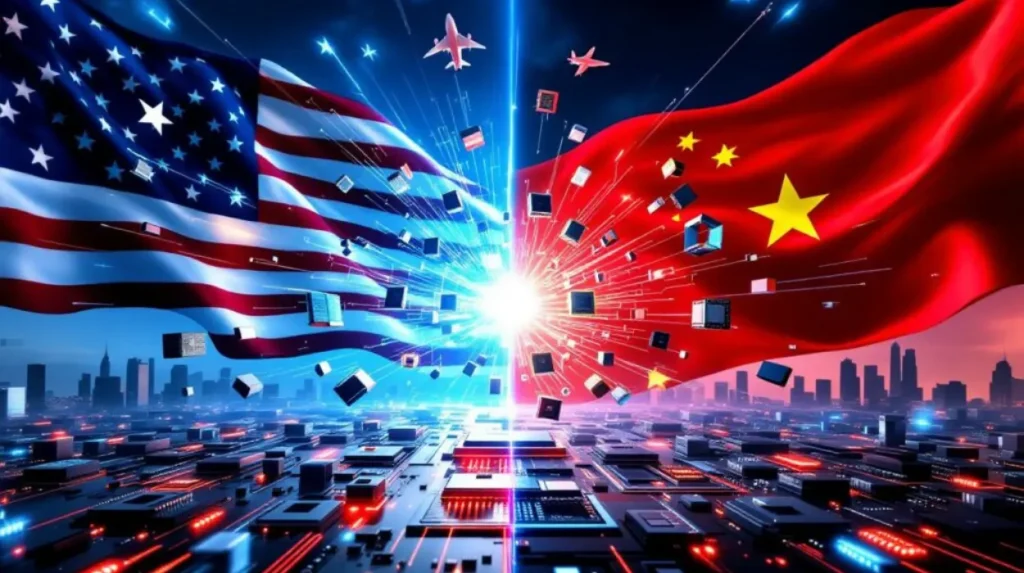
The U.S.–China strategic competition shapes global economic and security dynamics in 2025. Intensified by trade tensions, technological restrictions, and military posturing, this rivalry influences policymaking, international alliances, and global stability. The core issue centers on competing visions of global dominance, particularly in trade policies, advanced technology controls, and security strategies.
Trade Tariffs, Duties, and Reciprocal Measures (2025 Overview)
The U.S. maintains a complex tariff regime on Chinese imports, including a 55% average tariff combining multiple layers such as Section 301 and Section 232 tariffs, fentanyl-related duties, and reciprocal tariffs effective from early 2025. On August 1, 2025, the U.S. imposed a 50% tariff on semi-finished copper products and copper-intensive goods to strengthen domestic supply chains under the Trade Expansion Act Section 232. A 90-day tariff truce implemented in May 2025 reduced some duties but is set to expire August 12, 2025, risking renewed tariff escalation. China has responded with export restrictions on critical minerals such as gallium, germanium, and antimony, essential for U.S. tech industries.
Technology Export Controls and Semiconductor Industry Restrictions
U.S. export controls focus on restricting Chinese access to advanced semiconductors and AI technologies, vital to both civilian and military capabilities. Major U.S. tech companies like Nvidia and AMD agreed to pay the U.S. government 15% of revenues from semiconductor sales to China in exchange for export licenses, an unprecedented arrangement. China pressures U.S. policymakers to relax restrictions on high-bandwidth memory (HBM) chips, critical for AI applications, signaling ongoing tough negotiations over technology transfer. The U.S. aims to maintain leadership in AI while blocking China’s access to the most advanced chips, balancing economic interests with national security concerns.
Security and Military Posturing in Regional Hotspots
Military competition intensifies with continued U.S. efforts to counter China’s regional influence, including in the South China Sea and Taiwan Strait, while China strengthens ties with Russia, Iran, and other allies. China’s “four red lines,” emphasizing sovereignty and development rights, underpin its assertive military posture and diplomatic stance. Both sides engage in diplomacy to avoid direct military conflict but maintain readiness amid mutual suspicions and strategic rivalry.
Background and Historical Context of U.S.–China Relations
The U.S.-China relationship has evolved from economic interdependence to increasingly high-stakes strategic rivalry. The trade war initiated during the Trump administration escalated with tariffs and technology bans aimed at curbing China’s rise. Under both Biden and Trump administrations (2021–2025), the U.S. maintained bipartisan consensus on strategic competition, emphasizing technology denial, trade enforcement, and military deterrence. Key policy shifts include:
- The 2018-2020 tariff impositions and Section 301 investigations targeting unfair Chinese trade practices.
- Export controls initiated in late 2024 and early 2025 to decouple critical technology sectors, particularly semiconductors and AI hardware.
- Heightened military vigilance in Asia-Pacific, including freedom of navigation operations and alliances strengthening.
- China’s rise in defense investments and international partnerships, asserting a more multipolar world order.
Main Actors & Stakeholders
U.S. Government: Led by President Trump (2025), advocating strict tariffs, technology controls, and resource protection. Key officials include Commerce Secretary Howard Lutnick and Treasury Secretary Scott Bessent. The bipartisan Congressional consensus leans hawkish on China to protect U.S. technological edge and trade interests.
Chinese Government: Led by President Xi Jinping, emphasizing safeguarding “red lines” of sovereignty and development, investing heavily in domestic tech self-sufficiency and military modernization. The Ministry of Commerce plays a key role in managing export controls and trade negotiations.
Tech Corporations: Nvidia and AMD act as intermediaries, negotiating access to the Chinese market while complying with U.S. government policies.
Interest Groups: U.S. industry groups push for balanced policies that protect trade competitiveness without excessive decoupling; security think tanks advocate for robust deterrence against China’s expansionism. Chinese industrial policy favors technology independence.
Current Developments Shaping U.S.–China Relations in 2025
- The 50% tariff on copper products started August 1, 2025, reflecting broader efforts to secure critical supply chains domestically.
- Nvidia and AMD’s 15% revenue share agreement with the U.S. government for semiconductor sales signals cooperation but also exposes tensions over technology access and security.
- The upcoming expiration of the May 2025 tariff truce on August 12 poses risk of renewed trade hostilities. Discussions on extension continue after July negotiations in Sweden.
- The U.S. is considering further tariff and export control expansions under various executive orders issued in early 2025, targeting unfair trade practices and national security risks.
- China’s export controls on rare earth minerals and regulatory tightening respond to U.S. measures, fueling a tit-for-tat trade conflict that sustains broader geopolitical tensions.
Challenges and Risks Associated with Strategic Competition
Economic disruption: Prolonged tariffs and export controls could disrupt global supply chains, impacting U.S. and Chinese industries and consumer prices.
Technology decoupling risks: Severing high-tech links threatens innovation ecosystems and global tech standards, impacting U.S. leadership and global AI development.
Security escalation: Military posturing increases risks of accidental conflict in hotspots such as Taiwan and the South China Sea.
Political polarization: Bipartisan hawkish consensus in the U.S. may limit diplomatic flexibility, while Chinese nationalist rhetoric sustains confrontational policies.
Unintended alliances: China’s deepening ties with Russia and emerging powers could further fragment the international order, complicating U.S. foreign policy.
Political Implications for Domestic and International Policy
Domestic Politics: Strategic competition shapes U.S. electoral discourse, emphasizing national security, industrial policy, and economic nationalism. Technology sector and labor interests face pressure to adapt to new realities.
International Alliances: The U.S. reinforces its network with NATO, Japan, South Korea, and India to counterbalance China’s growing influence. Conversely, China strengthens Strategic partnerships with Russia, Iran, and Global South nations.
Voter Sentiment: Public concern grows over economic uncertainty, supply chain vulnerabilities, and broader geopolitical risks fueled by the U.S.–China rivalry.
Policy-making: A balancing act between deterrence and engagement guides U.S. strategy, attempting to secure advantage without triggering open conflict, while technological and trade policies remain front-line tools.