The reported move by U.S. officials to prepare a list of Spanish goods for possible trade restrictions marks a sharp escalation in a dispute that began as a NATO defence-spending disagreement and has quickly widened into a broader economic and diplomatic confrontation.
An executive order from President Donald Trump that would suspend trade with Spain, were such an executive order actually implemented, would result in billions of dollars in economic transactions being at stake, as well as testing how hard Washington is willing to push the pressure line with a NATO ally. This particular story is unfolding against the background of other ongoing issues between the two sides regarding security, the Iran crisis, and burden-sharing. What sets this particular story apart, however, is not so much the threat as the process that seems to have been set into motion for its implementation. It appears that the Treasury Department, Commerce Department and the U.S. Trade Representative are now compiling a “menu” of products from Spain that can be targeted depending on how the administration decides to go ahead with its plan.
How the dispute escalated
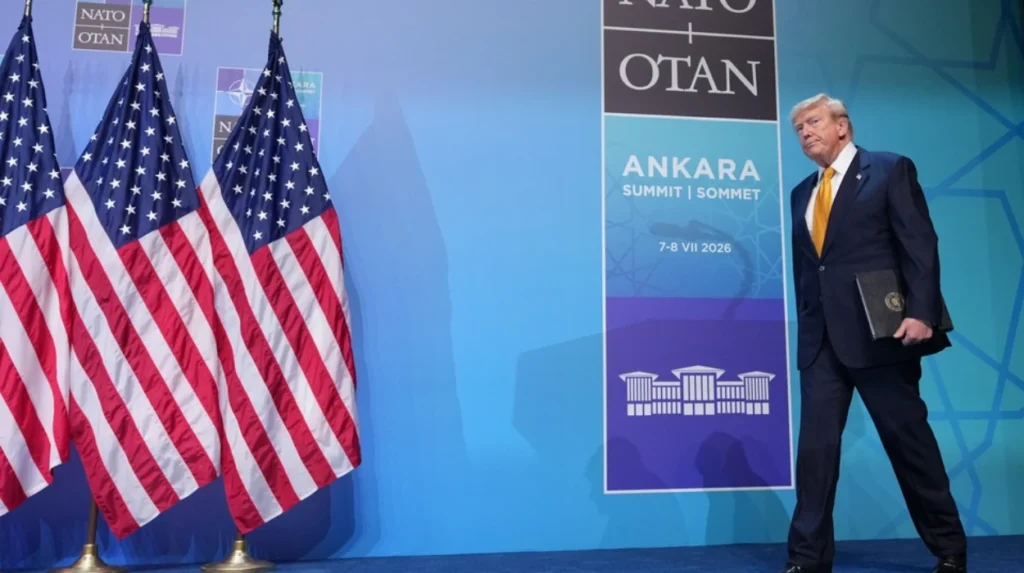
The crisis escalated at the NATO summit in Ankara, Turkey, on July 8, 2026, where Trump allegedly asked Treasury Secretary Scott Bessent to “cut off all trade” with Spain, following its failure to meet NATO defence-spending demands. According to Reuters, Trump elevated the crisis by announcing that he told his officials to end all commercial relations with Spain while linking the incident to the larger issues concerning the position of Spain in NATO. The proximate cause of the current crisis is Spain’s refusal to agree to the new defence-spending goal of 5% of gross domestic product (GDP) being advocated by President Trump. From Trump’s point of view, the matter is not only financial, but a question of loyalty and reciprocity in the context of NATO.
Trump has portrayed the dispute as a matter of principle, not just negotiation. According to Reuters, he repeated his desire to stop commerce with Spain and said,
“I don’t want to do any trade with them, alright?”
That statement underscores how the administration is using trade as leverage in a security dispute, a tactic that could have consequences far beyond the original NATO argument.
What officials are preparing
Perhaps the best indicator of whether the White House is stepping past mere words comes from the reports of coordination among agencies regarding the potential sanctions on Spanish products. There have been media reports that the Treasury, Commerce and USTR are preparing a list of goods imported from Spain that might be embargoed or otherwise sanctioned. While the list has not been made public, and nothing specific has yet been announced officially by the administration, the mere fact of such preparation is significant. It is because any retaliatory steps against a country normally start with pinpointed actions, with a move towards wider scope coming only later.
This can come from looking at certain classes of products, tariff codes and industry-specific vulnerabilities to determine where the levers are that will maximize the impact on the offending country while doing minimum damage to the retaliating party. This means that products such as olive oil, auto parts, steel, chemicals and others may be vulnerable.
Trade numbers show the stakes
The commercial relationship between the United States and Spain is substantial enough that even a limited restriction could affect businesses on both sides of the Atlantic. Reuters reported that U.S. exports to Spain in 2025 were about $26.6 billion, while U.S. imports from Spain were about $21.35 billion. That leaves the United States with a trade surplus in goods with Spain, which is an important detail because it complicates the political argument that a shutdown would simply punish a foreign seller without affecting American exporters.
The same reporting also points to how integrated the relationship is across sectors. Spain exports a range of goods into the U.S. market, and U.S. companies rely on Spanish suppliers in food, industrial manufacturing and chemicals. A sweeping restriction would therefore not function like a symbolic rebuke; it would interrupt real supply chains and could create domestic costs in the United States as well.
That is why the language used by the president should be read carefully. An order to “cut off all trade” is politically dramatic, but the actual policy tools available to the administration are more granular. In practice, the government could impose tariffs, quotas, licensing limits or targeted embargoes rather than an immediate and literal shutdown of every commercial channel.
Legal and political limits
The administration’s powers are limited. According to Reuters, the president may make use of such trade powers as Section 232 of the Trade Expansion Act and many others in order to justify the imposition of any trade restrictions on China. However, all of the above-mentioned measures generally involve investigation and notice of such actions in an official manner. This legal fact is very significant in the sense that it shows that the present situation is only at the preliminary stage, not the final one. Up to now, all evidence suggests that the United States is simply collecting information and options, and not preparing a schedule for an embargo.
The European Union also complicates matters. Spain is an EU member, and trade policy is largely handled at the bloc level, not by individual states acting alone. That means Washington’s decision to target Spain specifically could trigger broader EU concerns about precedent, retaliation and the limits of unilateral pressure on a member state. Analysts cited in reporting highlighted that legal and diplomatic issue as a major obstacle to any straightforward embargo.
Spain’s response and tone
Madrid has sought to keep the political atmosphere in check. The office of Spanish Prime Minister Pedro Sánchez has been reported to call the remarks from the U.S. side “business as usual,” adding that the two countries still have a good relationship and that most of the business is done privately between them rather than through their respective governments. This is important in that Madrid did not want to engage in a retaliatory game but also did not want to accept the premise that Spain’s relationship with the U.S. can be used as leverage. Spain’s reaction is also part of a strategic consideration. Without engaging in mirror tactics, Spain maintains diplomatic flexibility while avoiding the possibility of a market panic. This way, the Spanish government is sending a message that it does not recognize the notion that an alliance difference automatically translates into a trade issue.
There is also an important political nuance in Spain’s reaction: it underlines that private-sector commerce is deeply embedded in the relationship, making any “trade halt” far more complicated than a simple presidential declaration. That point may sound technical, but it is central to the credibility of the threat. The more integrated the two economies are, the harder it becomes to impose a clean break without collateral damage.
Products most exposed
The sectoral impact is where the threat becomes more concrete. Business reporting has pointed to Spanish olive oil, food items, auto parts, steel and chemicals as likely candidates for disruption if the administration selects product-specific measures. These are not fringe commodities; they represent real business lines with established import channels, and any hit to them would have knock-on effects for distributors, manufacturers and consumers in the United States.
Additionally, analysts will see whether the government plans to target highly visible items to make a political statement or sensitive items to have maximum leverage. An attack on a visible item may make headlines, but it won’t exert significant pressure, while targeting a critical raw material may disrupt production significantly, but the costs for U.S. consumers may increase significantly. It is one of the factors that explains the significance of the “menu” tactic suggested by analysts, since it shows that the government contemplates several ways to cause discomfort. In case of an attack, the most probable early steps will be more targeted than comprehensive. A blanket ban on trade with North Korea will be extremely difficult to implement in a very short period, while tariffs or licensing restrictions will be easier to manage.
Why this matters now
This dispute lands at a sensitive moment for transatlantic relations. NATO allies are already arguing over defence spending, burden-sharing and the broader challenge of presenting a united front in an increasingly unstable security environment. When trade policy becomes a weapon in that debate, the risk is that a bilateral quarrel turns into a wider alliance problem.
This episode highlights Trump’s governance strategy: applying economic pressure swiftly, presenting a black-and-white picture, and seeking alignment from allies in the public eye. Such an approach produces fast results and headlines, but it might produce a climate of unpredictability among business and diplomatic counterparts, who want clear rules of engagement. In this case, the alleged list of Spanish goods is not only a technical issue concerning trade but also a sign of how the administration may respond to conflicts with its allies in the coming months. The most justified interpretation of what is going on now is that the U.S. has already switched from threatening to preparing something, but not implementing it. The government agencies have allegedly started preparations of measures, Spain has been opposing the plan but does not escalate the situation, and the way to block the trade officially is complicated.
The stakes are therefore larger than a single trade dispute. If the administration follows through, it could reshape how allies interpret U.S. leverage, how the EU responds to unilateral pressure, and how businesses plan for political risk in transatlantic commerce. If it backs away, the threat itself may still leave a mark by showing how quickly security disagreements can spill into economic retaliation.