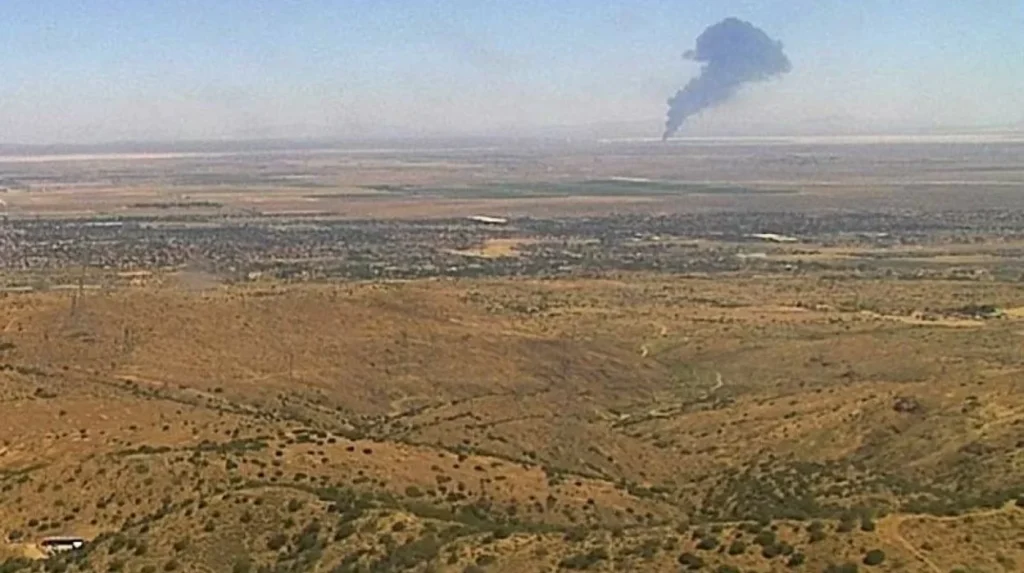
The morning of Monday, June 15, 2026, started with normal activities at Edwards Air Force Base in the Mojave Desert of California, but by 11:20 a.m., an event was unfolding at the base that would have huge ramifications for the United States’ military sector. One of America’s best-known and oldest airplanes, a U.S. Air Force B-52H Stratofortress bomber, was involved in a crash soon after it took off. This disaster claimed eight lives and was referred to as a “not survivable” situation by military authorities.
The accident happened in a test mission which should have been performed routinely and which has been carried out countless times without any problems whatsoever. The bomber took off from Edwards Air Force Base at 11:20 in the morning local time, but in less than five minutes there were emergency crews dispatched to the scene as the plane crashed to the ground in the desert. The resulting explosion was tremendous; the smoke from it could be seen rising into the air for miles in the Mojave Desert.
“After analyzing footage of the incident, the military determined that there were no survivors,”
stated General Hayes of the Air Force, delivering the grim assessment that would define this tragic event.
The Aircraft and Crew: Understanding What Was Lost
The B-52H Stratofortress plane which had crashed belongs to one of the most durable planes in service by the United States Air Force. Such an aircraft as many others in the B-52 series have seen many years of military use and serve as some of the most important military components for America. The B-52 is famed as being one of the longest serving bombers in the US Air Force, as it was first introduced into the service during the 1950s.
There were eight people in total on this mission, who included not only military personnel but also civilian workers hired by defense contractors. Two Boeing employees lost their lives out of the eight deaths, emphasizing how modern military aircraft use requires collaboration between military and civilian contractors. The involvement of Boeing employees in this tragedy indicates the nature of the mission, which might have been intended to perform tests related to aircraft performance or other important functions. Such test flights are critical for the operation of the B-52 planes, but there is always danger involved.
The loss of eight lives in a single incident represents a devastating blow to the military community. Each crew member represented years of training, dedication, and service to their country. Families, colleagues, and the broader military community are now grappling with the sudden and catastrophic loss of these eight individuals who were simply performing their duties during what should have been an ordinary workday.
Official Responses and the Immediate Aftermath
Edwards Air Force Base became the epicenter of emergency response operations immediately following the crash. Base officials quickly released their initial statement confirming the catastrophic nature of the incident.
“The B-52 Stratofortress crashed shortly after its departure from Edwards Air Force Base at 11:20 a.m.,”
the base statement read, providing the first official confirmation of what had transpired. Emergency crews responded promptly to the site, but the nature of the crash made any rescue efforts impossible.
The military’s judgment was immediate and definitive. Initial reports indicated that the disaster was “not survivable,” an unpleasant truth that made rescue impossible. Such a conclusion was made based on the extent of the explosion, its impact, and the total obliteration of the plane. The huge black smoke cloud that went up after the crash spoke for itself about the seriousness of the accident, with people witnessing the blast from a distance all over the Mojave Desert.
General Hayes, who provided crucial information about the incident, emphasized the thoroughness of the military’s initial investigation.
“After analyzing footage of the incident, the military determined that there were no survivors,”
Hayes stated, confirming what emergency crews at the scene had already concluded. His statement represented the official military position and provided closure to the agonizing question of whether any crew members might have survived the initial impact.
The Investigation: What Comes Next
Edwards Air Force Base has announced that it will conduct a full investigation into the incident, a process that officials acknowledge could extend for months.
“The base will conduct a full investigation into the incident, which could extend for months,”
explained military officials, setting expectations for a thorough and comprehensive examination of all available evidence.
This investigation timeline is consistent with major aviation accidents, where determining the cause requires extensive analysis of wreckage, flight data, maintenance records, and witness testimony.
A number of agencies and specialists will be required to carry out the investigation. This may include the investigative team from the Air Force itself, officials from federal aviation organizations, and possibly engineers from Boeing since there are employees of the company on board. Every possible element related to the flight will be looked at by investigators. From preparation to maintenance, all information about the performance of the aircraft in those crucial minutes following the takeoff will be analyzed. The video that General Hayes mentioned will provide significant clues for the investigators.
According to reports, the cause of this accident has yet to be established because the investigation is ongoing. As is the case whenever there is an aviation disaster, no assumptions about the cause must be made until after the entire evidence has been analyzed. Given the time span of six months proposed for investigating the cause of this tragedy, one could assume that determining the cause is going to prove quite challenging.
B-52 Fleet Safety and Historical Significance
The B-52 Stratofortress is a crucial part of the US Air Force fleet that has been serving the country for more than seven decades now. However, due to the current disaster, one might wonder about the safety of the old planes. As much as the B-52 has served reliably for many years, the fact that it is an older plane creates some difficulties in its usage. This is because most B-52s used today are more than 50 years old. A lot of money has gone into making sure that the planes stay in use for long.
Traditionally, there have been many accidents associated with the usage of B-52; however, the fatal ones resulting in the loss of all eight crew members at once are quite infrequent occurrences over the recent years. Being so large and complex, the failure in its operation can result in disastrous consequences, and the death of all the crew members is an example of such problems. Furthermore, the plane was used on the training mission at the time, which creates additional complications for the investigation process.
The B-52’s role in modern military strategy remains critical. The aircraft provides long-range strike capabilities that no other platform can match, and its ability to carry both conventional and nuclear weapons makes it indispensable to national defense planning. This tragedy will likely prompt reviews of B-52 operational procedures and safety protocols across the entire fleet, as the military seeks to ensure that similar incidents do not occur in the future.
Impact on the Military Community and Families
The fact that there were losses on the part of the crew by eight has had huge waves in the military community, especially among the Air Force and those at the Edwards Air Force Base. Their peers have to cope with the fact that they lost their colleagues and teammates, while their families must deal with the harsh reality of losing their loved ones in such a tragic and abrupt way. It is customary in the military community to support their families in the event of any tragedy, and they will get plenty of assistance.
Edwards Air Force Base, which has been a center of aviation testing and development for decades, will forever be marked by this incident. The base has seen numerous accidents throughout its history, but this particular tragedy stands out due to the number of lives lost and the catastrophic nature of the crash. Personnel at the base will likely observe memorial services and ceremonies to honor the eight crew members, and the military will probably establish permanent memorials to ensure their sacrifice is never forgotten.
The broader implications of this tragedy extend beyond the immediate military community. Defense contractors, particularly Boeing, will face questions about their role in the incident and the safety of the aircraft they maintain and support. The two Boeing employees who died represent the closest such personnel can get to the front line of military operations, and their deaths highlight the risks that civilian contractors face when working alongside military personnel on active missions.