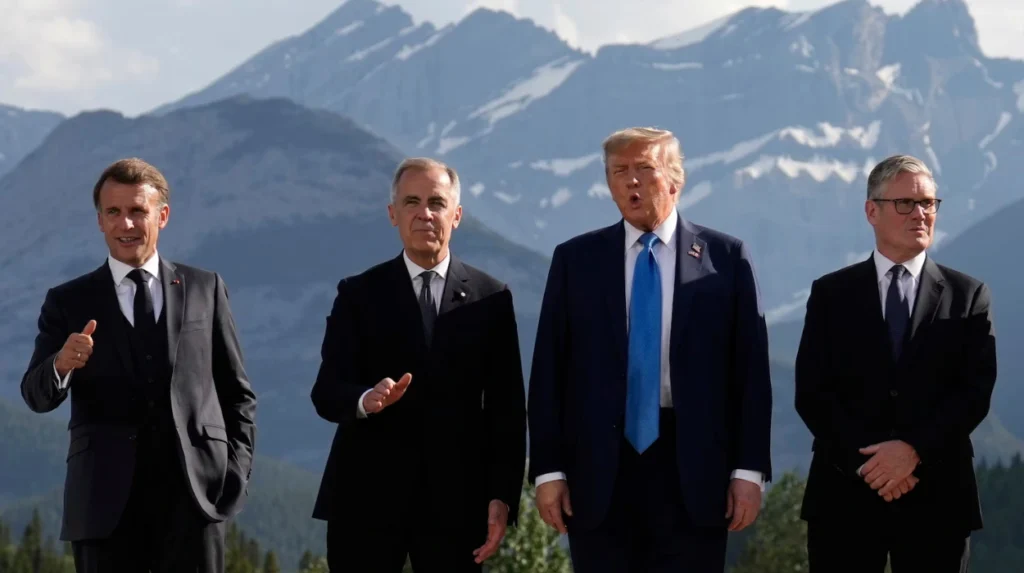
The start of the G7 meeting in France comes against a backdrop where unity amongst Western nations seems to be visibly challenged, and with President Trump being there, it is even more clear that this is the case. The G7 meeting is not taking place the way it should have; instead of being just another meeting for leading industrialized democracies, it is emerging as a very political one indeed.
What matters here is not simply the discord, but rather the increasing divergence between the way America views the world and the way its European partners do so. Trump’s foreign policy stances have caused much anxiety in European capitals time after time, and now they will become an object of discussion at the upcoming meeting. Efforts are being made to keep up the rhetoric of partnership, but the items of the agenda make it clear that there are some substantial disagreements nonetheless.
Ukraine and Iran Dominate the Agenda
Ukraine and Iran represent the two critical flashpoints in setting the tone of the meeting. The Europeans are likely to demand further backing for Ukraine from an economic and strategic perspective, as the current situation represents one of the most significant security concerns in Europe. It is not just a matter of safeguarding Ukraine’s independence, but also the reputation of the Western alliance and balance of power in Europe.
Iran has become a defining issue in its own right. It seems that the summit will occur amid speculation regarding Trump’s peace deal with Iran, which has aroused serious concern among allies over whether this approach is sustainable and whether it has any implications for the future of US foreign policy decisions. The problem with the European countries’ view of Washington’s approach to Iran is that it is focused not only on whether there can be containment of conflict, but also whether Washington’s method of decision-making is undermining diplomatic efforts.
The result is a summit where security debates are tied tightly to credibility. European leaders want reassurance that the United States remains committed to collective defense and to a rules-based international order. Trump, by contrast, is expected to advance an agenda that reflects American interests first, even when that creates discomfort among allies. That gap is at the heart of the geopolitical divergence now defining the meeting.
Europe Seeks Unity, but Anxiety Remains
The European leaders heading into France have a distinct objective: to ensure that this summit does not become an exercise in showing the world the split between the two sides of the Atlantic. In private, there will certainly be an effort to maintain a positive approach and avoid any conflict. On the surface, the rhetoric is expected to emphasize partnership, shared values, and common historical alliance traditions.
The problem facing Europe is that they no longer consider Washington a reliable partner when it comes to dealing with certain important issues. This lack of predictability impacts everything from military strategies to trade policies. The real issue here is not the fact that Trump might have different ideas compared to the Europeans, but that he could actually change the rules of the game, thereby forcing Europe to adapt rather than being part of the process. It is precisely because of such issues that the summit has been referred to as an uncomfortable reunion of sorts for the family.
France, as host, is trying to steer the gathering toward consensus without pretending the disagreements do not exist. That balancing act is difficult because the summit is being held at a moment when geopolitical crises are overlapping rather than isolated. When leaders arrive already divided on major wars, sanctions, and trade policy, even a modest joint statement can be difficult to achieve.
Trade and Economic Tensions
Trade is another fault line likely to surface during the talks. Tariffs, supply chains, and broader economic competition remain sources of friction between the United States and its G7 partners. European governments are pushing for a more stable and rules-based approach to global commerce, while Washington under Trump has often leaned toward leverage, pressure, and renegotiation.
The distinction is relevant because trade policy has moved beyond being a purely economic matter. It is now a part of an overall struggle for strategic independence, industrial policy, and access to key technologies. From the perspective of EU leaders, the problem is whether or not the G7 remains an effective tool for economic diplomacy. As for Trump, it is expected that the focus will continue to be transactional.
In addition, the summit will feature talks on resilience in the face of global economic challenges and governing emerging technologies. These issues might not appear to be politically relevant at first glance, but they have very much to do with the underlying strategic conflict. The general approach in Europe is one of regulation and cooperation, while that of the United States is more opposed to being constrained by any limitations.
What Trump Wants from the Summit
Trump enters the summit with the ability to shape the entire tone of the meeting. His presence alone ensures that the G7 will not be viewed as a simple multilateral gathering. Instead, it becomes a stage on which allies must assess how far they can work with Washington and where they must prepare to push back.
These likely concerns can certainly be predicted with ease. Firstly, one can expect him to craft an American policy of power, bargaining and results. This approach will resonate with certain American constituencies, but it will definitely cause headaches for alliance management. For instance, it is well-known that European leaders cannot bank on traditional views concerning American leadership. For this reason, every single phrase and every single side meeting becomes of crucial importance.
While Trump’s opponents are concerned with the fact that such approach leads to unpredictability and instability as it makes the process of strategy-making more similar to the process of negotiation, Trump’s supporters will take it as a clear sign of unwillingness of Americans to continue to bear any extra burden without something in return. These two aspects of Trump’s political approach will become especially visible at the G7 summit.
France’s Diplomatic Test
Hosting the summit presents a dual benefit and difficulty for France. As the organizer of the summit, Paris would want to portray itself as a leader capable of projecting peace and seriousness. However, it is up to France to handle the reality of having allied countries with varying red lines. The French must ensure that the conversation is sustained until some sort of agreement is reached.
The point here is that summits do not require huge breakthroughs as much as they need to avoid falling apart altogether. Being able to conclude with at least a sense of accord in place – without any visible fallout from the gathering, with certain principles being agreed upon, and bilateral communication channels open – will already be deemed successful.
The broader political value of the summit may lie in optics as much as outcomes. A summit that looks orderly can still mask serious disagreement, but in diplomacy, appearance matters. Leaders want to signal competence, continuity, and control, even when the underlying politics are unsettled.
The Bigger Geopolitical Picture
The deeper significance of the summit is that it reflects a larger shift in world politics. The G7 was built on the idea that leading democracies could coordinate strategy through trust, shared institutions, and common purpose. That model still exists, but it is being tested by conflicts that expose national interests more clearly than before.
Neither Ukraine nor Iran is an isolated problem. Rather, these events serve as reminders of the current state of affairs, namely, the erosion of strategic alliances, instability in energy relations, and growing power politics in international diplomacy. In such a way, the French summit serves as a gathering point of these trends within which the G7 member states will have to choose between cooperation and discord management.
Such a decision becomes particularly crucial due to the importance of the G7 as an institution. Even in the case of conflicting interests, the grouping sends out clear messages about the main concerns of Western countries as a whole. Hence, depending on the outcome, the summit will either demonstrate the readiness of the West to cooperate and maintain balance or fail to provide any united front against the emerging global challenges.
This summit is not just about formal meetings or diplomatic photo opportunities. It is about whether Trump and his G7 counterparts can coexist in a shared framework while holding sharply different views on war, trade, and international order. The word “divergence” is not an exaggeration; it is the defining feature of the gathering.
The most likely outcome is a summit shaped by careful language, controlled tension, and selective cooperation rather than dramatic breakthroughs. That may disappoint those hoping for a grand diplomatic moment, but it would still reveal something important: the G7 remains relevant precisely because it is now the place where the West’s internal contradictions become impossible to ignore.