The American president, Donald Trump, has landed in Beijing, signaling a significant point in U.S.-China relations as he heads to China alongside a team of influential businessmen from America. This important event is scheduled for May 13, 2026, and is expected to usher in negotiations between the American president and Chinese President Xi Jinping.
The inclusion of tech moguls and industry chiefs is indicative of Washington’s approach to utilizing economic inducements in light of the underlying tensions surrounding tariffs, technology, and geopolitics. With the leaders of the world’s two leading economies gathering at the summit, the implications for global logistics, national security, and market stability cannot be overlooked.
Arrival Ceremony Signals High Stakes
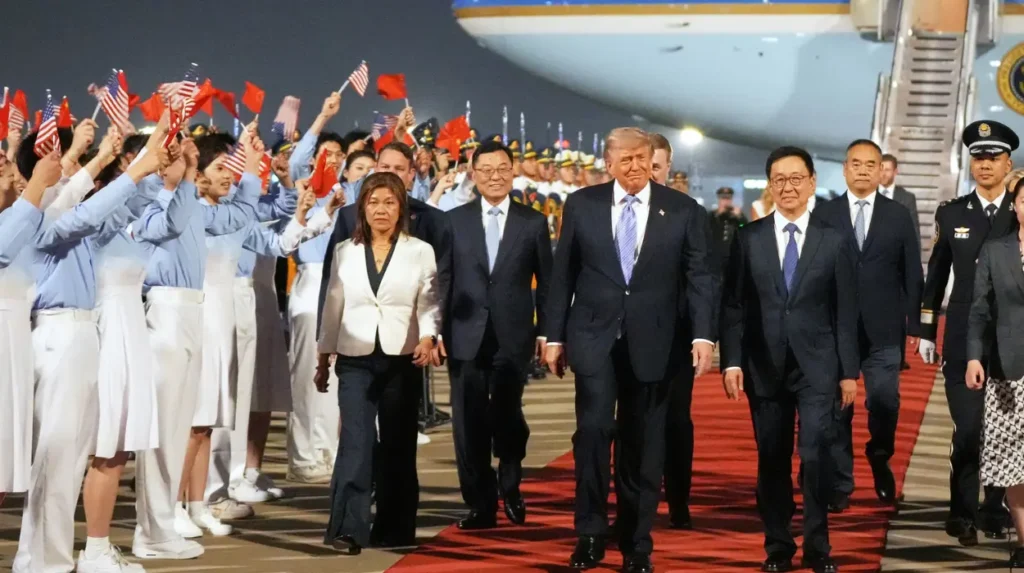
Arrival at the Beijing airport was an act of great pomp and circumstance. Trump disembarked from Air Force One to the red carpet and was welcomed by a brass band, flag carriers, and around 300 Chinese kids dressed in blue and white and waving both the US and Chinese flags while shouting “Welcome! Welcome!” in Mandarin.
The welcoming committee was headed by Chinese Vice President Han Zheng, which is significant considering he serves as Xi’s special envoy for diplomacy and attended President Trump’s inauguration in 2025. The officials accompanying him were Ambassador to China David Perdue, Chinese Ambassador to the United States Xie Feng, and China’s executive vice minister of foreign affairs Ma Zhaoxu.
In sharp contrast to the undercurrents, Trump raised his fist before getting into his limousine without any immediate comment. The military honor guard and the military band served to underscore the significance of the event as this was Trump’s first time coming to China since 2017. It should be noted that the participation of Han Zheng is more significant than the last time Trump visited China when he was met by State Councillor Yang Jiechi.
Delegation of Power Players
Among the notable members that form Trump’s entourage are several influential businessmen who have turned the tour into a dual-purpose journey of diplomacy and business. They include CEO of Tesla and SpaceX Elon Musk, CEO of Nvidia Jensen Huang, CEO of Apple Tim Cook, chairman of BlackRock Larry Fink, CEO of Micron Sanjay Mehrotra, and top managers of Boeing, Visa, Goldman Sachs, and Citi. The selection is a clear example of the United States’ desire to gain access to certain markets such as semiconductors, artificial intelligence chips, and aircraft.
The selection of delegates is not a coincidence. Nvidia has been trying to get permission to export advanced H200 AI processors into China despite restrictions on exports from the United States and national security evaluations from Beijing. Micron Technology has also faced constraints with the export of its products for China’s infrastructure projects. Boeing has been eyeing contracts with Chinese airlines.
White House principal deputy press secretary Anna Kelly previewed the trip by stating,
“President Trump will continue doing what he has done over the past year: rebalancing the relationship with China and prioritizing reciprocity and fairness to restore American economic independence.”
She added that the focus includes establishing a board of trade for non-security-related goods exchanges.
Packed Agenda: Trade, Tech, and Geopolitics
The two-day summit, spanning Thursday and Friday, promises exhaustive discussions on an agenda brimming with flashpoints. A welcome ceremony at the Great Hall of the People kicks off Thursday, followed by bilateral talks, a visit to the historic Temple of Heaven, and a lavish state banquet. Friday features tea, a working lunch with Xi, and a tour of Zhongnanhai Garden, the Communist Party headquarters, before Trump’s departure. These formalities frame substantive negotiations on tariffs, rare earth materials, artificial intelligence, the Iran conflict, and Taiwan tensions.
Trade dominates, with Trump pushing to uphold the October 2025 truce that halted tariff escalations exceeding 100 percent and restored some rare earth exports. U.S. Treasury Secretary Scott Bessent’s prior three-hour talks in South Korea with Chinese Vice Premier He Lifeng laid groundwork for preserving this fragile balance. Analysts speculate announcements of major Chinese buys in American aircraft, soybeans, and beef, echoing hopes from Senator Steve Daines, R-Mont., who recently visited China. On CNBC’s “Squawk”, Daines noted,
“It is in both leaders’ interest to maintain a stable relationship and to de-escalate rather than decouple. We hope to see some kind of trade agreements come out, likely involving Boeing, beef, and beans.”
Technology and semiconductors form another core pillar. U.S. firms like Nvidia and Micron seek eased restrictions, while Trump aims to secure greater market access. On Truth Social Monday, Trump posted optimistically, anticipating “great things” from the summit, and framed his ask directly:
“I will be asking President Xi to ‘open up’ China,”
referencing the CEOs in tow. Beijing’s foreign ministry spokesperson Guo Jiakun responded cautiously, affirming readiness to
“expand cooperation, manage differences and inject more stability and certainty into the turbulent world.”
Geopolitical Flashpoints: Taiwan and Iran
Beyond economics, security issues loom large. Taiwan remains a persistent irritant, with China reiterating opposition to a proposed $14 billion U.S. arms package pending White House approval. Washington upholds its legal commitments to Taiwan’s defense despite lacking formal ties. Trump is expected to press Xi on Beijing’s stance toward the island, amid heightened assertiveness from China.
The Iran war adds urgency, with discussions centering on China’s economic support for Tehran and Russia, including oil purchases and potential arms deals. Trump told reporters before departure,
“We’re going to have a long talk about it,”
confirming Iran and the Strait of Hormuz crisis on the docket. White House previews emphasize pressing Xi on strategic support, as U.S. courts have curtailed Trump’s unilateral tariff powers and inflation from the conflict pressures Republicans ahead of midterms.
Broader Context and Challenges
This summit occurs against a backdrop of mutual vulnerabilities. For the U.S., disrupted supply chains from prior trade wars, narrowed tariff authority, and war-driven inflation heighten the need for wins. China grapples with weak domestic demand and export pressures, though Xi faces no electoral heat. Beijing-based advisor Liu Qian of Wusawa Advisory told Reuters,
“The Trump administration needs this meeting more than China does,”
highlighting Washington’s political imperatives.
Trump’s pre-trip rhetoric on Truth Social positioned the visit as a marketplace offensive, urging China to reciprocate American openness. The corporate delegation amplifies this, signaling a hybrid diplomacy where business lobbies align with state goals. Yet challenges persist: U.S. export controls on AI and chips clash with China’s security reviews, and Taiwan arms sales provoke Beijing’s ire.
Potential Outcomes and Implications
Optimism tempers realism. Analysts foresee deals on Boeing planes, agricultural goods, and possibly AI sales permissions, stabilizing ties without full decoupling. Senator Daines’ endorsement of de-escalation aligns with White House aims for reciprocity. A new trade board could oversee exchanges, fostering long-term fairness.
However, breakthroughs hinge on concessions. China may demand eased tech curbs in exchange for purchases, while Taiwan and Iran test rapport. Success could lower inflation, boost U.S. exports, and calm markets; failure risks renewed tariffs and escalation. As Trump and Xi navigate this, the Beijing summit embodies a high-wire act—balancing competition with collaboration in a fractured world order.