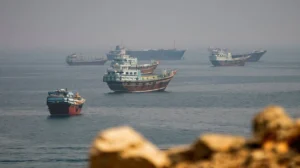
The Strait of Hormuz remains the most vulnerable sea route in the energy system of the world, connecting the producers of the Gulf with the Asian and European markets. In the 2026 continuum of escalation between Washington and Tehran, it has ceased to be a geographical factor and has shifted on to active strategy. What was once considered as a neutral route is currently being used as a diplomatic weapon in the force of negotiation.
The existing U.S. naval configuration has rendered the Strait into a realm of manipulated pressure, as opposed to free passage. Even minor restrictions have been disproportionately impactful on market confidence, with shipping insurers and logistics operators changing behaviour in the anticipation of risk, as opposed to an actual disruption. This proactive response has been successful to enhance the effect of the blockade to a greater extent than what the law provides.
Energy Flow Disruption And Strategic Signaling
The design of the blockade is an indication of a twofold approach; limiting the Iranian-linked revenue streams without being openly closed to world shipping. This uncertainty is not without purpose and Washington is able to argue that he had restrained himself but at the same time kept up the pressure. Nevertheless, it also brings about interpretive ambiguity to the commercial actors, who have begun to consider the Strait to be partially unreliable.
How The Blockade Is Reshaping The Ceasefire Dynamics
The ceasefire agreement between the United States and Iran was weak in the first place and the maritime restrictions aggravated the situation. The advent of the blockade has changed the system of incentives which forms the basis of diplomatic de-escalation, and made the value of restraint less apparent on both sides. Continued pressure is being perceived by Tehran as a sign that negotiations are being done in a tactical form and not being taken seriously.
Concurrently, Washington presents the blockade as an artificially enhanced escalation that would not ruin all diplomatic avenues but would retain leverage. The resulting tension between pressure and negotiation, known by analysts as a compressed escalation environment, has given rise to a situation in which ceasefire stability is constantly compromised by coercive behavior simultaneously.
Asymmetry In Negotiating Conditions
Lack of mutual economic bailout to Iran has undermined internal political reasons for long-term engagement. In the absence of apparent advantages, the Iranian leadership is under growing pressure at home to resist, instead of compromising, making the ceasefire structurally unstable even though it is formal.
Regional Reactions And The Security Calculus In The Gulf
There is a combination of official approval and quiet apprehension of regional Gulf actors to the developments of the Strait of Hormuz. Although the majority of governments are in favor of the freedom of navigation tenets, they are also subjected to the economic instability posed by long term uncertainties in sea travel.
The energy exporters are especially sensitive to changes in the cost of shipping and insurance premiums, which have been on the increase since the implementation of targeted interdiction measures. This poses a strategic dilemma, the U.S. deterrence is advantageous to the states that are dependent on stable exports, but disadvantageous to those impacted by the instability that deterrence creates.
Gulf Security Alignment And Strategic Dependency
Nevertheless, the Gulf states remain very dependent on U.S. naval presence as a stabilizing element. The increasing uncertainty of Strait conditions however is leading to a re-evaluation of the need to diversify export routes and reduce dependency on chokepoints in the long run.
Legal And Normative Tensions Surrounding Maritime Control
The legal contextualization of the blockade is based on a very limited understanding of the maritime enforcement rights, which involved the differences between Iranian-linked shipping and the general transit rights. The aim of this interpretation is to maintain the international norms and increase the flexibility of operation.
Yet, experts in law and policy analysts observe that the common law implication of these measures might go beyond the formal scope of such measures. Enforcement activities at a chokepoint that is technically constrained can have systemic effects that question prevailing doctrines on free navigation.
The bigger issue is not merely the legality as such but replicability. When such reasoning is replicated by other states in disputed marine areas, the overall impact may be to divide the international shipping regime into jurisdictional pieces.
Economic Pressure And The Structural Strain On Global Energy Markets
The energy markets have responded not merely to physical disruption, but also to a perceived instability. The Strait of Hormuz hosts a high volume of oil deliveries to the world and even the slightest uncertainty touches the market pricing dynamics in futures markets.
This sensitivity has made maritime chokepoints such a pressure resource in geopolitics even more strategic. But it also brings systemic risk in that excessive use of such instruments will create an incentive to diversify long-term without taking vulnerable paths.
Acceleration Of Energy Diversification Trends
Energy-importing economies have already been diversifying their supply chains such as non-Gulf sources and strategic reserves. The tensions of 2026 will probably cement such diversification policies, slowly diluting the leverage that the control of chokepoints gives to one or another actor.
Strategic Implications For Long-Term U.S. Leverage
While the blockade may deliver short-term bargaining advantages, it also contributes to a longer-term structural shift in global energy and security architecture. As states adapt to uncertainty in the Strait of Hormuz, they are investing in redundancy rather than reliance.
This gradual shift could dilute the strategic centrality of the Strait itself, even if it remains geographically indispensable. The paradox is that increased use of pressure mechanisms may accelerate the erosion of the very leverage they are designed to preserve.
The evolving situation suggests that the Strait of Hormuz is no longer simply a corridor of transit but a contested instrument of diplomacy. Whether this transformation stabilizes into a managed form of coercive equilibrium or escalates into a broader challenge to maritime norms will depend on how quickly actors recalibrate between pressure, restraint, and the diminishing returns of chokepoint politics.