The US has been more vocal in its policy towards Iran by developing an enabling law that attempts to make the use of long-term coercive measures normal. Instead of framing the existing actions as a separate military operation, policymakers refer to them as an ongoing security posture that is the result of decades of confrontation. With this framing, Washington is able to sanction sustained sanctions, naval enforcement, as well as limited strikes under a single doctrine of continuing necessity.
Events in 2025 solidified this direction, with the growth of sanctions regimes and maritime enforcement operations becoming a part of national security policy. The officials have stressed that it is not an immediate solution but that it is long-term containment, which has been characterized as one that denies capacity over time, instead of an attempt to confront its adversary decisively. The language is symptomatic of a strategic change to a place of endurance, where legal justification is used to maintain pressure, as opposed to conflict resolution.
Domestic legal architecture underpinning sustained coercion
The basis of the never-ending pressure on Iran is almost entirely based on the interpretations of the constitutional and statutory power of the U.S. The executive branch has tried to keep the operations without the need to seek new legislative authorization by framing the current operations as extensions of the existing mandates.
Continuity of self-defense justification
The main idea of this argument is the notion of cumulative self defense. The officials in the U.S argue that the threats of Iran in the region, such as proxy involvement and sea accidents are constant and therefore warrants sustained self-defense. By combining these actions into one story, the administration does not have to establish certain levels that would need redefining by the congress.
This continuity argument is effective to augment episodic incidences into a legal basis of long-term action. It enables policy makers to introduce current actions not as escalatory but as in line with an established defensive stance, and thus lessening the perceived necessity to make any formal statements or time-limited commitments..
War powers tensions and congressional limits
Although this is framed, there remains a great deal of controversy in domestic legal circles. Critics say the magnitude and length of the present operations are beyond what can be deemed as defensive. The War Powers Resolution, which is intended to curb executive action at will, puts more and more stress when it is extended to an open-ended campaign.
This tension was on display as congress sought to put limitations on the situation through 2025. Some legislators advocated the need to be more specific on the authorized requirements, but the executive branch insisted that no additional powers were needed. This has led to a legal grey area where military and economic action are still in place and have not been mandated by a clear law.
International law and contested interpretations of force
The American law defense is facing a much tougher challenge in the international community whereby there have been stricter interpretations on the application of force. It is complicated by the lack of explicit multilateral authorization which makes the legitimacy of continued operations complicated.
Expanding self-defense beyond immediate threat
The stance of Washington is based on a more liberal interpretation of self-defense which has anticipatory and collective aspects. The officials maintain that the dangers of missile armaments and local networks by Iran justify the preemptive actions that they present as a way of avoiding the situation.
Nevertheless, this interpretation is disputed by numerous international legal experts; it is important to underline that the traditional doctrine restricts self-defense to immediate and proportional measures. The extrapolation of the same principle to explain the continuation of operations, brings up the issue of eroding established thresholds especially in cases where actions do not have a particular event that triggered them.
Absence of multilateral authorization
This is complicated by the fact that international bodies have not given their permission thus making the legal environment more difficult. In the absence of a definite mandate, prolonged pressure would be perceived as the imposition of a mandate, instead of a collective security action. This difference has important implications to the rest of the legitimacy of international norms of the use of force.
The difference between the American and the international understandings of the law presents an example of the increased distance in the points of legal consensus. Whereas Washington underlines the need and continuum, the critics stress the idea of proportionality and procedural legitimacy, which forms an unresolved contradiction that defines perceptions of the conflict in the world.
Economic coercion and maritime enforcement strategies
The constant pressure on Iran is not only military but also in the economic sphere where sanctions and sea blockades are predominant. These actions are put in place as non-kinetic instruments, which are auxiliary to overall security purposes.
Sanctions as structural pressure mechanism
Sanctions were developed to become a long-term tool that will limit the financial ability of Iran. The United States wants to restrict the resources to use in the region by focusing on exports of energy and financial networks. Officials say that these actions are not only legal but also needed and call them precision tools that can result in the human cost of a large-scale conflict.
However, the length of these sanctions prompts one to think about the cumulative effect of these sanctions. With time, the economic pressure sustained erodes the distinction between applied enforcement and disruption of the system, especially when civilian sectors are involved and the overall economic stability.
Naval blockades and freedom of navigation concerns
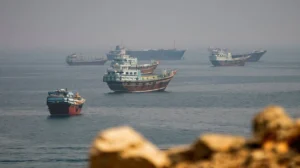
The pressure framework has also been further added through the addition of maritime enforcement in strategic chokepoints. The United States tries to tighten the impact of sanctions by blocking the transit of Iranian oil shipments to strengthen their efficacy and show the ability to control the important trade routes.
This method however, brings about legal issues of freedom of navigation. Prolonged maritime blockades can be construed as de facto blockades, which have dissimilar legal repercussions under the international law. The further such actions continue, the more they are likely to trespass the traditional norms of conducting open seas and business transit.
Energy geopolitics shaping legal justification
The legal strategy with the energy policy has become more and more accentuated. The ability to control energy flows is not only a strategic goal, but also one of the main aspects of the legal discourse in favor of further pressure.
Leveraging oil dependency dynamics
The United States has been shaping its behavior as the need to curtail Iranian capacity to fund its activities in the region by the revenues of its energy sources. Limiting the export of oil, policy-makers would undermine the economic basis of the strategic operations of Tehran.
This argument establishes a direct connection between the security policy and energy markets. The claim that economic disruption is the key to establishing long-term stability is presented as legal arguments to further pressure, an effective way of incorporating energy considerations into the larger context of self-defense.
Global market recalibration risks
Simultaneously, the continuous pressure on Iranian exports helps to drive changes in the dynamics of energy in the world. Alternation supply chains and diversified sourcing strategies have been achieved faster since 2025 as they have cut off the dependency on conventional routes and suppliers. Though this adaptation will increase its resilience, it can also reduce the strategic advantage of having control over specific chokepoints.
The paradox of the interaction between legal justification and market response is brought to the limelight. Short-term measures aimed at enhancing influence can push towards structural change undermining it in the long term, especially as other actors in the world adapt to the unpredictability of the long term.
Strategic implications of normalizing indefinite pressure
The evolution of perpetual pressure on Iran reflects a broader transformation in how states conceptualize conflict and legality. By embedding coercive measures within a continuous legal framework, the United States is effectively redefining the boundaries of acceptable state behavior.
This shift carries implications beyond the immediate context. If sustained pressure becomes normalized, other states may adopt similar approaches, constructing legal narratives that justify open-ended actions. The resulting environment could see a gradual erosion of clear thresholds, replaced by flexible interpretations shaped by strategic necessity.
The trajectory of this doctrine suggests that the central question is no longer whether pressure can be justified, but how long such justification can be maintained without undermining the legal structures it relies upon. As policymakers continue to navigate this evolving landscape, the balance between strategic imperatives and legal coherence remains uncertain, raising the possibility that the future of international order may hinge less on established rules and more on the narratives that states construct to sustain them.