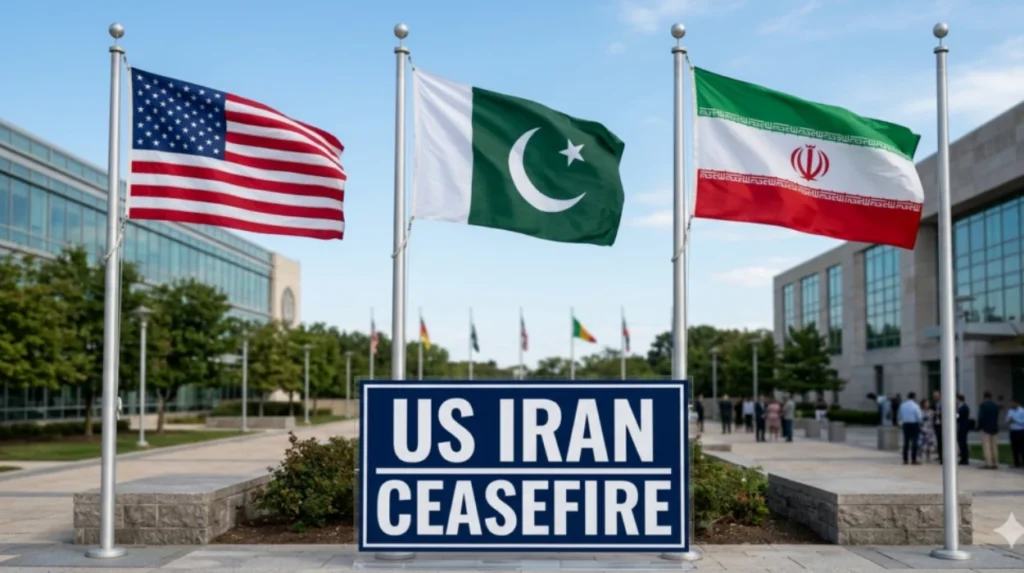
The abrupt collapse in scheduled diplomatic talks in Islamabad has revealed a greater frailty in the US-Iran ceasefire actions. What seemed initially to be a logistical hiccup has turned into an eye-opener on the level of strategic misalignment in which both Washington and Tehran seem to be conducting business in two entirely different diplomatic paradigms. The end of envoy travel has highlighted the weakness of informal channels of negotiation without institutional support.
During the first part of 2026, there were signs of de-escalation by both sides. Nevertheless, the Islamabad standoff gives a picture of how haphazard dialogue can turn a slow-moving momentum in the reverse direction. It has been observed by the analysts that there is no intent anymore, but ambiguity, a kind of move that is interpreted by both sides as no longer as an opportunity; now, it is a maneuver that needs to be approached with caution.
Mechanics of miscommunication in ceasefire diplomacy
The current paralysis is rooted in a mismatch between signaling strategies. The present paralysis lies in discrepancy between the signaling strategies. The topic of calibrated pressure on the part of Washington is in stark contrast with a focus on strategic autonomy by Tehran, which makes even the initial engagement more difficult than before.
Contradictory diplomatic signaling
The U.S. officials have alternated openness to negotiation, with reinforcement of punitive measures through public messaging. Although this dual track strategy is aimed at keeping leverage, it may jeopardize the credibility. Tehran has reacted by projecting these messages as being mixed, something that it has always been suspicious of American motives.
This perception was enhanced by the Islamabad episode. What Washington termed as a recalibration of the schedule was seen as sign of untrustworthy commitment in Tehran. This misinterpretation exhibits the extent to which a small procedural choice can have disproportionate diplomatic impact in a tense setting.
Interpretation gaps and domestic audiences
Both governments have to put up with domestic political limitations affecting the way of conveying and receiving signals. In Washington, one should preserve a stance of power, which continues to be politically required especially after augmented sanctions arrangements will be unveiled in 2025. In Tehran, the leadership should not seem to surrender particularly when there are internal economic pressures.
These homegrown factors form a cycle of external message to internal consumption. Consequently, the diplomatic communication turns to be stratified with conflicting histories, making it more confusing and prone to miscalculation.
High-pressure strategy and its unintended consequences
High-pressure tactics have been the focus of the U.S. policy, but their effectiveness in promoting ceasefire goals is more and more debated. Maritime enforcement and financial restrictions are among measures aimed at forcing negotiation but tend to have countermeasures.
Economic coercion and resistance dynamics
The sanctions and blockades have worsened during 2025 and into 2026 with a target of the Iranian economy sectors. Although these actions have physical costs, they also help to build stories of resistance in Iran. The authorities of Tehran have repeatedly stressed that any negotiations made under pressure are not legitimate, and their adherence to these negotiations is not politically feasible.
This dynamic brings about a strategic paradox. Even the instruments created to coerce negotiation can also decrease the desire to negotiate as the domestic political price of looking to negotiate becomes prohibitive.
Military signaling and escalation risks
The diplomatic environment has also been complicated with the deployment of the navy and the positioning of the regional forces. These are meant to deter but are often perceived as escalation, which results in actions that lead to increased tensions. This risk is worsened by the lack of definite communication channels as both parties base their responses on guesses instead of having direct communication.
The net impact is an insecure environment in which signaling to stabilize, rather than take part in uncertainty, is introduced. This compromises the circumstances under which ceasefire talks take place, which requires predictability and self-restraint.
Institutional gaps and limits of personal diplomacy
The fact that high-level, personality-driven diplomacy has been relied upon has revealed weaknesses in the negotiation process. Lack of strong institutional structures means development will be based on ad hoc relationships as opposed to long term interaction.
Absence of multilateral mediation frameworks
As opposed to the past diplomatic processes which entailed the multilateral platform, the recent U.S.-Iran ceasefire processes do not have a consistent framework of third party mediation. Lack of such structures minimizes the chances of neutral facilitation and both parties are left to untangle themselves in complicated negotiations with no external stabilizing processes.
In 2025, there were attempts to reestablish intermediary functions by regional actors, which were not very successful, in part because of conflicting geopolitical interests. The collapse of the Islamabad channel was perceived as a possible workaround and hence its failure was of great importance.
Fragility of episodic engagement
As much as personal diplomacy may be able to produce quick breakthroughs, it is not sustained enough to deal with complex conflict management. The Islamabad stalemate points out the swiftness with which a momentum can be lost when there is no institutionalization of interactions.
This intermittent quality of interaction generates instability, with development being extremely time-dependent, perception-dependent and politically-dependent. In the absence of a dialogue, the process of forming trust will not develop, and it is not possible to build long-term deals.
Regional implications of stalled ceasefire negotiations
The U.S.-Iran stalemate in ceasefire talks has great consequences to the stability of the region. The uncertainty caused by long lasting tensions is increasingly impacting on the neighboring states and the global markets.
Spillover effects across Middle East security landscape
Regional actors have also adapted to the diplomatic stalemate by changing their strategies. Others have become more defensive preparedness, and others have sought to use alternative diplomatic avenues in order to avert danger. This diversification is an indication of a larger trend to strategic hedging as the level of confidence in a U.S.-Iran solution is declining.
The uncertainty has also reacted in the energy markets as the price swings have been associated with the view of escalation risk. The lack of a ceasefire framework continues to contribute to volatility, which has an impact on the global economic stability.
Shifting role of intermediary states
All countries that are placed as possible mediators such as those in South Asia and the Gulf are under pressure to mediate. The Islamabad incident revealed the possibilities and the constraints of such positions and showed the difficulties of the neutrality-strategic interests balance.
These mediated processes are also complicated with the wider geopolitical context, in which the competition of great power affects regional politics. Successful mediation is not only based on the local dynamics but also on the goodwill of major actors to either endorse or at least condone such efforts.
Prospects for recalibrating ceasefire diplomacy
The trajectory of U.S.-Iran ceasefire efforts will depend on whether both sides can adapt their approaches to address the current communication breakdown. The existing strategy, characterized by pressure and ambiguity, appears increasingly insufficient for achieving sustained de-escalation.
A shift toward clearer signaling and structured engagement may be necessary to restore momentum. This would likely involve reintroducing multilateral elements, enhancing transparency, and reducing reliance on symbolic gestures that are prone to misinterpretation. Developments in late 2025 demonstrated that even limited coordination can produce temporary stabilization, suggesting that incremental progress remains possible.
Yet the broader challenge lies in reconciling competing strategic objectives with the practical requirements of negotiation. As both Washington and Tehran navigate domestic and regional pressures, the path toward a ceasefire remains uncertain, shaped as much by perception as by policy. Whether the Islamabad impasse becomes a turning point toward more disciplined diplomacy or a precursor to prolonged stalemate will depend on how effectively both sides can transform signaling into substance, leaving observers to question whether clarity itself has become the most elusive ingredient in modern conflict resolution.