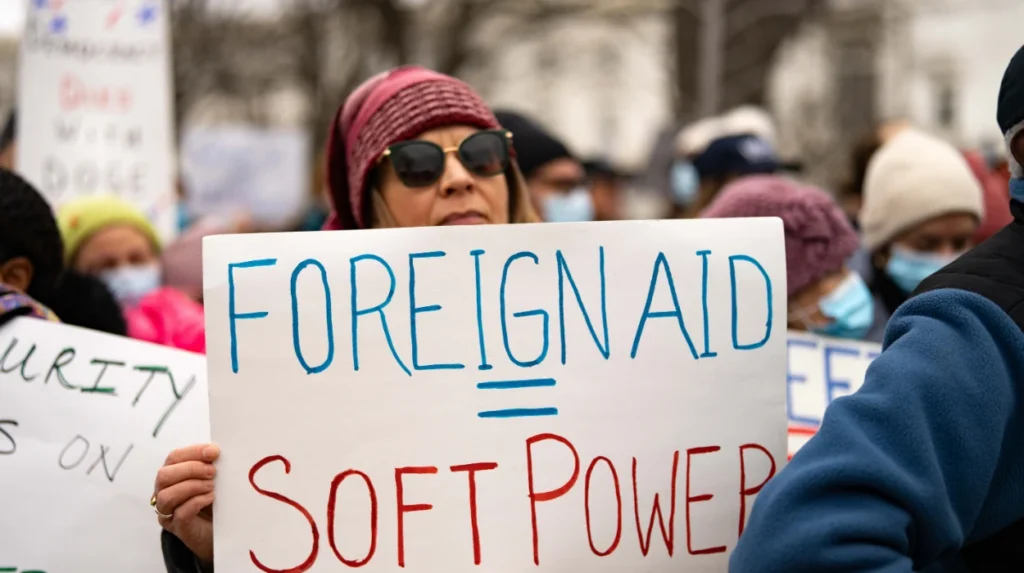
Humanitarian aid has been a focal point of the United States foreign policy which has incorporated both moral imperative with strategic motivation. Its implementation in conflict zones and disaster-prone regions is hardly ever independent of the wider geopolitical calculations. The changing nature of global competition and sophisticated crises by 2025 have raised concerns as to whether humanitarian aid remains capable of providing meaningful political leverage in addition to relief.
The development of aid into foreign policy systems is indicative of a two-fold purpose design. Although it generates immediate help, it is also a stabilizing mechanism of strategic regions. The rising complexity of the global conflicts is however provoking the assumption that humanitarian interventions turn into lasting impact.
Aid As A Stabilization Mechanism
Humanitarian aid is frequently intended to strengthen weak governance frameworks by aiding fundamental services. In places where stability is at stake, aid may be used to avoid institutional failure and ensure that there is at least some level of order among the populace. This role is in line with those of security, especially in regions where the failure of states might leave vacuums that can be occupied by non-state actors.
However, stabilization results are not assured. Within some of the crisis settings in 2025, assistance has alleviated humanitarian misery without making any substantial governance ability enhancements. This misalignment points to the shortcomings of relief efforts as a form of replacement of more encompassing political solutions.
Alignment With Strategic Interests
Patterns of aid distribution are often reflective of strategic concerns, and not necessarily humanitarian necessity. Geopolitically relevant regions are likely to be given long-term interest, which supports the view that humanitarian aid is a continuation of foreign policy interests. This congruence can boost the impact in the short-term but jeopardizes credibility when the recipients view help as conditional.
This conflict between strategic congruence and humanitarian impartiality has been intensified because recipient states demand to have more freedom to determine their external alliances.
Competitive Global Aid Environment
The international aid environment has been radically changed especially in the year 2025, as various actors increased their humanitarian presence. This change has diminished the monopoly of assistance led by the United States and brought new dynamics to the influence competition.
The humanitarian aid in this environment is carried out in a market of substitutes where recipient states receive competing offers, judged based on material benefits as well as political consequences.
Rise Of Alternative Aid Providers
The increased humanitarian involvement of emerging powers and regional actors has led to more humanitarian intervention with less political strings attached. This strategy is attractive to the governments that want to diversify partnerships but not to be too close to one external power.
The availability of other suppliers reduces the power that comes with United States humanitarian assistance. Where aid used to be an entry point to further political affiliation, it now competes as part of a wider ecosystem of influence.
Shifting Perceptions Of Neutrality
Neutrality perceptions are very crucial in deciding how effective humanitarian aid will be. When aid is perceived to be politically inclined, its ability to create goodwill reduces. In a number of 2025 cases, the recipient communities had taken the aid and were suspicious about the greater intentions of the donor.
This change highlights an essential problem: humanitarian aid can no longer be based on the supposed moral authority to gain influence. Rather, it has to move in a world where perceptions are crafted by conflicting narratives and experiences.
Structural Constraints On Effectiveness
The constraints of humanitarian assistance lie not merely in the external rivalry but also in structural factors that are inbuilt in the design. Relief intervention is commonly used to respond to crises which are themselves the outcomes of profound political, economic and social rifts.
Consequently, humanitarian aid functions in settings where its ability to spearhead systemic change is limited by default.
Complexity Of Modern Conflict Zones
Modern conflict situations are such that they surpass the limits of humanitarian responses. Long-standing wars, divided rule and transnational pressures result in situations in which relief can be used to treat the symptoms and not the causes.
In 2025, a number of humanitarian missions have been impeded by challenges that relate to insecurity, access limitations, and political fragmentation. These issues restricted the scope and efficacy of assistance, and supported the difference between the planned results and the real ones.
Recipient Agency And Policy Resistance
The growing agency of recipient states and communities in their interaction with outside aid. The change is indicative of a wider trend of sovereignty assertion of international relations. When humanitarian aid is viewed as a tool to influence people externally, it is likely to create resistance that undermines its effectiveness.
In other cases governments have taken aid but turned down policy expectations. This relationship depicts the restraint of humanitarian aid as a means of influencing political conduct.
Operational Risks In High-Intensity Environments
The operations of humanitarian aid in unstable areas are fraught with operational risks which also complicate its use as an instrument of foreign policy. These dangers have increasingly been amplified over the last few years, especially in settings where there are non-state actors and hybrid threats.
The operational problems of 2025 have shown that humanitarian operations are becoming more vulnerable to disruptions that may compromise their humanitarian and strategic goals.
Security Threats To Aid Delivery
Relief efforts are often near conflict zones, which puts aid workers and facilities at risk of security threats. Non-state actors can attack aid convoys, facilities or staff to disrupt operations or to extract resources.
These dangers add more money and limitations to humanitarian operations. The attempts to establish the provision of aid may confuse the boundaries between the humanitarian and military operations that may have an impact on the perceptions of neutrality.
Politicization Of Humanitarian Access
The access to the affected populations may be often determined by the negotiations with the local authorities and armed forces. Such relations may politicize humanitarian activities, whereby access depends on adherence to local authority.
In some of the 2025 scenarios, access control curtailed the targeting of vulnerable groups by aid organizations. This fact underscores the reliance of humanitarian interventions on political circumstances that they can do nothing about.
Evolution Toward A Transactional Framework
The general change of direction toward the transactional approach to international relations has had an impact on the purpose of humanitarian assistance in foreign policy. The need to expect aid to bring strategic advantages has been enhanced as states focus on the measurable returns on engagement.
This development brings up concerns as to whether humanitarian aid can preserve its moral basis and still adapt to a more transactional world.
Balancing Ethics And Strategy
Humanitarian aid is at the crossroads of moral duty and strategic decision-making. This balance is even more challenging to maintain when political pressures require visible returns on investment.
The danger is that of overemphasizing strategic results at the cost of humanitarian values. This would destroy credibility among recipients and diminish the effectiveness of aid as a means of influence in the long run.
Adapting To Multipolar Realities
As the international system becomes more multipolar, the role of humanitarian aid must adapt to a context where influence is distributed among multiple actors. This environment demands greater flexibility and responsiveness to diverse local conditions.
The ability to navigate these dynamics will determine whether humanitarian aid retains relevance as a foreign policy tool or becomes increasingly marginal in shaping global outcomes.
The trajectory of humanitarian aid reflects a broader transformation in international relations, where influence is no longer secured through singular instruments but through complex, interconnected strategies. As crises grow more intricate and competition intensifies, the question shifts from whether humanitarian aid can deliver influence to how it can coexist with evolving geopolitical realities without losing its foundational purpose.