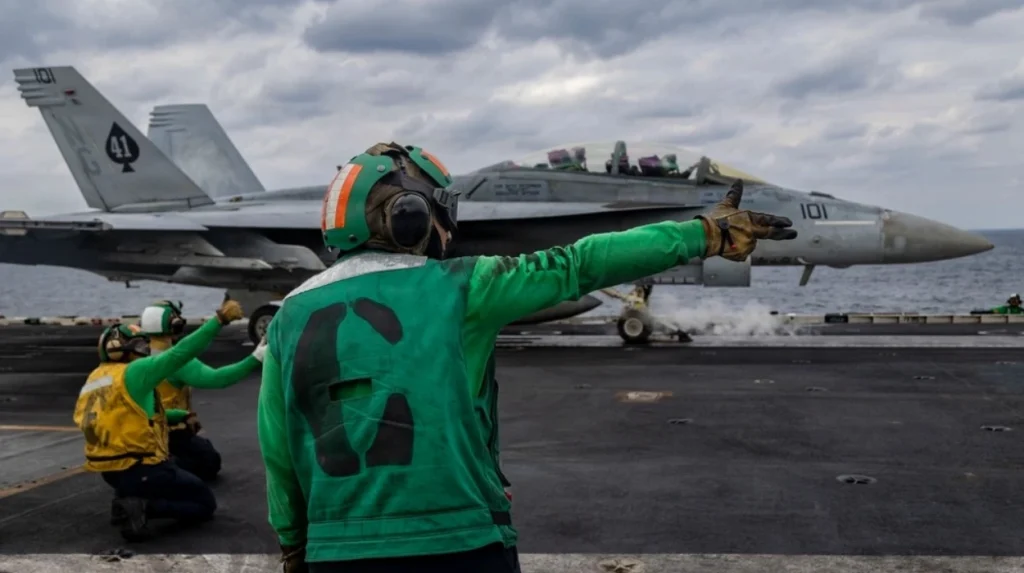
President Donald Trump has indicated a willingness to employ the military in case of a nuclear deal with Iran that remains unconcluded, and this highlights the influence of congressional inertia on the working environment. His deadline of February 2026 when he requires Iran to give in on nuclear enrichment is also coupled with increasing US naval deployment which further strengthens the plausibility of possible attacks without legislative sanction.
War powers resolutions have been proposed by lawmakers to restrict unilateral action but procedural hurdles and partisan alignment have decreased their effectiveness. The Republican control of both houses of congress has not had much enthusiasm to limit executive latitude, and any Democratic attempt to demand a floor vote has had little success in penetrating majority dominance. The outcome is a classic deadlock in the constitution where the presidential action surpasses congressional decision.
The keyword word of interest, congressional inertia, represents a trend that has become a norm cutting across administrations: legislative checkpoints usually react gradually and unevenly once the executive arm of government expresses an imminent military intervention.
Constitutional authority and interpretive elasticity
The constitution separates war authority between the Congress and the president, but the interpretations have been changing with decades. In Article II, the president is given powers in the capacity of the commander in chief, which has been used by the successive administrations to have restricted military interventions without necessarily declaring war.
According to the legal opinion of the Office of Legal Counsel of the Department of Justice, airstrikes lasting less than a period or defensive operations have long been claimed to be not a war because they take less than the constitutional minimum of a war, and thus do not require a congressional vote. This argument has been used to justify actions as diverse as those in Libya in 2011 or Syria in 2018, setting precedents that are used in the calculations today.
Under the present Iran circumstances, the administration officials indicate that they may present targeted attacks on nuclear or missile targets as an act of preemptive defense on US personnel and regional security and stability, thus falling within the executive power capabilities.
The War Powers Resolution’s practical limits
The War Powers Resolution of 1973 was used to re-balance power following the Vietnam war and it required consultations by limiting unauthorized engagements to 60 days without congressional authorization. In reality, presidents have been willing to meet reporting demands and challenge the constitutionality of the law or have had to interpret the terms of the law in a constrained sense.
Attempts to repeal or reformulate old Authorizations to Use of Military Force such as the Iraq AUMF of 2002 that was repealed in 2023 have not meaningfully limited executive flexibility. Bipartisan bills to demand Iran operations are proposed by such lawmakers as Representatives Thomas Massie and Ro Khanna, but they have not been moved to decisive votes by the leadership.
These processes support the view of congressional inertia that creates room to act by the executive, especially when presented as a limited or time-sensitive situation.
Partisan alignment and strategic calculation
In early 2026, Republican majorities have been keen on exercising presidential maneuverability. House Speaker Mike Johnson has also stated that consultation is good but decisions on national security must be flexible. The same sentiment is reflected in the Senate leaders who put more emphasis on deterrence and quick response capability.
This stance shows wider partisan support of the foreign policy of Trump. New leadership with slim margins in both houses is unlikely to be interested in breaking party cohesion over possible military eventualities. Furthermore, not many members want to be seen as offensive in the case of escalating tensions in the region by Iran.
Political calculations prefer executive action unless a prolonged conflict changes the public opinion.
Democratic objections and limited leverage
Democratic legislators have prevailed that preemptive strikes not authorized would be unconstitutional in intent. They refer to post-Vietnam reforms as the example of the intention of the Congress to eliminate unilateral military escapades. But such objections without the majority to back them are merely statements and not restrictions.
History indicates that preliminary air assaults usually produce low resistance in the short term as long as the number of casualties is minimal. Prolonged legislative counteraction is likely to appear when activities are increased or goals confused.
Public opinion and electoral timing
Polling towards the end of 2025 and early 2026 indicates the indecisiveness of American voters. Most of them are unwilling to engage in long-term Middle East operations, but a considerable amount of minority favors airstrikes, provided it is in the cause of stopping the spread of nuclear arms. The difference between limited operations or ground deployments is still important.
When Trump pledged during his campaign that he would not engage in endless wars, it is being reiterated, as expectations were that whatever was done would be prompt and brutal. The early military actions tend to stimulate the high spikes of approval, which strengthens the confidence of the executives.
This caution and rally dynamics negatively affect instant electoral risk, especially where no noticeable increase takes place.
Midterm horizon and accountability
As midterm elections are planned to come in November 2026, the legislators might have to compute that short-term operations would not be the primary vote-getters until there are more casualties or the economic upheaval is peaked. It might change that equation because of the volatility of oil prices and unrest in certain regions in the globe, yet, in the meantime, electoral incentives to exercise congressional power seem weak.
The congressional inertia therefore entangles itself with timing in politics and thus an atmosphere where executive decisions are not accountable is formed.
Military precedent and lowered thresholds
The June 2025 operation called Operation Midnight Hammer revealed that Washington was ready to attack Iranian nuclear-related targets not expecting any long-term retaliation. The move was successful in the view of President Trump as it undermined the immediate enrichment capacity, but Tehran responded cautiously to the action, which strengthened the idea that limited attacks were controllable.
The associated precedent drops bars of psychology and political action. Unless the consequences of the previously conducted operations prompt the full-scale war, the policymakers can find the potential risks of repeating that action satisfactory.
Normalization of limited force
It has become more and more common over the years since the targeted killing of Qassem Soleimani in 2020 to position discrete military actions as not witching war but as defensive measures. This framing has made episodic force a statecraft mechanism normal. The congress has been very unsuccessful in regaining control over these episodes.
The net impact is a structural situation whereby small scale strikes become expected options as opposed to exceptional actions.
Iranian response and escalation pathways
Masoud Pezeshkian, the Iranian President, has made several open declarations that Tehran will reach a negotiated solution, though it would protect its sovereignty. The authorities still claim to enrich themselves within the framework of the Nuclear Non-Proliferation Treaty. The Islamic revolutionary guard corps has threatened the regional states hosting the US forces to aid in attacks.
The intention behind these signals is to prevent escalation and maintain bargaining power. Tehran should consider the domestic pressures, economic tension and the danger of not having additional infrastructure damages.
Proxy networks and regional calculus
The asymmetric strength of Iran such as the partner group within the region gives the chance of the calibrated retaliation. Last-mile interference or pressure on US-orientated regimes through maritime interference would change the Kalibrate of escalation. Such reactions, though, endanger expansion of the battle and welcome more far-reaching American intervention.
EU governments and Russia, among other regional powers, have called on restraint fearing that an error would upset the energy markets and the international relations.
Institutional balance in flux
Congressional inertia reflects structural patterns rather than a single moment of inaction. Decades of interpretive elasticity, partisan alignment and public ambivalence have gradually tilted practical war powers toward the executive branch. The Iran scenario underscores how swiftly presidents can mobilize force within that framework.
Whether this equilibrium endures may depend less on legal theory than on outcomes. If limited operations achieve deterrence without entanglement, legislative complacency may persist. If escalation spirals or strategic objectives remain elusive, pressure to reclaim authority could intensify.
As naval assets hold position and diplomatic channels operate under compressed timelines, the balance between constitutional design and operational tempo remains unsettled. The coming weeks will test whether congressional inertia continues to enable decisive executive action or whether unfolding events compel lawmakers to more assertively define the boundaries of American war powers.