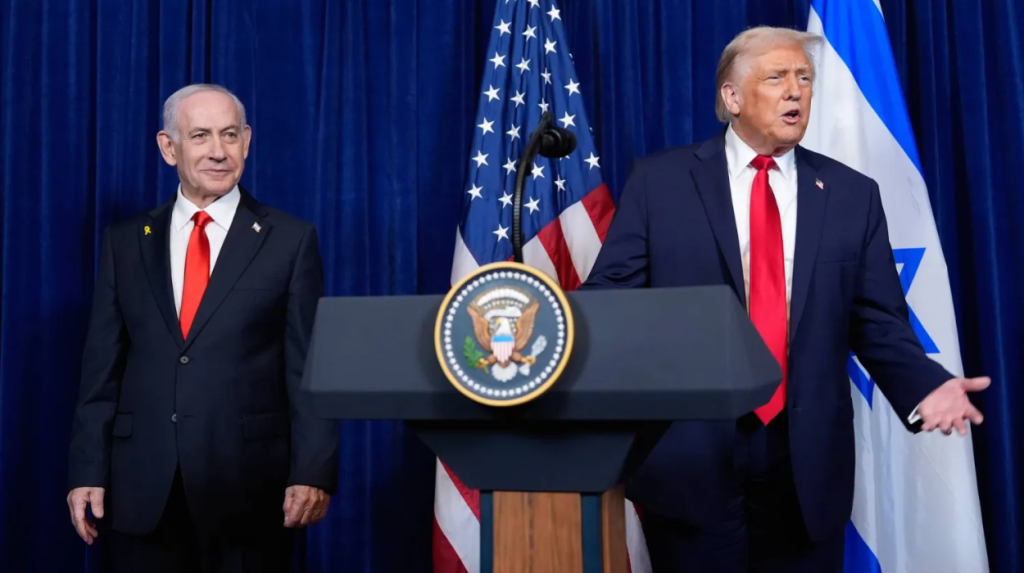
During his visit to the US, which is scheduled for later this week, Israeli Prime Minister Benjamin Netanyahu is likely to press President Donald Trump for the possibility of military options against Iran. This is because Israel is planning different options in case negotiations between the US and Iran fail, and Israeli officials remain unconvinced that talks between the two will be fruitful.
Pushing “Principles” for Negotiations With Tehran
Netanyahu announced that he would be briefing Trump on a set of guiding “principles” for dealing with Iran, framing them as vital not only to Israel but to broader regional security. He spoke of the “unique closeness” between Israel and the United States and reiterated close personal bonds with Trump as he boarded his flight to Washington for what was his sixth official visit to the US president in the past year.
The visit comes shortly after Washington and Tehran held a round of nuclear talks in Oman, the first since a June 2025 conflict in which the US bombed Iranian nuclear facilities in retaliation for Israeli strikes. For Netanyahu, these talks appear to be a strategic gamble as well as a chance to shape US policy before a deal is made.
Israeli Concerns Over Iran’s Military Capabilities
As reported by Israeli sources, the Israeli leader plans to brief Trump on the latest intelligence regarding Iran’s military progress, especially in rebuilding its ballistic missile arsenal from the previous year’s war. Israel believes that Iran may be able to replenish its missile arsenal, estimated at 1,800 to 2,000 ballistic missiles, without outside help in just a few weeks or months.
Israel is not formally part of the US–Iran talks, but Netanyahu has historically sought to exert significant influence over US presidents on Iran policy, often attempting to shape negotiations behind the scenes.
Diplomatic Tensions and Iranian Pushback
The meeting comes after intense diplomatic activity between Israel and the United States, including recent visits by senior Israeli military and intelligence officials to the Pentagon, and meetings between US envoys and Israeli leadership in Jerusalem. At the same time, Iranian officials accused Netanyahu of trying to undermine diplomacy. Ali Larijani, Iran’s senior official, cautioned that the Trump administration should not let Netanyahu scuttle talks, accusing Israeli leaders of “playing a destructive role” in regional diplomacy.
Israel’s Hardline Demands vs. Iran’s Red Lines
Netanyahu, however, has not revealed his principles of engagement, though on previous occasions he has said that Iran should agree to a broad range of disarmament measures, such as the agreement between Libya and Western countries in 2003. Israel has long demanded that the agreement on the nuclear issue should, among other things, require Iran to abandon its stockpile of enriched uranium, halt any enrichment process, impose restrictions on its missile programs, and cease its support of regional groups.
On the other hand, Iran has taken the position that it will discuss and negotiate nuclear issues with the United States only, and not anything else, such as their missiles and their alliances with other countries, as reiterated in recent statements from Trump, which indicate a possible shift towards a different agreement centered on preventing the acquisition of nuclear technology by Iran exclusively.
Netanyahu’s Strategic Dilemma Over a Narrow Nuclear Deal
For Netanyahu, the most worrisome situation is the possibility of a limited nuclear agreement that reduces but does not eliminate restrictions on Iran’s capabilities, while leaving the larger military and regional position of Iran untouched. Analysts have stated that the most desirable outcomes for Israel would involve direct US military action towards Iran or an arrangement that would completely_disable the defensive posture of Iran.
Such outcomes appear unlikely given Tehran’s insistence on preserving its missile program and regional alliances, raising the prospect that Netanyahu could find himself opposing a deal negotiated by a US president with whom he claims close alignment.
Iran’s Missile Program and Regional Proxies
Iran has outrightly refused to consider talks over its missile development program, which they consider an integral part of their defense against Israel. Last year, Iran relied significantly on missiles to fight the conflict, especially when the Israeli offensive undermined their air defense capabilities, and they embarked on launching hundreds of missiles at Israel, resulting in heavy casualties.
Beyond the issue of missiles, the United States and Israel may also be interested in limiting Iran’s support to regional allies such as Hezbollah, Hamas, Houthis, and Iraqi militias. However, the axis of resistance, which refers to Iran’s regional allies, remains an important part of Tehran’s strategy despite the recent military pressure from Israel.
Uranium Enrichment: A Core Sovereignty Dispute
A major open question is whether Iran will be allowed to enrich uranium on its soil. Tehran maintains that enrichment is a sovereign right, and it has offered strict monitoring and limits, rather than an outright ban. The stance echoes earlier disputes over the 2015 JCPOA deal-which Netanyahu led strident opposition against for leaving Iran’s military capabilities intact and lifting enrichment limits after a predetermined period.
US Military Posturing and Rising Regional Tensions
The United States has increased military deployments in the Middle East, including an aircraft carrier, destroyers, and fighter jets, to pressure Iran into an agreement. Iran, however, has dismissed military threats as ineffective, signaling it will not negotiate under coercion.
US Ambassador Mike Huckabee, accompanying Netanyahu, has stressed that Washington and Jerusalem share “red lines” on Iran’s nuclear ambitions, though Trump’s recent comments suggest a more flexible negotiating posture than Israel would prefer.