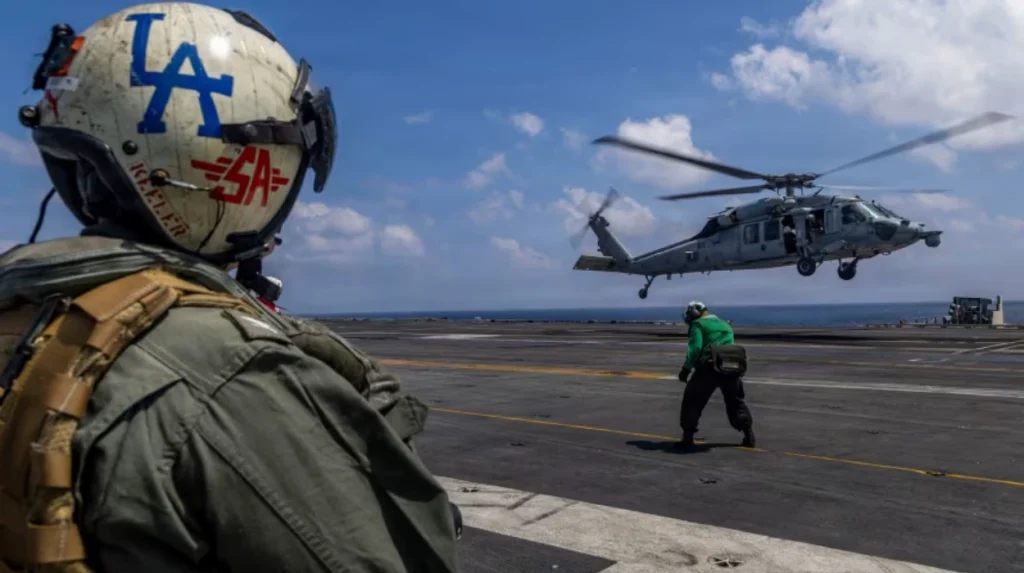
As reported by CNN from two different sources, the carrier strike group of the USS Abraham Lincoln has begun operations in the Indian Ocean, bringing it closer to locations in Iran for possible US military operations. Additionally, this carrier is within the area of operations of US Central Command, responsible for overseeing US military operations throughout the Middle East.
Although this positioning of a US carrier near Iran suggests that there are still planning operations against Iran, these may or may not be executed in the near future. While President Trump continues to consider possible options with Iran, US officials have stated to CNN that no final decision has yet been made.
A carrier strike group is made up of an aircraft carrier and its supporting groups of missile cruisers, anti-aircraft ships, and destroyers or frigid structures; therefore, it has a strong capability to fight back and have offensive capabilities with much success..
Allies Urge Washington to Restrain Military Action
As U.S. military resources draw nearer to the area, American ally countries are calling for calm to develop. A number of partners are cautioning Washington to refrain from escalating any further militarily, cautioning that an attack would have implications for the stability of the entire region. Regional officials informed CNN earlier this month that Arab states in the Persian Gulf that back the U.S. have contacted the Trump administration encouraging it not to launch an attack.
Rising Death Toll Amid Iran’s Protest Crackdown
The Iranian government’s crackdown against anti-government protests is also taking a high human price inside Iran. The U.S.-based Human Rights Activist News Agency (HRANA) said the death toll has climbed to at least 5,520 since the protests began about a month ago and an additional estimated 17,091 deaths are still under investigation.
President Trump has issued several warnings to Iran about their treatment of protesters, stating the U.S. would intervene if the Iranian government continued to harm its own citizens. However, Trump’s tone has softened recently and at one point last week he indicated that Iran would be receptive to diplomatic discussions.
Washington Signals Willingness to Talk
On Monday, the Trump administration reiterated that it remains open to discussions with Tehran, provided Iranian leaders understand the conditions.
“We are open for business … as they say,”
a US official told CNN.
“So if they want to contact us and they know what the terms are, then we’re going to have the conversation.”
The statement reflects a dual-track approach from Washington—maintaining military pressure while leaving the door open to negotiations.
Tehran Prepares for Possible US Strike
Meanwhile, Iran is openly bracing for the possibility of US military action. In Tehran, authorities unveiled a large mural in Revolution Square on Sunday depicting a swarm of fighter jets flying over a warship bearing the US flag.
During Friday prayers in the capital, the imam leading the sermon issued a stark warning to Washington.
“The trillion dollars you invested in the region are under the watch of our missiles,”
said Mohammad Ali Akbari.
Iranian rhetoric toward the US has escalated sharply over the past week, with officials warning that any attack would provoke a response capable of destabilizing the entire Middle East.
Iran Warns of Retaliation and Regional Fallout
Iranian Foreign Ministry spokesperson Esmaeil Baghaei said Monday that Tehran is “more than capable” of delivering a “regretful” response to any US aggression.
“The arrival of one or several warships does not impact Iran’s defensive determination,”
Baghaei said.
“Our armed forces are monitoring every development and are not wasting a single second to enhance their capabilities.”
On Saturday, Iran’s military claimed its missile capabilities and operational efficiency had increased significantly since the 12-day war with Israel in June. That conflict began after Israel launched a surprise attack on Iran last year, killing several senior military commanders and nuclear scientists. The United States later joined the fighting, striking key Iranian nuclear facilities.
Missile Arsenal and Proxy Network Raise Stakes
Iran possesses a vast arsenal of medium- and long-range ballistic missiles, several of which were used against Israel during the conflict. Its drone program—another pillar of Iranian military power—has also been deployed beyond the region, including in Russia’s war in Ukraine.
Maj. Gen. Ali Abdollahi, commander of Iran’s Khatam al-Anbiya Central Headquarters, warned last week that any aggression against Iran would immediately turn
“all American interests, bases and centers of influence into legitimate, definite and accessible targets.”
Iranian officials have also cautioned that a US strike would not be limited to bilateral confrontation. Washington’s allies in the region could also face retaliation.
Pro-Iranian Militias Signal Readiness for War
Iran’s network of regional proxies adds another layer of risk. While some groups, including Hezbollah, have been significantly weakened by Israel over the past two years, others remain heavily armed and operational.
On Sunday, Abu Hussein al-Hamidawi, commander of Kataeb Hezbollah—a pro-Iranian militia in Iraq—called on Iran’s supporters worldwide to prepare for conflict.
“We call on Iran’s loyalists across the globe to prepare for all-out war in support of the Islamic Republic of Iran,”
he said.
“We tell the enemies, the war against the Islamic Republic will not be a walk in the park.”