Glass towers, a shining Mediterranean port, modernized highways, and a transformed coastline as a regional tourism hotspot. That is the future promised for the Gaza Strip by Jared Kushner as represented in a presentation given to the World Economic Forum in the Swiss ski resort of Davos.
In a speech lasting only 10 minutes, the ex-senior adviser to President Donald Trump of the United States argued that the population of Gaza’s cities could easily develop as long as the security conditions for development are met.
“In the Middle East, they build cities like this in three years,”
Kushner said, implying that large-scale reconstruction could take place relatively soon, “if we make it happen.” But could a region so ravaged, so full of unexploded ordnance, so occupied, ever undergo such a transformation so quickly?
How Does Kushner’s Vision Compare With Reality on the Ground?
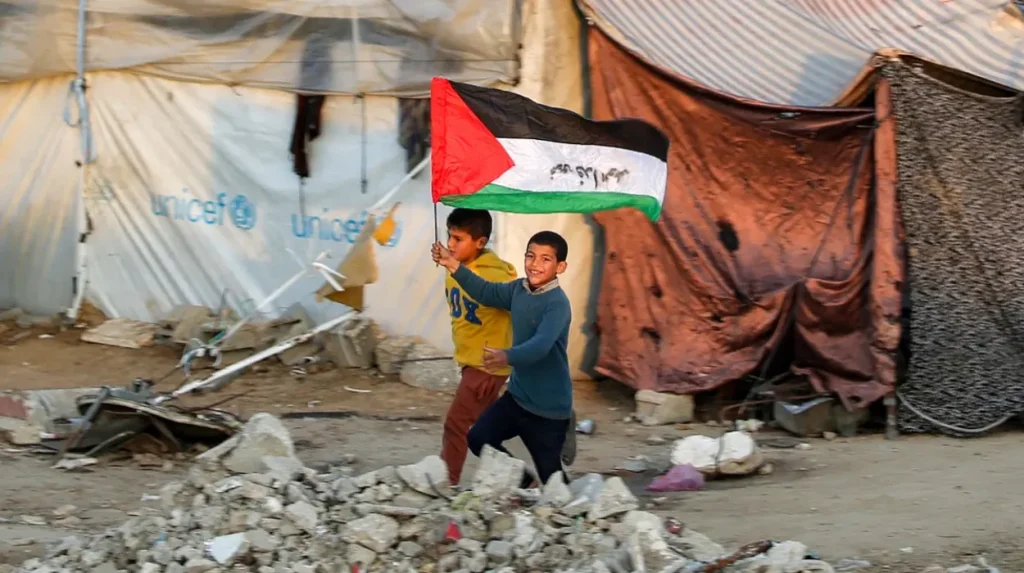
The optimism in Davos sharply contrasts with assessments by the United Nations and Palestinians living in Gaza. Across a territory home to roughly two million people, collapsed apartment buildings form mountains of debris, sewage-contaminated water spreads disease, and streets resemble eroded canyons rather than functioning roads.
According to the U.N. Office for Project Services, Gaza contains more than 60 million tons of rubble—enough to fill nearly 3,000 container ships. Clearing it alone could take more than seven years, followed by extensive demining.
Kushner spoke as Trump and other world leaders gathered to endorse the charter of the Board of Peace, the body tasked with overseeing the ceasefire and reconstruction. Yet the scale of destruction raises a fundamental question: is the plan grounded in engineering realities, or political messaging?
Can Reconstruction Happen Without Security?
Security, Kushner acknowledged, is the linchpin of his proposal—and its greatest uncertainty.
It remains unclear whether Hamas would disarm, even partially. Israeli forces continue to fire on Palestinians in Gaza almost daily, despite a ceasefire in effect since Oct. 10. Gaza’s Health Ministry says at least 470 Palestinians, including women and children, have been killed since then. Israel says its troops respond only to ceasefire violations.
Hamas officials insist they have the right to resist Israeli occupation, though they have floated the idea of “freezing” weapons as part of a pathway toward Palestinian statehood.
Without lasting security, Kushner said, there would be no investors, no jobs, and no reconstruction. A joint estimate by the U.N., European Union, and World Bank places the cost of rebuilding Gaza at $70 billion.
One of Kushner’s slides made the condition explicit: reconstruction would not begin in areas that are not fully disarmed.
Who Controls Gaza During the Transition?
Kushner said the Board of Peace is working with Israel on “de-escalation” and focusing on the demilitarization of Hamas. Oversight would fall to a U.S.-backed Palestinian committee known as NCAG, which would eventually transfer authority to a reformed Palestinian Authority.
But will Hamas accept this structure?
The group has said it would dissolve its governing role to allow a new administration, yet it has been vague about the fate of its fighters and weapons. Hamas has controlled Gaza since 2007, when it seized power from the Palestinian Authority.
Complicating matters further are other armed groups operating in Gaza. Kushner’s presentation suggested they would be dismantled or integrated into NCAG—an ambitious goal in a fragmented, heavily armed environment. During the war, Israel itself supported some rival armed groups to weaken Hamas, adding another layer of instability.
Where Do Palestinians Live While Their Cities Are Rebuilt?
One of the most striking omissions from Kushner’s presentation was what happens to Gaza’s population during reconstruction.
He did not explain where residents would live while their neighborhoods are demolished, cleared, and rebuilt, nor how demining would be carried out. Today, most families are crowded into coastal areas and parts of Gaza City, living in makeshift shelters and tents.
For many Palestinians, talk of “new cities” triggers fear rather than hope.
“I was planning to pitch a tent where my old house was and gradually rebuild my life,”
said Ahmed Awadallah, who lives in a displacement camp in Khan Younis. He worries that even if Kushner’s high-rises materialize, his family would end up in a cramped apartment—or excluded altogether.
Are the Promised High-Rises Really for Gaza’s Residents?
Others are more skeptical. Bassil Najjar, who lives in the same camp, believes the proposed towers are not intended for displaced Palestinians at all. His destroyed home lies in an area currently under Israeli control.
“I have lost hope to return to my house,”
he said.
Kushner’s plan includes new roads, a rebuilt airport, an expanded port, and a “tourism zone” along the coastline—precisely where many displaced Palestinians now reside. It also envisions eight residential zones interspersed with parks, agricultural land, and sports facilities.
Slides highlighted zones for “advanced manufacturing,” “data centers,” and an “industrial complex,” though Kushner did not specify what industries would operate there or who would benefit from them.
Why Start With Rafah—and What About Demining?
Kushner said reconstruction would begin in Rafah, a southern city devastated during the war and currently under Israeli military control. He described rubble clearance and demolition as already underway.
Yet he did not address demining.
The United Nations warns that unexploded bombs and shells are scattered across Gaza, posing severe risks to civilians searching through debris for belongings or remains of relatives. Rights groups say large-scale rubble removal and demining have barely begun in populated areas, partly because Israel has restricted the entry of heavy machinery.
After Rafah, Kushner said attention would turn to Gaza City—rebranded in his slides as “New Gaza”—a place he described as offering “great employment.”
Would Israel Ever Accept This Vision?
Some experts argue the plan collapses under scrutiny.
Nomi Bar-Yaacov, an international lawyer and conflict-resolution specialist, called the proposal “totally unrealistic,” saying it reflects Trump’s real-estate mindset rather than the realities of peacemaking.
High-rise buildings near Israel’s border would likely be unacceptable to Israeli security planners, she said, as they could overlook military bases and sensitive installations.
There are also political obstacles. Kushner’s proposal ultimately hands Gaza to a reformed Palestinian Authority, yet Israeli Prime Minister Benjamin Netanyahu has categorically rejected any postwar arrangement involving the PA. Even in the West Bank, the authority suffers from deep unpopularity, plagued by accusations of corruption and collaboration with Israel.
Is This a Reconstruction Plan—or a Vision Detached From Politics?
Kushner’s presentation offered a sweeping, investor-friendly image of Gaza’s future. But it left unanswered questions about sovereignty, displacement, consent, and control—issues that have defined Gaza’s tragedy for decades.
Until those questions are addressed, many Palestinians see the promised skyline not as a symbol of renewal, but as another plan drawn without them in mind.