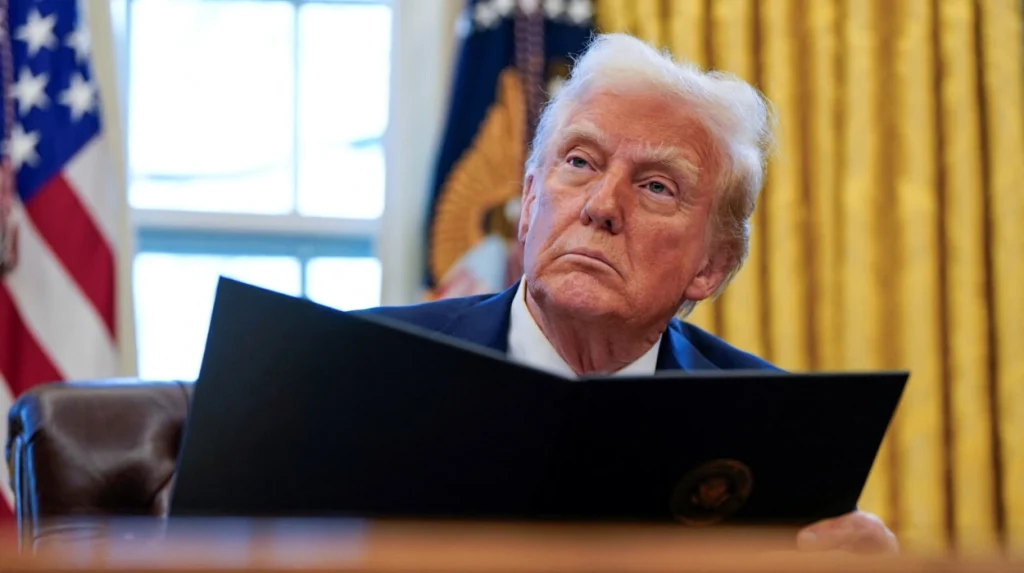
The Trump administration’s announcement of a new “Board of Peace” for Gaza marks one of the most controversial and ambitious attempts by a US government to directly influence the post-war governance of the Palestinian territory. Framed by the White House as a technocratic, stabilisation-driven initiative, the board is intended to oversee Gaza’s temporary administration, reconstruction, and security transition following more than two years of devastating war.
Yet behind the rhetoric of peace and rebuilding lies a body dominated by political heavyweights, billionaires, and long-standing US power brokers—raising fundamental questions about legitimacy, intent, and feasibility. The board’s composition, the absence of women, the marginalisation of Palestinian political actors, and the heavy presence of figures associated with past military interventions all point to a governance experiment shaped more by geopolitical calculation than local consent.
A Governance Model Without Sovereignty
According to the White House, the “founding executive board,” chaired by President Donald Trump himself, will supervise a committee of technocrats tasked with administering Gaza during a transitional period. This structure deliberately avoids language associated with Palestinian sovereignty, elections, or self-determination. Instead, it mirrors international trusteeship models previously applied in post-conflict zones such as Iraq, Bosnia, and Kosovo—each with mixed or deeply contested outcomes.
Gaza’s reconstruction challenge is immense. The World Bank estimates that rebuilding the territory could cost over $50 billion, with more than 70% of housing units damaged or destroyed, critical infrastructure crippled, and unemployment exceeding 80%. Any governing authority will have to manage humanitarian relief, reconstruction contracts, security coordination, and political transition simultaneously. Against this backdrop, the board’s membership becomes especially consequential.
Tony Blair and the Shadow of Iraq
Sir Tony Blair’s inclusion as the only non-US citizen on the executive board has drawn particular scrutiny. As UK prime minister from 1997 to 2007, Blair was a central architect of the 2003 Iraq War—an intervention widely viewed as destabilising the Middle East and eroding trust in Western-led peace initiatives.
Blair later served as the Quartet’s Middle East envoy, a role criticised by Palestinian groups for prioritising Israeli security and economic “peace” over political rights. His endorsement of Trump’s Gaza plan as the “best chance of ending two years of war” reflects a familiar approach: conflict resolution driven by elite diplomacy and economic incentives rather than grassroots political inclusion. For many Palestinians, Blair symbolises a model of intervention that promises stability but delivers prolonged dependency.
Marco Rubio and Conditional Peace
As Secretary of State, Marco Rubio anchors the board firmly within Trump’s broader foreign policy worldview. Rubio’s past opposition to a Gaza ceasefire and his calls for the total destruction of Hamas underscore a security-first doctrine that prioritises military outcomes over political reconciliation.
While Rubio has since endorsed the phased ceasefire agreement reached in October, his framing of peace remains conditional—dependent on demilitarisation and compliance rather than negotiation. This approach aligns closely with Israeli strategic objectives but risks alienating large segments of Gaza’s population, where Hamas, despite widespread criticism, remains a central political and social actor.
Real Estate Logic Meets War Ruins
Steve Witkoff and Jared Kushner embody one of the most striking features of the board: the fusion of diplomacy with real estate and investment logic. Witkoff, a property developer and close Trump confidant, has become a key negotiator in both the Gaza and Ukraine conflicts. His emphasis on “reconstruction and full demilitarisation” echoes US policy in post-war Iraq, where disarmament and privatisation went hand in hand—with deeply destabilising effects.
Kushner’s past remarks about Gaza’s “valuable waterfront property” have only intensified fears that reconstruction will prioritise commercial redevelopment over the rights of displaced Palestinians. With more than 1.7 million Gazans internally displaced, land ownership, return rights, and housing policy are among the most sensitive political issues. Any perception that Gaza’s reconstruction is being treated as a real estate opportunity rather than a humanitarian obligation could undermine the board’s credibility from the outset.
Finance, Development, and the Power of Capital
The presence of Marc Rowan, CEO of Apollo Global Management, signals the central role private capital is expected to play in Gaza’s rebuilding. Private equity involvement in post-conflict zones is not new, but it often brings tensions between profit motives and social needs. Gaza’s economy, already fragile before the war, lacks basic regulatory institutions capable of overseeing large-scale private investment without exacerbating inequality or corruption.
Ajay Banga’s role as World Bank president introduces a more conventional development perspective. The World Bank has historically emphasised institution-building, transparency, and macroeconomic stability. However, its projects in Palestine have repeatedly been constrained by Israeli control over borders, resources, and movement. Without addressing these structural constraints, even the most well-funded reconstruction plans risk becoming technocratic exercises detached from political reality.
Security Without Accountability?
Robert Gabriel’s inclusion reflects the board’s strong national security orientation. A long-time Trump adviser with ties to hardline figures such as Stephen Miller, Gabriel represents continuity with Trump’s earlier Middle East policies, including the sidelining of international law in favour of unilateral decision-making.
This security-heavy composition raises concerns about accountability. Gaza’s future governance will require not only stability but also mechanisms to address war crimes, civilian harm, and long-standing human rights violations. The board’s mandate, as currently described, makes no reference to international legal frameworks, UN oversight, or transitional justice—key pillars in post-conflict recovery elsewhere.
The Token Local Presence
Nickolay Mladenov’s appointment as the board’s representative on the ground, overseeing a 15-member Palestinian technocratic committee, appears designed to provide a veneer of local involvement. While Mladenov brings extensive UN experience, the National Committee for the Administration of Gaza (NCAG) lacks electoral legitimacy and operates under the authority of a foreign-led executive board.
Ali Shaath’s leadership of the NCAG, given his background in the Palestinian Authority, may further complicate matters. The PA’s legitimacy among Gazans has been severely eroded, and its limited control in the West Bank has done little to inspire confidence that it can manage Gaza’s post-war recovery under external supervision.