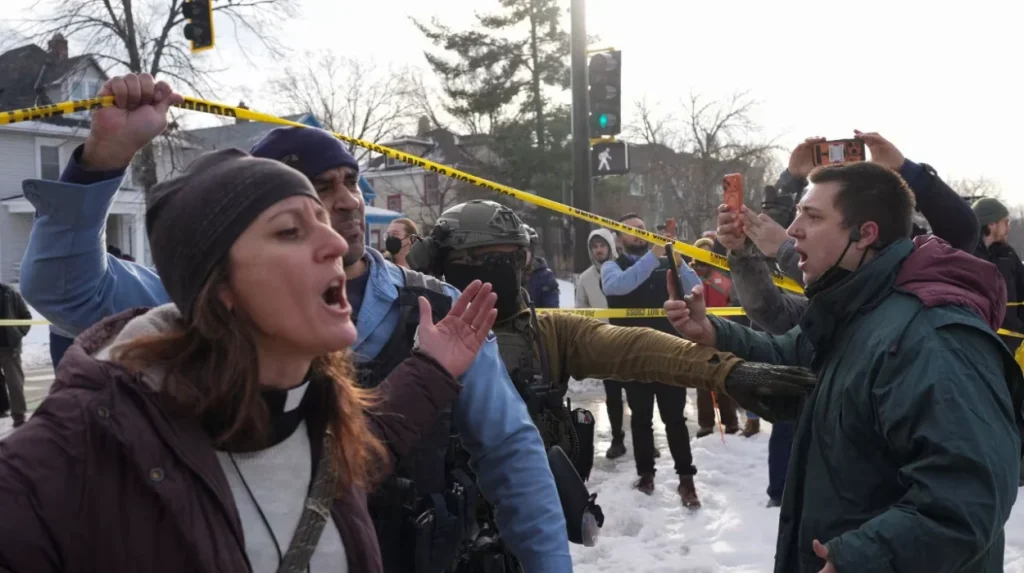
It took only seconds for a quiet, snow-covered residential street in Minneapolis to become the epicenter of America’s latest political trauma. A bystander’s video captured an ICE agent shooting 37-year-old Renee Nicole Good at point-blank range — a moment that rapidly spread across millions of screens nationwide.
The footage felt jarringly unreal. With older homes in the background, ice underfoot, and green-clad federal agents converging on a civilian vehicle, the scene evoked images more commonly associated with authoritarian crackdowns than with life in a US city.
Yet this killing quickly became another defining moment in Donald Trump’s second term — one that underscores how deeply political power, law enforcement, and violence are now intertwined.
A US citizen has apparently been shot by ICE agents in Minneapolis. I’m gathering information, but the situation on the ground is volatile.
— Tina Smith (@SenTinaSmith) January 7, 2026
ICE should leave now for everyone’s safety.
Please be safe Minneapolis.
Why did Minneapolis officials respond with open fury?
Minneapolis Mayor Jacob Frey reacted with visible outrage just one day into a federal crackdown that brought 2,000 agents into the city. His message to ICE was blunt and profane: “Get the fuck out.”
For city leaders, the shooting represented not just a tragedy but a collapse of coordination between federal enforcement and local governance — and a warning of what happens when heavily armed agents flood civilian neighborhoods.
Today’s shooting in Minneapolis by a DHS agent was horrific and demands a full, independent investigation.
— Chuck Schumer (@SenSchumer) January 7, 2026
DHS agents should not be patrolling our neighborhoods like an occupying force—their presence is only creating chaos and costing lives. https://t.co/YQVsibcK2d
How did the Trump administration shape the narrative?
Rather than signal restraint or promise an independent inquiry, Trump and Homeland Security Secretary Kristi Noem moved swiftly to frame the killing in political terms.
Noem labeled the incident “an act of domestic terrorism.” Trump went further, claiming on social media that Good had “violently, willfully, and viciously” run over an ICE officer and that the shooting was an act of self-defense — a claim not clearly supported by available video footage.
He also attacked a woman heard screaming in the footage, dismissing her as a “professional agitator.”
Who was Renee Nicole Good beyond the headlines?
As political leaders sparred, it fell to Good’s mother, Donna Ganger, to humanize the woman at the center of the storm. Speaking to the Minneapolis Star Tribune, she rejected the administration’s portrayal, describing her daughter as compassionate, forgiving, and affectionate — “not part of anything like that at all.”
Her voice cut through the rhetoric, reminding the public that the victim was not a symbol, but a person.
Is this another chapter in America’s cycle of political violence?
Good’s death did not occur in isolation. It followed a grim series of politically charged violent acts: two assassination attempts against Trump in 2024; the murder of Minnesota Democratic lawmaker Melissa Hortman and her husband; the killing of a health insurance executive in New York; and the fatal shooting of conservative activist Charlie Kirk.
Together, these incidents reflect a nation where political conflict increasingly spills into bloodshed — eroding public trust and exhausting collective morale.
Why does accountability feel elusive?
Under normal circumstances, investigators would examine whether the ICE agent’s use of force was justified, whether engagement rules encourage escalation, and whether alternative outcomes were possible.
But critics argue that Trump and Noem’s early declarations risk prejudging any inquiry. While Noem later conceded that “any loss of life is a tragedy” and that the situation was “preventable,” she offered no retreat from her original framing.
Vice President JD Vance echoed the administration’s stance, saying Americans could view Good’s death as tragic while also considering it “a tragedy of her own making,” and reaffirmed the administration’s full backing of ICE.
How dangerous has immigration enforcement become?
The Minneapolis shooting highlights the growing volatility surrounding ICE operations in major cities. Often masked, federal agents have conducted aggressive operations that sometimes ensnare US citizens alongside undocumented migrants.
Social media has amplified confrontations — showing vehicle rammings, chaotic arrests, and violent clashes. ICE officials told CNN that attacks on agents increased by 1,000% last year. Noem cited an earlier incident in which an officer was dragged by a car during a protest.
Is Trump’s immigration crackdown making America safer — or riskier?
This raises a central question: does Trump’s hardline immigration strategy enhance public safety, or does it place civilians and officers alike in greater danger?
Even setting aside the details of Wednesday’s shooting, critics warn that ordinary Americans could be harmed simply by being in the wrong place at the wrong time. A few seconds of fear, misjudgment, or confusion can now carry lethal consequences.
Is the US drifting toward authoritarian enforcement norms?
Trump has repeatedly described immigration as an “invasion” and authorized what critics describe as militarized responses. That language, combined with aggressive tactics, has prompted comparisons to authoritarian states where individual lives are subordinate to political ambition.
In such systems, violence is not an accident — it is a feature.
Why does Minneapolis carry symbolic weight?
The shooting occurred just one mile from the site where George Floyd was killed in 2020 — another death captured on video that ignited a global reckoning over policing and race.
That proximity deepens the sense that Minneapolis has once again become a national mirror, reflecting unresolved tensions between authority, accountability, and human dignity.
Could this incident reshape political opinion?
Trump was reelected in part because many voters believed the Biden administration lost control of the southern border. Enforcement, supporters argue, is necessary for safety.
Yet scenes like the one in Minnesota seem far removed from Trump’s promise to target “criminals, rapists, and the worst of the worst.” In hindsight, the shooting could become a moment that persuades undecided voters — especially ahead of midterms — that the crackdown has gone too far.
How divided are Americans over what happened?
Reactions split predictably. Critics see state-sanctioned violence and the erosion of due process. Supporters argue the officer acted under threat and point to crimes committed by undocumented migrants.
But even some law enforcement leaders expressed unease. Minneapolis Police Chief Brian O’Hara warned he had feared such a tragedy due to how federal enforcement was being conducted.
Former Vice President Mike Pence, however, framed the incident as a warning against harassing ICE officers.
Are protests playing into a larger political strategy?
Minnesota leaders worry that unrest could justify an even harsher federal response. Trump has long portrayed Democratic cities as lawless “hellholes” to legitimize extreme measures, including National Guard deployments.
Governor Tim Walz and Mayor Frey urged residents to protest peacefully, warning against giving the administration a pretext for escalation.
“They want a show,” Walz said. “We can’t give it to them.”
When does politics give way to human decency?
As night fell, residents gathered on Portland Avenue for a vigil — another community mourning a life lost amid forces larger than any one person.
Minnesota Senator Tina Smith captured the moment’s moral weight: “When do things stop being about politics and start being about actual human decency?”
For now, that question remains unanswered — hanging over a nation grappling with the consequences of power exercised without restraint.