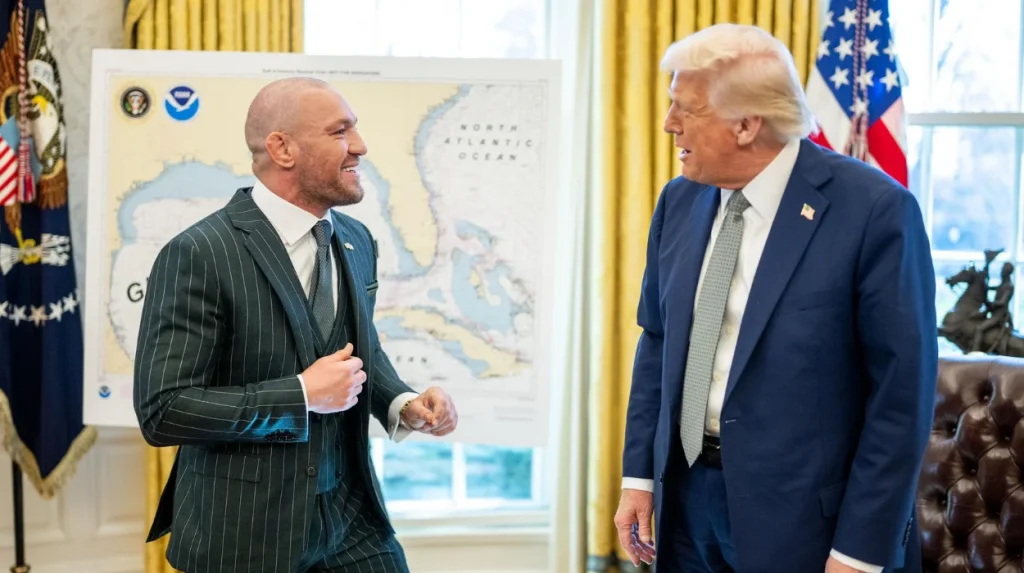
The Oval Office appearance of Conor McGregor on 17 March 2025 marked the strategic shift to being a sporting personality and a political aspirant. The visit to U.S. President Donald Trump on St Patrick Day saw McGregor departing from diplomatic formalities and into political intentionality on matters of national Irish interests, particularly immigration and sovereignty. What could have seemed a mere symbolism turned out to be a definite show of the fact that McGregor was looking to gain political legitimacy before even contemplating running to become Ireland’s president.
Addressing the White House, McGregor put Ireland in the context of a menace of what he called an illegal immigration racket causing havoc, saying that Irish identity was stretched in the countryside. He had an appeal to the Irish diaspora in the United States, claiming that the future generation would cease to be connected to their heritage in case, as he said, Ireland would become unrecognizable. The rhetoric was nationalistic and a direct reflection of rhetoric that has spread into the populist movements across the globe.
The Oval office moment was thus a diplomatic theatre and a strategic branding at the same time. With a Trump-congruent sentiment of sovereignty and identity, McGregor was sending an indication of adherence to U.S. right-populist networks, which he considers politically beneficial to his goals.
Political reaction in Ireland and public pushback
The political administration of Ireland disassociated itself with what McGregor was saying. Taoiseach Micheal Martin issued a mass media statement to remind McGregor that he was not an official ambassador of Ireland and that St Patrick’s Day was a day of community, not division. He juxtaposed the tone of McGregor to the values of fellowship and inclusion and placed the statements of the fighter out of the country line.
The rebuke was even increased by Tanaiste Simon Harris who called the rhetoric employed by McGregor as harmful. A “true feeling of disgust in Irish officials was cited by Harris who emphasized that the position of McGregor was not within government priorities. His criticism was more imputed in the words that he called McGregor projecting toxic masculinity, which does not align with the reality that we have democracy today.
Media and public sentiment
In the Irish media coverage, it was generally polarized, as most media outlets presented the visit as politically provocative and a blow to the Irish reputation internationally. The 2023 civil judgment obtained by McGregor on sexual assault, which is at the core of the mistrust in people, became the subject of public discussion once again. To critics, the Washington platform was not a fit to a person whose legal scandals still define his image to the masses.
The opinion polling has also been consistent with the electoral support of McGregor remaining in the single figures, with polls towards the end of 2023 indicating that his presidential chances were about 8 percent. Analysts complain that his confrontational manner and scandals curtail crossover in the centrist Irish political culture.
Business ties and strategic networking after the visit
The Oval Office meeting was later succeeded by Mcgregor announcing in September 2025 that he planned to form a business alliance with Donald Trump Jr. to expand the MMA promotion business of McGregor, MMA.Inc. The deal emphasized a calculated connection between political access and trade growth, a paradigm that is not new to the U.S. celebrity-politics relations.
White House UFC event plans
The Trump administration subsequently confirmed proposals of a UFC-style exhibition at the White House as part of the 250-year celebrations of America in mid-2026. Reports indicated that McGregor might be offered a purse headline of 100 million and about 100 special-entry visas giving associates strategic mobility in business and sporting partnership.
These changes show that McGregor is using political exposure to build his enterprise brand. His ability to remain eligible and continue to fight in spite of an 18-month USADA ban, announced in late 2025, highlights his exceptional position at the nexus of politics and sports entertainment.
McGregor’s political viability and barriers to office
Nevertheless, in Ireland, McGregor is experiencing structural problems in spite of being recognized internationally. The nomination of presidential candidacy involves an amount of 20 TDs/ Senators or four local councils. Having institutional support through established parties, the outsider candidates are also likely to count on civic good will, which McGregor does not enjoy among political elites. Analysts observe that his rhetoric and past court rulings have created controversy that makes the process of building coalitions difficult.
Celebrity, populism, and political capital
The appeal of McGregor is part of a larger trend of populism based on celebrities that play on the appeal of online influence. His anti-establishment framing has been reinforced by other high profile supporters like Elon Musk and influencer Andrew Tate, who have presented him as a voice of the forgotten Irish people. To critics, such alignment is a question of foreign influence on the Irish political discourse and the exportation of U.S. rhetoric of culture wars.
Identity politics, nationalism, and transatlantic symbolism
The textual development of the theme of immigration, identity, and sovereignty by McGregor is a nationalistic speech using digital technologies and transatlantic connections. His meeting with Trump was not merely a domestic signaling but it was the validation of the U.S. power structures that were historically connected to the power of Irish-American but were now being linked to the right-populism of the time.
Masculinity, power, and public image
The persona of McGregor combines physical superiority, business swagger and political controversy which defines masculinity as a virtue of leadership. Those who support him find power and sincerity; those who oppose him have cautioned that the style poses a danger of creating rifts and eroding changing cultural conventions within Irish discourse.
A shift in diaspora engagement
McGregor cast the external voices as stakeholders in Irish politics by directly addressing the Irish diaspora in the U.S. This approach is the opposite of the policy of the Irish government, which is concerned with the domestic consensus. The rewriting of the engagement of the diaspora shows the unusual campaign structure of McGregor.
The evolving narrative and political trajectory
The Oval Office moment is considered the turning point of the transformation of McGregor into a political player after his life as an athlete. His rhetoric, coalition and his media approach all provide a conscious adherence to populist templates that have transformed politics in various democracies. However, the political culture of Ireland, institutional streams and popular mood are hardly conducive.
The question of whether the ambitions of McGregor are a stop and start media cycle or a political movement is based on how Ireland will react to the debate of identity, migration, and global influence. As Ireland explores the challenges of demographic change, digital populism and global ideological flows, the strategy developed by McGregor illustrates a laboratory of whether or not celebrity power can counterpose old structures with a new politics based on performance, influence and confrontation.
The question now is how not only can McGregor win office, but whether his political experiment is an indication of a more general change with regard to how Irish political identity will interact with the populist flows of the international scene, and the American political image, in the coming years.