The United States has declared what it calls the single greatest financial offensive ever marshalled against an adversary, opening what Treasury Secretary Scott Bessent termed an “economic D‑Day” aimed at collapsing Iran’s regime through unprecedented coordinated economic isolation. The announcement, delivered through a Financial Times op‑ed and social media posts ahead of a Monday press conference in Washington, signals a sharp escalation from rhetoric to operational detail in a campaign that President Donald Trump has described as
“the most crushing economic operation ever taken against any country.”
The architecture of an “economic D‑Day”
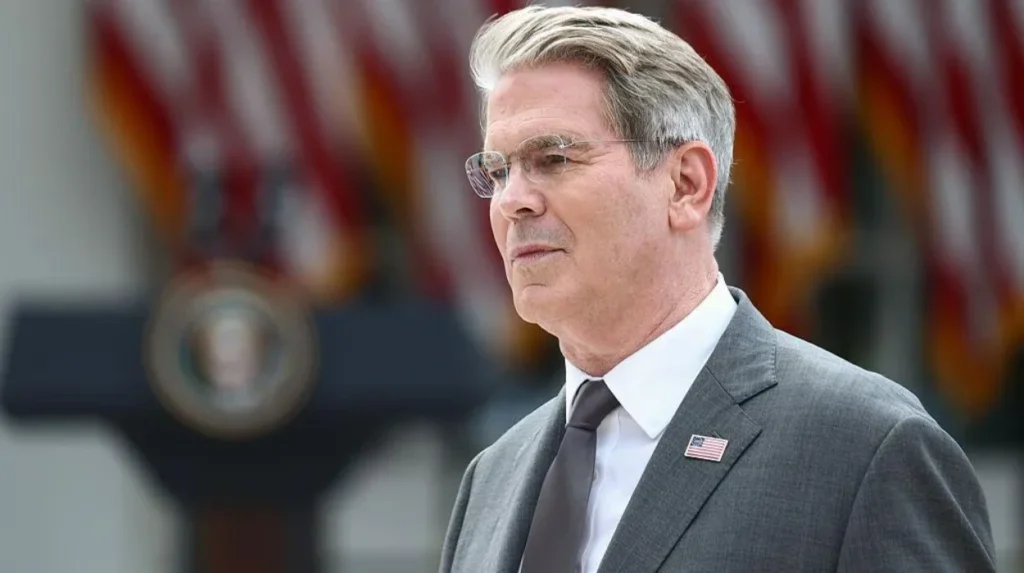
Bessent’s framing is deliberate: by invoking D‑Day, the administration is positioning the new sanctions not as another incremental pressure tool but as a decisive, system‑wide assault on Iran’s ability to finance its state, military, and proxy networks. In his op‑ed, Bessent wrote that
“at dawn begins an economic D‑Day — the single greatest financial offensive ever marshaled against an adversary,”
adding that
“any nation that serves as a financial artery of a withering regime should expect to share in its isolation.”
The message to third countries is unambiguous: continued trade and financial facilitation for Tehran will be treated as complicity, with secondary sanctions and enforcement actions to follow.
The Treasury chief has repeatedly stressed that the goal is regime collapse through economic strangulation rather than large‑scale new military operations.
“We are going to have the toughest sanctions in history… It worked in Venezuela once we put up the blockade. It is working in Cuba right now, and it is going to work in Iran, and we are going to collapse this regime,”
Bessent told CNBC, outlining the administration’s belief that sustained maximum pressure can force internal change. He added that Washington’s stance is binary:
“You are either with us or against us… we are going to squash the economy of this murderous regime, which that will curtail their ability to project power through their proxies.”
From toughest sanctions in history to secondary pressure on trade partners
Although the specifics of the new steps have yet to be announced at Bessent’s press conference scheduled for Monday, the Trump administration has already signaled its intention to focus on secondary sanctions against Iran’s trading partners and financial intermediaries. As Trump said,
“there will be economic consequences to anyone who provides any type of lifeline to Iran,”
effectively putting Beijing, Baghdad, and Gulf countries on notice that their access to the U.S. financial systems would be compromised if they continue to buy Iranian oil and conduct business transactions with Tehran.
Of all the parties, Beijing is the most important one here. According to U.S. Treasury statistics cited by Al Jazeera, 90 percent of Iran’s oil sales goes to China making it the prime target of the new effort to impose secondary sanctions. Similarly, Reuters analytics from 2025 show that more than 80 percent of Iran’s exported oil is bought by China which means that any “blockade” is contingent on either coercion or bypassing Chinese demand. While Bessent called on Beijing to work with him, China’s embassy in Washington denied the claim and said that
“sanctions and pressure do not help solve the problem.”
Instead, China suggested that diplomacy was the way forward. It seems that the new plan of action relies on multiple choke points of the financial system: correspondent banking, insurance, shipping, and logistics of the energy industry rather than on the old-fashioned entity designation.
“Fearful nations that practice appeasement and do business with Iran’s financial and economic sectors”
are going to be penalized for their “cooperation.”
Iran’s counter‑threats: “not a single drop of crude” and Hormuz coercion
Tehran has responded with maximalist rhetoric and concrete maritime threats, warning that any nation joining the U.S. economic war will be treated as an enemy and that Iran is prepared to disrupt oil exports from the Gulf if the pressure continues. Mohsen Rezaei, secretary of Iran’s Supreme National Security Council, warned that
“not a single drop of crude will be exported” if the economic war continues,
and that Iran would regard participating in or supporting the U.S. economic war as “an act of war.” This aligns with earlier statements from Iranian officials that
“any country that becomes a partner in creating economic restrictions against us will be regarded by us as an enemy.”
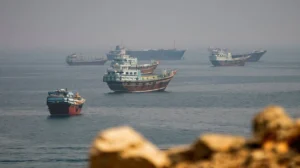
One of the most concrete manifestations of escalation took place in the Strait of Hormuz, one of the world’s key transit points for oil transportation. The state-controlled Persian Gulf Strait Authority (PGSA) of Iran has said that vessels which fail to comply with PGSA’s transit regulations may be fined or detained in the future, adding that those vessels working together with other non-compliant ships will be blacklisted as well. In addition, cargo confiscation was mentioned as one of the possible steps, making the situation very difficult for charterers and shipowners who have been operating in the area of the ongoing six-month-long war and who had a missed 60-day ceasefire period. According to Iranian media, the Parliament adopted a rule which would require paying for services rendered by Tehran to all the vessels which will transit the Strait of Hormuz, although at the moment of writing the measure needed full parliamentary approval.
Military posture and the spectre of regional escalation
Alongside economic threats, Iran’s military leadership has issued stark warnings of retaliatory strikes across multiple domains. Major General Ali Abdollahi, chief of staff of Iran’s armed forces, declared that
“with preparedness across land, sea, air, air defence and cyberspace, Iran’s armed forces will respond to the enemy’s new threats with crushing, punishing and devastating responses.”
This language echoes earlier statements that Iran’s response to new U.S. threats would be “devastating,” and reflects Tehran’s effort to signal credible deterrence as Washington ramps up pressure.
The regional dimension is acute. Gulf states have been warned against joining U.S. economic measures, and some Gulf energy facilities and desalination plants have previously come under Iranian attack, raising the risk that economic warfare could spill into kinetic strikes on infrastructure. NATO’s top commander convened a videoconference of allies at the chief‑of‑defence level to discuss supporting freedom of navigation in the Strait of Hormuz, though it was not framed as a formal NATO mission, indicating that Western militaries are preparing contingency options without immediately committing to a multinational operation.
Economic context: sanctions on top of a war‑strained economy
The new sanctions by the United States are to be added to an existing sanctions framework against Iran, with the American authorities claiming that the Iranian economy is in “freefall” due to rising inflation and a plummeting currency. The country has been living under sanctions since the Islamic Revolution of 1979, but the Iranian government admits to being under severe pressure due to high levels of inflation, weakening currency, shortages of energy, and damage to its infrastructure resulting from several months of confrontation. In the eyes of the United States, the idea behind the plan is that increased economic pressure would eliminate the necessity for the use of new military campaigns, limit Iran’s funding of its army and allies, and increase pressure on Iran from within. Bessent directly ties the sanctions to the strategy of “coordinated economic isolation” in the history of American foreign policy, as he claims that economic measures can do what military ones cannot without leading to war.
Market reaction and the limits of coercion
Despite the bellicose rhetoric from both capitals, oil markets initially reacted with restraint. Crude prices pulled back in Asian trading on Monday: WTI fell about 1.3% to $85.93 a barrel and Brent dropped 1.3% to $93.22 a barrel, according to CNBC, suggesting that traders are weighing the risk of supply disruption against the possibility that sanctions will ultimately curb Iranian exports. This muted reaction may reflect skepticism about the immediate impact of new sanctions, as well as the expectation that some buyers will continue to absorb Iranian barrels through opaque channels.
The effectiveness of the U.S. campaign will ultimately depend on enforcement capacity and the willingness of key partners, particularly China, to curtail purchases of Iranian oil and related financial services. If Washington can credibly threaten secondary sanctions on major Chinese entities, it may force a recalibration in Beijing’s approach; if not, Iran may be able to sustain a shadow economy that blunts the impact of even the “toughest sanctions in history.”
What comes next: enforcement, exemptions, and diplomatic off‑ramps
Bessent’s Monday press conference should clarify what the specific sanctions measures are going to be, enforcement methods to be applied, and their targets. It is crucial to find out whether the U.S. will offer some countries temporary exemptions, how the humanitarian trade will be addressed, and whether it will cooperate with its allies to close potential gaps regarding shipping and insurance.
On a diplomatic level, the problem lies in the fact that despite all the efforts to make the Iranian regime collapse, any actions on Iran’s part to stop the export of oil or attack Gulf facilities may result in an outbreak of the regional war. Iran’s stance that support of the U.S. economic war against Iran constitutes an “act of war” creates a very tight corridor for other countries that are interested in limiting the influence of Iranian oil but do not want to take part in this confrontation with the U.S. However, the trend is obvious – the United States is counting on the success of the unprecedented financial offensive, and Iran hopes that its capability to threaten the flow of oil in Hormuz will prevent the implementation of sanctions.