The effects that the Cold War had on American foreign policy are still evident in the way international relations are going to be in 2025.
Since the beginning of the era of the superpower, which started in the period immediately after World War II, the United States embraced interventionism not as a means of defensive strategy, but as a principle of containment of communism and the desire to assert global power. The history of that period is reflected in the modern military alliances, diplomatic priorities, and the philosophical basis of foreign relations.
The Foundations of the U.S. Interventionism During the Cold War
The concept of interventionism was a direct reaction to the international menace of the Soviet Union witnessed during the cold war. It was the period of geopolitical separation of capitalism and communism and led the United States into a trail of calculated interventions in the world.
The Truman Doctrine and Early Intervention Logic
In 1947, President Harry Truman declared a new strategy in the foreign policy: The United States would support those countries that faced the threat of communism. This policy became also known as the Truman Doctrine and became the signal of the shift to an active global policy. It made the U.S. an ambassador of liberal democracy ready to act diplomatically, economically or through military intervention when the strategic interests were endangered.
This doctrine was the excuse that made the Americans intervene in areas that were way beyond the geographical boundaries of its influence. As time progressed, it became a wider containment policy, whose assumption was the domino theory; in which, one nation would convert to communism, and the others would follow.
Military Expansion and Strategic Alliances
The doctrine of interventionism became stronger in 1950 with the NSC-68 report of the National Security Council, which supported a vital military build-up. This strategy formed the basis of massive military expenditure and the formation of alliances like NATO. The Cold War also witnessed the U.S. fight a direct war with proxy wars in Korea and Vietnam that had characterized the interventionist spirit of fighting communism in an indirect form using local actors and allies.
Long-Term Structural Drivers of Cold War Strategy
Although early policy was ideological, U.S. interventionism in the long-term strategy was institutionalized by structural realities.
Military-Industrial Capacity and Global Readiness
By the fifties, military expenditure had increased by a massive percentage, integrating military preparedness into the US system of government. The military contractors, research facilities and intelligence networks developed into a long-term system of international projection to support the Cold War operations. These resources allowed the US to deploy forces quickly and developed an impression of sustained readiness that would shape the choice of policy long after the end of the Cold War.
Policy Continuity Across Administrations
The different U.S. administrations irrespective of the political party supported the same trend of intervention. Undercover operations in Iran (1953) and Guatemala (1954), overt military aid in South Vietnam, and active participation in Latin America all were indicative of a deep conviction in active leadership in the world. Intervention was not some tactic but one of the principal features of American world positioning.
How Cold War Doctrine Shapes Policy in 2025
Although the Cold War officially came to its end over 30 years ago, the structures it left can still be traced in the current foreign policy of the United States.
Great Power Competition and Modern Alliances
Countering the influence of China and Russia in 2025 are also included in the strategic priorities of Washington. These tensions are usually described using Cold War lingo language of containment, sphere of influence and proxy war. Formation of NATO to incorporate Finland and Sweden and efforts to ensure continued defense to Taiwan and South Korea are examples of how Cold War alliances have endured.
Moreover, intelligence politics, cyber defense politics, and foreign weapons politics are still rooted in the Cold War mentality. The belief that the U.S. needs to have forward presence to combat threats has remained the driving force to military deployments and diplomatic agreements.
The Enduring Shadow of the Domino Theory
Though the initial domino theory involved the spread of communism, the same idea that ensures that the unstable regions do not proliferate remains. The rationale of this has been participation in the Middle East, Africa, and the Indo-Pacific. The most recent event, the exodus of the U.S. troops in Afghanistan in 2023, along with the consequent reassessments, depicts the balance of interventionism instinct and the urge of strategic restraint.
Evolving Applications of Interventionism
Intervention forms are no longer the same yet the principles that govern them are still based on the Cold War traditions.
Sanctions, Cyber Conflict, and Strategic Competition
Instead of using ground forces, contemporary interventions can be in the form of economic sanctions, computer attacks, or drone attacks. The United States restrictions on Chinese AI companies and Russian energy corporations in 2025 are a reflection of new uses of old rules: make the opponent weaker, defend the allies, and strengthen the international system that the United States is in charge of.
Information warfare and cyber activities also reflect the Cold War spying, but with modern technology. Like the Cold War proxy wars, hybrid conflicts in Ukraine, in which disinformation campaigns and cyberattacks collide with kinetic warfare, strongly resemble each other.
Balancing Intervention and Domestic Pressure
In 2025, American society is tired of long-term military involvement. The world is now pressuring policymakers to redefine international commitments without necessarily forsaking strategic presence. This juggling act of remaining influential and not being entangled is a direct result of the Cold War experience especially in the case of the long wars such as the Vietnam war.
The Trump Administration and Interventionist Rhetoric
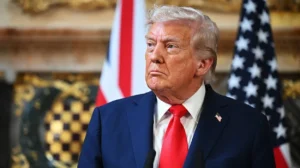
The Trump presidency signified a change in tone and not necessarily content of intervention. With the slogan of America First, the administration denounced multilateralism but at the same time increased military spending and placed extra pressure campaigns against its enemy.
The Trump administration was Cold War- Positioned in other parts of the world like the Middle East and Indo-Pacific. The strengthening of military assets, the expansion of the number of sanctions, and the restructuring of traditional alliances was reinvented and not abandoned. The interventionist legacy was not lost, and Trump might have used a transactional approach.
Strategic and Ethical Reflections on Interventionism
Interventionism found its way into the US foreign policy identity with the Cold War whose costs and effectiveness are debatable.
Mixed Outcomes and Global Perceptions
On the one hand, the U.S. intervention served as a measure to restrain the proliferation of the authoritarian regime, safeguard allies, and control over access to the most important markets in the world. On the other side, interventions usually destabilized the nations and made it possible to implore authoritarian oppression as observed in Chile, Iran, and Nicaragua. This has made the image of America complicated by the ethical ambiguity of these actions, and it has given rise to the doubt about world leadership.
Contemporary Lessons and the Call for Recalibration
The necessity to redefine interventionism becomes more and more obvious in 2025. The world issues like global warming, cybersecurity, increasing populism require collective instead of individual solutions. However, even several American reactions are based on Cold War reflexes.
The policy of tomorrow will need to combine the lessons of the Cold War with the problems of incorporating new strategic instruments, which should entail multilateralism, soft power, and management by default rather than hard default solutions. According to analysts, more emphasis should be paid to diplomacy, and coalition-building, especially in tension management with China and addressing global crises that will not have military solutions.
The Cold War set the stage for America’s interventionist worldview, creating structures and habits that continue to shape how it engages with the world. As global dynamics evolve, U.S. policymakers face a critical challenge: whether to continue adapting Cold War strategies or to redefine them entirely for a multipolar 21st century. The decisions made in this transitional moment will determine whether interventionism remains a central pillar or becomes a relic of past superpower rivalry, an enduring question at the heart of American foreign policy.