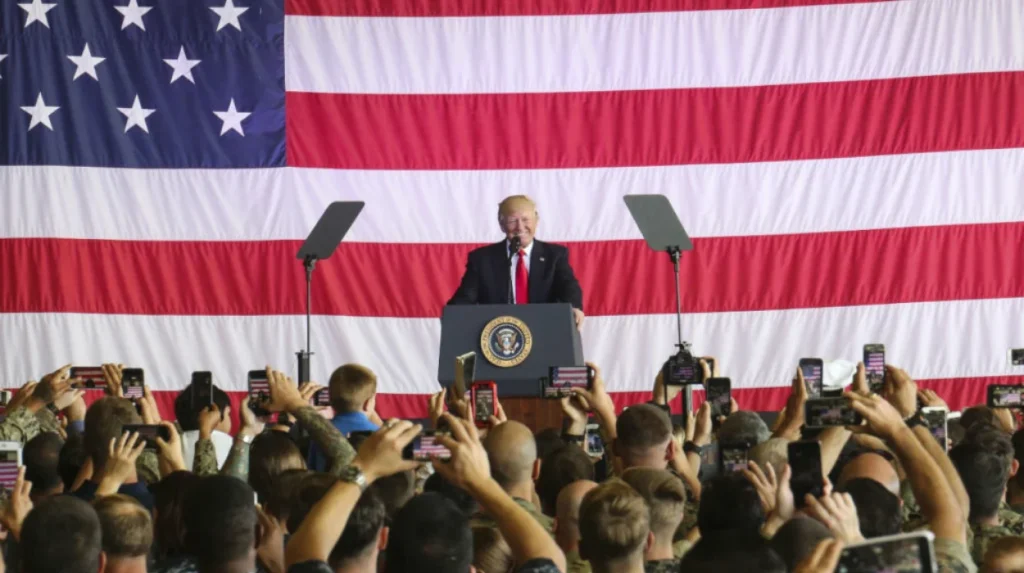
In 2025, the second rise of Donald Trump as the American President resulted in the revival of the dedication to the America First policy which believes that only one-sided choices and national interest are essential rather than old friendships. This is a strategy that goes on to destroy the liberal post-war world order that the United States was involved in building since 1945.
Withdrawing Washington into unilateralism and compelling the allies to renegotiate agreements on defense, trade and diplomacy, the U.S is driving a paradigm shift in geopolitics of the world. The resultant changes are redefining international cooperation, stability, and the role of America as perceived by nations.
Foundations of Post-War U.S. Leadership and Institutional Legacy
The U.S. created a new order on the basis of economic integration, military balances and common democracy values after World War II.
Multilateral Systems and American Dominance
The NATO, the United Nations, the World Bank and the International Monetary Fund were institutions created to facilitate peace and economic growth. The domination of the U.S.A in these institutions provided world stability to a certain degree, and its investments with regards to defense, diplomacy and technology extension continued to reach the various continents.
The post-war supremacy of Washington was strengthened by its control of the access to space exploration, artificial intelligence, and international finances. The robust American technological edge was strengthened by annual research and development investment, 3.4 percent of GDP in 2024, in support of the credibility of American foreign policy in the future.
Disrupting Alliances through Transactional Diplomacy
The America First policy by Trump destroys multilateralism and focuses on bilateral agreements that require more concessions to be made by conventional allies.
Realignment of Western Alliances
European and North American partners have experienced repeated strains. In early 2025, the U.S. imposed new tariffs on Canadian steel and threatened withdrawal from defense pacts unless member states increased military spending beyond the agreed NATO benchmarks. The result has eroded trust and growing efforts among European nations to pursue greater strategic autonomy.
At the Munich Security Conference in February 2025, European leaders, including France and Germany, openly acknowledged the diminishing reliability of American support, signaling a pivot toward a more independent European defense framework. This shift underscores the unraveling of Cold War-era structures.
Unpredictable Foreign Engagements
Trump’s controversial remarks about absorbing Greenland and parts of Canada and his conditional stance on military aid to Ukraine have unsettled global observers. These actions signal a willingness to challenge international norms and rewrite geographic realities under nationalist justifications.
The Retreat from Global Institutions and Norms
The White House’s retreat from multilateralism has impacted diplomatic structures built to address transnational issues.
Withdrawal from Treaties and Global Forums
In 2025, an executive order mandated a formal review of U.S. involvement in over 100 international treaties and organizations. Following this review, the administration confirmed withdrawal from the Paris Climate Agreement, the World Health Organization, and the UN Human Rights Council.
These exits have prompted other global players, notably China and Russia, to increase their influence within these institutions. BRICS nations, bolstered by recent additions like Egypt and Indonesia, have expanded their role in shaping alternate governance structures that challenge Western-centric norms.
Economic Nationalism and Market Disruption
Trade relations have been redefined through a protectionist lens. New tariffs and withdrawal from the Indo-Pacific Economic Framework have disrupted supply chains and exposed U.S. companies to retaliatory measures. Major trading partners including Mexico, the EU, and Japan have initiated countermeasures, undermining global economic integration.
Changing Security Architecture in East Asia and Europe
Due to the selectivity of Washington to its commitments, allied states are reviewing their defense policies.
Shifting Security Calculus in Asia
Both South Korea and Japan have been uneasy about the fate of the U.S. military support in the region where there are tensions with both China and North Korea. Tokyo has indicated that it is going to quadruple its defense budget by 2027 and expand its collaboration with other Southeast Asian nations.
Contrarily, the thawing of the relationship between the U.S administration and Russia, despite the unending conflict in Ukraine, has torn down the NATO unity. European mistrust has been sharpened by comments by Trump partly blaming Ukraine and an indication that he is willing to broker a deal to stop the fighting in a way that would give Russian territory to the invaders.
Diplomatic Fallout from Isolationist Policies
Relations around Africa and Latin America have been impacted as the U.S. foreign aid which was used as a soft power in dissemination is rapidly declining. The policy countries which used to be in coordination with Washington on policy issues are moving towards bilateral agreement with Beijing and Moscow.
A Realignment of Global Influence and Power Centers
This world India is in by the year 2025 is much more one of a diffusion of power when the classical Western dominance is being rebalanced.
Multipolarity and the Rise of Non-Western Blocs
China’s continued investment in the Belt and Road Initiative and its digital currency infrastructure has expanded its economic footprint. Russia’s energy and defense cooperation with Central Asia and the Middle East remains strong. Both powers leverage U.S. retrenchment to propose alternative visions for global governance.
Europe, faced with U.S. disengagement, has begun formalizing its own rapid reaction force under the European Defence Union, aiming for initial operational capability by 2026. This transition repositions Europe as an independent geopolitical actor.
Regional Discontent in the Americas
Trump’s provocative comments about annexing Greenland and incorporating Canada into U.S. territory have met firm resistance. Canadian officials labeled the idea “imperialist fantasy,” while Latin American leaders have condemned the rhetoric as destabilizing to hemispheric diplomacy.
Such initiatives have raised concerns of whether the U.S. places importance on sovereignty and autonomy within regions even of friendly neighbors.
The Personalization of Foreign Policy and Strategic Identity
In addition to ideology, Trump in his second term foreign policy is arguably more personalized in foreign strategy, and built around his own political brand and domestic branding.
Other critics claim that international visits and summits are positioned as less of geopolitical planning but rather part of brand promotion. Washington has lost out on the liability owing to its approach in prioritizing bilateral optics over multilateral consensus.
With the changing times, most countries are becoming multilateral in their alliances to lessen the reliance based on U.S commitment, and this is diluting the conventional pattern of allied organizing developed during the Cold War.
Influential Voices and Strategic Perspectives
Civil society response has also dwelled on these trends, as more voices are raised in the direction of the U.S. influence.
Any of them could be speakers like one of them was former NASA astronaut and foreign policy commentator, Terry Virts who stressed the threats to commit treason in terms of weakening partnerships built up over generations and stalling in international leadership (source). He also warned that withdrawing the traditional allies would weaken American soft power and weaken democratic coalitions that are already weak enough as it were.
This evaluation reflects an increasingly inescapable realization that the weakening of U.S. multilateral leadership is well beyond a question of image only-it is a strategic depth of capability, impact and moral credibility.
The renewed America First policy now having a solid grip on world affairs in 2025 promises to be a stark contrast to the international collaboration of the post World War II world. The United States is becoming an inaccurately unpredictable and selfish actor through its transactional foreign strategy, withdrawal to multilateral institutions, and interference in the systems of trade and security alliances around the world.
The world order after the war is at an inflection point as decrepit confederations summon to their last breaths and in their places rising hegemonies emerge. What path Washington pursues, whether it changes course or entrenches even more deeply in this nationalist direction, the fallout will be felt in international relations, in trade and finance, and in case of war, in security, down the line.