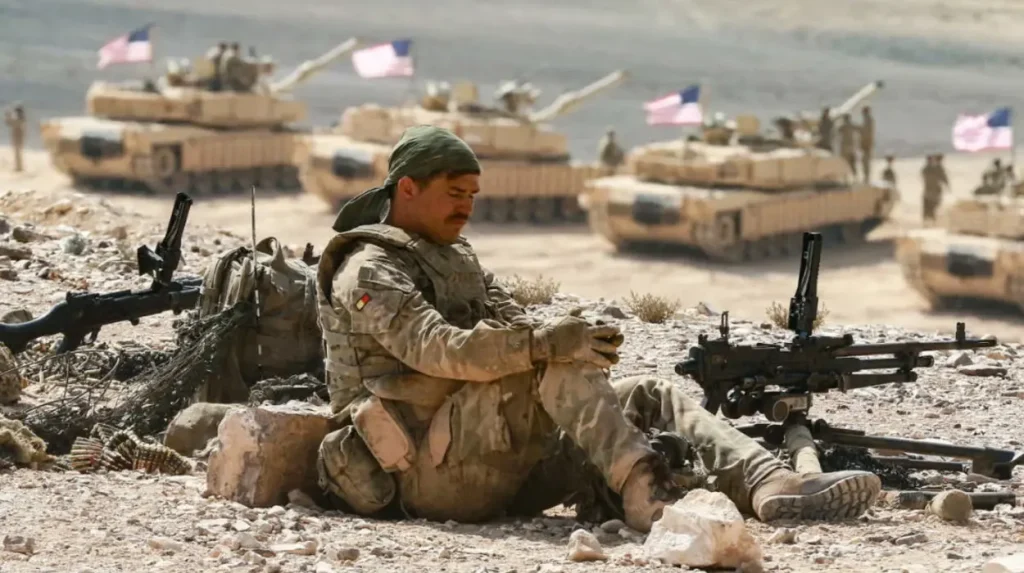
The United States involvement in the Middle East started with a few engagements in the early nineteenth century. The beginning of the naval projection of America in the Mediterranean was the Tripolitan War (18011805) against North African pirates. But throughout decades, the region was dominated mainly by British and French influence.
The balance of powers changed following World War II. The rise of the U.S to be a super power that had strategic interest in the Middle East was informed by the dynamics of the Cold War and increasing oil reliance. The two priorities (i) stabilization of the Soviet Union and (ii) development and assurance of energy resources had been the basis of a long term US policy in the region.
The US had initiated that deep economic and military relationship between itself and the Gulf monarchies, especially Saudi Arabia by the 1950s. The American oil energy, especially via the Arabian American Oil Company (Aramco) was at the center of entrenching US influence on the Persian Gulf.
The Cold War and Strategic Realignments
The Eisenhower Doctrine and the Strategy of Containment
At the time of the Suez Crisis in 1956 the European colonial powers (who saw themselves as masters of the Middle East) were shown how bad they could be fooled (thanks to the emerging Sino Soviet rivalry) and were aware that there could be no practice of conventional colonialism anymore. In 1957, the Eisenhower Doctrine was proclaimed and it pledged the US to protect the Middle East nations against the communist assault.
The ideology was much more than the fending off the communism. It practically provided the US the permission to use military force in the region. Only one year afterward, the US Marines were introduced in Lebanon to help the pro-western administration during political turmoil.
This interventionist position was met with criticism. Such leaders as Gamal Abdel Nasser of Egypt viewed American activities as neo-imperialist. The move by Nasser to be in alliance with the Soviet Union and forming the United Arab Republic with Syria in 1958 was evident of the increasing opposition to the US sponsored governments and policies.
The 1953 Iran Coup and Its Enduring Impact
The best-known and one of the earliest actions of American intervention was the Iranian coup in 1953. The overthrow of Prime Minister Mohammad Mossadeq who nationalized the oil industry in Iran was engineered by the CIA and British intelligence.
The Shah was reclaimed and western oil interests regained its control. The coup left a bitter feeling that lasted over the long-term, as it added to the anti-American face that led to the Islamic Revolution in 1979.
The use of this intervention also precedes that would be practiced in other regional environments that it would betray the democratic intentions and cement authoritarianism as a political decision.
The Arab-Israeli Conflict and the Double Standard
Consistent US Support for Israel
The US has been Israel ‘s main ally since its recognition in 1948. This gain was escalated following the six-day war of 1967 when Israel captured the Golan heights, Sinai Peninsula, West Bank, and Gaza strip. Israel is the leading recipient of US foreign assistance due to American military assistance to Israel, which amounted to more than 3 billion dollars in recent years.
There is increased frustration in the region because of the manner in which Washington has defended Israel in the United Nations, especially by vetoing some resolutions to condemn settlements expansion and occupation. Whilst there is much reference to humanitarian reasons, this alliance is more aligned by strategic compatibility and home political reasons, such as lobbying.
Arab Perspectives and Regional Tensions
Arab leaders and people have always perceived American policy as biased. Whereas, the US can be seen to have been enforcing UN resolutions against Iraq and Libya, it has also been protecting Israel against this on issues such as illegal settlements and status of Jerusalem.
Such lack of consistency in behavior has dilapidated the credibility of the US when it comes to peace talks. The inability to negotiate an enduring solution to the Israeli-Palestinian stalemate has become one of the major complaints among Arab people and a source of recurrent radicalization and lack of trust.
Doctrines of Oil, Security, and Permanent Presence
The Carter Doctrine and the Gulf Security Architecture
In 1980, President Carter decided that the United States would employ military force to defend its interests in the Persian Gulf after the Soviet invasion of Afghanistan and the Iranian Revolution. This declaration became the so-called Carter Doctrine which made the military commitments of America to the oil-rich monarchies of the region official.
This doctrine formed the grounds of the creation of US bases in countries such as Bahrain, Kuwait and Qatar. Over time, it also hardened a security system to focus on the stability of pro-western governments, no matter how illegitimate or poor caretakers of human rights they might be.
Permanent Footprint and Arms Sales
The Gulf War in 1991 and the Iraq invasion in 2003 further entrenched American military presence. By 2025, the US maintains tens of thousands of troops in the region and continues to sell billions in arms annually to countries like Saudi Arabia, the UAE, and Egypt.
These alliances have produced mixed outcomes. While they deter external aggression, they have also enabled domestic repression. US-supplied weapons have been used in conflicts like the war in Yemen, where civilian casualties have drawn international condemnation.
Shifting Alliances and the Use of Proxies
Support for Monarchies and Military Regimes
During the Cold War, Washington was more comfortable using authoritarian partners as they were regarded as the bulwarks against the leftist ideology as well as Islamist movements.
This strategy focused on Saudi Arabia, Egypt during the Mubarak presidency and Jordan under King Hussein. The US assisted such regimes through military and economic assistance, despite the oppression and suppression of political opposition as well as the abridgment of civil liberties.
Those alliances might have provided longevity in the short run, but it also left a stagnated form of development in democracy as well as fuel anti-American feeling particularly amongst the younger generation of the people looking to the change in politics.
The Islamic Alliance Strategy
During the 1960s and 1970s the US policy makers nurtured a group of Islamic states consisting of Saudi Arabia at the helm, as an opposite tool to secular Arab nationalism. This policy also led to the emergence of religious conservatism, especially Wahhabism in the region.
According to critics, this has in effect brought about the ideological background under which extremist groups arose, which is evident even after 9/11.
The Post-Cold War Landscape and Declining Authority
The Arab Spring and American Hesitation
The uprisings in 2011 in the Arab countries have questioned US alliances that have existed. The behavior of the Obama administration in Tunisia and Egypt was to support protesters rhetorically but once things got out of control it resorted to supporting the status quo once again.
In Bahrain, a US ally which also hosts the Navy Fifth Fleet, Washington remained conspicuously quiet when the government crushed the protests. Strategic ambivalence in the Syrian case was demonstrated in the response to the civil war: some rhetorically supported rebels without an intervention, full-scale one, though.
The US will have a more polarized region in the middle of the 2020s. Whilst still being one of the vital actors, other forces, such as China, Russia, and regional interests, such as Iran and Turkey, continue to influence what happens on the ground.
2025 and the Multipolar Middle East
As of 2025, American leverage is constrained. The Abraham Accords normalized relations between Israel and several Arab states, but failed to address the Palestinian issue. Meanwhile, Washington’s attempts to re-enter the Iran nuclear deal remain stalled.
Regional powers are increasingly hedging their bets. Saudi Arabia and the UAE maintain close ties with both the US and China. Turkey’s independent foreign policy has often clashed with NATO goals. The Middle East is no longer a theater of American unipolar dominance.
Social Impact and Immigration Patterns
US Policy and Diaspora Communities
The amendment of the laws of immigration in the 1960s in the US saw increased immigrants of the Middle Eastern region moving to the US. They ran away in response to wars and political persecution- in Iran, Lebanon, Iraq, Palestine and Afghanistan.
Such communities have diversified American and civil life, and, at the same time, they have influenced domestic consideration about foreign policy. The campaign against the war in Iraq and Gaza, defense of the refugee rights are frequently related to the diaspora networks that have direct links to the eruptions in the region.
Expert Perspectives on US Legacy
Rathbone is a recognized researcher of American foreign policy who spoke about the history of the US activities in the Middle East. He underlined the conflicting forces that influenced policy, such as an urge to keep things stable, relying on authoritarian allies, and an unwillingness to behold primary causes of dissatisfaction.
According to the point of view suggested by him, American strategy frequently compromised long-term reform in exchange of short-term control, which are only beginning to play out in 2025:
Since 1967, the US has viewed Israel as a landed aircraft carrier in the Middle East, serving as a bulwark against Arab nationalism to ensure “the greatest material prize on Earth” belongs to the US. pic.twitter.com/pE3fVF4gdd
— Rathbone (@_rathbone) October 13, 2024
The Unfinished Story of US Influence
There is a complex story left by the United States in the Middle East. Its participation in naval battles and even coup and an open-ended war has seen the region changing in intended and unforeseen ways.
However, with the changing geopolitical order and increasing assertions of power on an autonomy basis by regional players, the question is out there whether the US will go with the flow or hold on to the old paradigms. The echoes of 20th-century intervention still reverberate through today’s conflicts, alliances, and political movements, and their resonance may define the region’s future just as forcefully as they shaped its past.