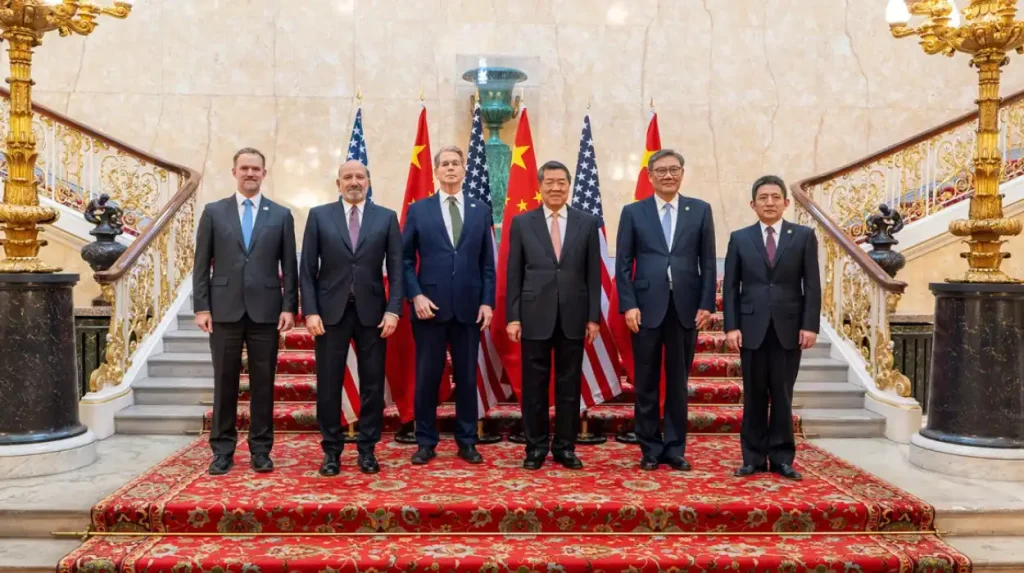
Following two days of negotiations in London to reduce tensions and loosen export restrictions that may disrupt global industry, officials from both the US and China said Wednesday that they had reached an agreement on a framework to carry out their trade ceasefire.
It has been suggested that both parties agreed to remove export restrictions on products and technology that are essential to the other, even though neither party revealed any details of the agreement.
Washington pledged to aggressively revoke Chinese student visas. It prohibited the sale of chip design tools to China, citing Beijing’s apparent retraction from its Geneva agreement to relax rare earth shipments.
Will the US relax chip export rules for China?
Experts speculate that the Trump administration would be willing to relax regulations on some microchips that China considers essential to its manufacturing industry. The United States will continue to impose limits on extremely expensive Nvidia processors that can power AI systems.
The most recent round of negotiations, which took place at the opulent Lancaster House in the heart of London, highlighted how important export controls have become in the competition for trade between the biggest economies in the world.
How critical are rare earths in US-China tensions?
It also emphasised Beijing’s strong position in the rare earth supply chain and its increasing willingness to use this position to pressure the US to relax export restrictions on China.
China has a near-monopoly on rare earth minerals and associated magnets, which are vital to US businesses and defence and are used in everything from automobiles to fighter fighters. China’s foreign exports of rare earths have skyrocketed since early April, when Beijing implemented new licensing regulations on certain minerals in response to Trump’s tariffs, endangering businesses worldwide, ranging from electronics and military to energy and automobile manufacturing.
Trump has been enforcing punitive measures against Beijing over the last month, believing that China had not fulfilled its Geneva pledges. These actions involve restricting technology sales to Beijing and threatening to annul Chinese students’ US visas.
Why is Huawei central to China’s tech ambitions?
A prohibition on American businesses supplying semiconductor design software to China is another of the restrictions. US corporations were also cautioned by the White House not to utilize AI processors manufactured by Huawei, China’s national tech champion. China, which believes that Washington’s actions go against the Geneva Accord, has reacted negatively to the actions.
How do the semiconductors dominate the US-China trade war?
The rivalry for cutting-edge technology has been simmering for a while, even if US access to rare earths hasn’t been a point of contention until lately. In an attempt to stop Beijing from using American inventions to strengthen its military and artificial intelligence capabilities, Washington has increased its efforts in recent years to limit China’s access to chip-related technology.
Trump targeted businesses like Huawei with restrictions during his first administration, including limiting the sale of chips to them. These efforts were stepped up in 2022 by then-President Joe Biden, who restricted the transfer of cutting-edge semiconductors to China due to worries that they would be used to fuel its military.
In an effort to curb China’s technical advancement, the limits were later extended to include prohibitions on the sale of high-bandwidth memory chips, chipmaking equipment, and even goods made outside the US utilising US technology. China’s vital industries, which Xi has emphasised, such as semiconductors and artificial intelligence, are under a lot of strain due to the growing restrictions.
But Beijing is looking to Huawei, the massive Chinese electronics and telecom company, to lead innovation in these areas, and the company has recently emerged as a national champion. The company’s smartphone industry was originally devastated by US limitations, but in 2023, it staged a dramatic comeback with a device that used cutting-edge components that Washington thought it had prohibited.